Jan. 24 will mark 55 years since the death of Bill Wilson, who co-founded Alcoholics Anonymous along with Bob Smith.
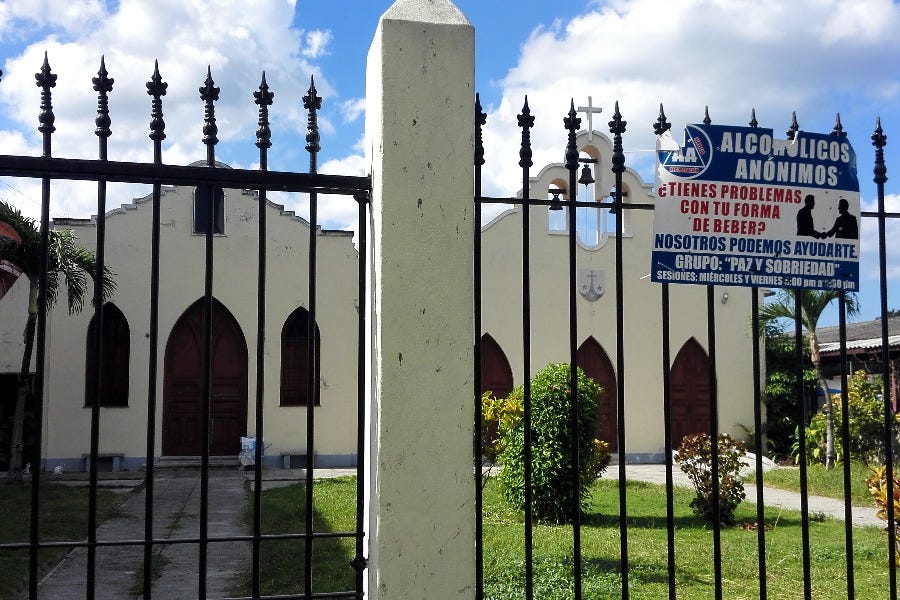
AA is firmly established in the culture’s imagination, particularly in the Anglosphere. But less well-known is the role the Catholic Church played in the development of the fellowship, and, in turn, how AA influences the faith of many Catholics today.
Accurate membership figures are hard to come by, given the fellowship’s guiding principle of anonymity. But there are more than 123,000 AA meetings in approximately 180 countries, with literature translated into more than 100 languages.
AA was founded in 1935. In 1936, there was only one Catholic member of the embryonic fellowship that would transform the treatment of alcoholics the world over. In 1939, there were two.
But in the period 1939 and 1940, the number of Catholic alcoholics joining AA grew enormously. By October 1940, Bill Wilson wrote in a letter that, “as matters now stand, I suppose AA is 25% Catholic.”
A key player in that transformation was Sr. Ignatia Gavin of the Sisters of Charity of St. Augustine, who worked with Bob Smith at St. Thomas Hospital in Akron, Ohio. Her help for alcoholics garnered her the nickname “the Angel of Alcoholics Anonymous,” and a letter of thanks from President Kennedy in 1961.
Early AA was intrinsically bound up with the Oxford Group, an American Protestant movement that aimed to return Christianity to its early roots and was instrumental in the sobriety of Wilson and then Smith.
For Catholics in the 1930s, AA’s affiliation with the group posed some problems. For example, the Oxford Group asked that members share their worst and most secret sins with one another, but Catholics wanted to do that with a priest, in the sacrament of confession. And some priests said parishioners would be at odds with the Church for attending an Oxford Group meeting which included public self-disclosure of sin.
Sr. Ignatia played a central role in overcoming the roadblock.
She insisted that St. Thomas Hospital was, in her words, “non-sectarian,” and admitted patients regardless of religious affiliation. To her, the Oxford Group was “a cult” due to its lack of tolerance toward those with different religious beliefs.
In light of that, AA began to move away from the Oxford Group, and its leaders decided to adopt a non-denominational position, refusing to have an official position on issues outside its own work for alcoholics.

Making better Catholics?
Fr. Ed Dowling, a Jesuit who served as Bill Wilson’s spiritual director for 20 years, once wrote: “There is something spiritual about an art museum or a symphony, and the Catholic Church approves of our use of them. There is something spiritual about AA too, and Catholic participation invariably results in poor Catholics becoming better Catholics.”
Fr. Dowling first met Wilson in 1940 after the publication of the “Big Book”, a textbook of sorts for AA that explains how to do the 12 steps that lead to recovery. But he influenced Wilson so much that he considered converting to Catholicism. As a Jesuit, Dowling saw strong similarities between the 12 steps and the Spiritual Exercises of St. Ignatius Loyola.
Alex*, a practicing Catholic in his 30s in London, told The Pillar that being in AA had indeed made him a better Catholic.
“My prayer and faith life before AA were characterized by self-loathing, fear of hell, and constant criticism of myself. My prayer and faith life since coming into AA have been characterised by hope, peace, and, at times, an inner joy which can’t help but break out into thanksgiving to God,” Alex said.
Among the aspects of the 12 steps that engenders such changes, according to adherents, and is a departure from Catholic practice are steps four and five — respectively, the writing and sharing of a “fearless moral inventory” — examples of how AA is similar, yet distinct, from the Catholic faith.
At first appearance, they might seem similar to a confession, and the “Big Book” suggests some members might want to do the sharing part with a priest. But many alcoholics in recovery say the steps are effective because, they target the peculiar twists of thinking caused by years of shame, guilt, and remorse.
A fellow alcoholic is more likely to understand that thinking and have felt similar despair, supports say. Of course, for Catholics, the practice is not a substitute for confession, as without a priest, there is no absolution, but some Catholics in AA say it can complement the spiritual life.
An early AA pamphlet for newcomers called “The Table Mate” says that a Catholic “must, in confession, seriously consider his problems in relation to his alcoholic thinking.”
Alongside the steps is the requirement for regular attendance at meetings, with the community and fellowship that brings. Further, the frequent exhortation to help other alcoholics, as outlined in step 12, brings about a remarkable improvement in self-esteem. The “Big Book” itself says that “faith without works is dead,”
“I was disordered in so many parts of my life before coming into AA – my thinking was always in the extreme and I suffered quite badly from scruples,” Alex said.
“I have been shown a practical program of action in AA which will allow me to get through any difficult time with dignity, integrity, and faith in the goodness of God,” he added.

Opening the door to faith
AA’s non-denominational approach, and desire to not overwhelm the newcomer, means the phrases “Higher Power” or a “God of your own understanding” are used regularly in meetings.
Some might interpret that as religious indifferentism, but the flipside is that AA makes no imposition on someone’s faith, supporters say.
In some cases, opening the door to faith in God in AA has led to Catholic conversions.
Henry, a married American in his 40s living in Spain with two children, has been sober for more than two years.
On All Saints Day 2023, he was received into the Catholic Church, which he told The Pillar was because of AA.
Henry said that his AA sponsor – someone who takes the newcomer through the 12 steps and guides them through sobriety – encouraged him to investigate a call he had felt for 14 years toward the Church. Henry’s sponsor at the time was an observant Jew who at one time trained to become a rabbi.
“I would have left Christianity totally had it not been for the 12 steps, the AA literature, and my Jewish sponsor,” Henry said.
Henry had started RCIA 14 years ago, but frustration about a needed annulment from a prior marriage slowed the process. He resisted the prospect of an annulment, not least because he didn’t want to speak to his ex-wife.
“It caused a lot of resentment in me,” he said.
But during a recent fifth step — the sharing of the moral inventory — his sponsor encouraged him to look at the situation with a fresh perspective.
Henry got in contact with another priest, reached out to his ex-wife, and eventually his situation was resolved.
“That leads me to completely forgive and be forgiven by my ex-wife, which was not on my radar,” he said.
Henry described the “symbiotic relationship” between his faith and his membership in AA as “like two hands interlacing their fingers” or “two rivers converging in one.”
“When I go to Mass, go to confession, read my Bible, or pray the rosary, I see it all as recovery. By ‘recovery,’ I don’t just mean not drinking or not using. I think of it as the parable of the talents: Am I being who I’m made to be?” Henry explained.
Potential friction
Both Henry and Alex said there was no real friction between their faith and AA. But Alex did say there are sometimes issues with his faith and other members of the program.
“No one in AA is perfect and there have been times when I have been speaking to someone who has said something totally contrary to my faith,” Alex said. In some instances, this has involved a sponsor giving him romantic advice “contrary to the Church’s teaching on marriage and chastity.”
The “Big Book” encourages the recovering alcoholic to “be quick to see where religious people are right.” But not all those in AA have favorable views of religion in general, and it is not uncommon to hear a phrase in meetings such as “religion is for those who are scared of hell; spirituality is for those who have been there.”
So for Alex, the solution is not to ask from the program what it cannot give.
“In some ways, it is a case of rendering to Caesar what belongs to Caesar and to God what belongs to God,” he said.
For Henry, there has been no friction. His recovery has provided “guardrails,” while his Catholic faith reminds him that every day is important in the spiritual life.
“Jesus says pick up our cross daily,” he observed.
Mindful that he didn’t want to get “too opinionated about the Church,” Henry also suggested that the Church could learn from AA’s emphasis on honesty and vulnerability, and the radical change it brings about in people’s lives.
Advice for Catholics with a drinking problem
The World Health Organization estimates that globally around 7% of people aged 15 or older suffer from Alcohol Use Disorder, and around 3.9% of the population have alcohol dependence. It is not unreasonable to suppose that Catholic families, parishes, religious communities, and the ecclesial hierarchy would include people who would benefit from AA.
Alex and Henry both encouraged such people to try the program.
“Talk to your priest, go to confession, pray the rosary, and ask in prayer: ‘God, do you need this? Do I need to turn this over to you?’” Henry proposed.
Alex’s advice was similarly direct.
“If you throw yourself into AA with all the desperation of a dying person — and that is what you are if you are suffering from alcoholism — then God will surely bring you out of the hole you have found yourself in, and into a new and wonderful life,” he said.
Alongside Sr. Ignatia and Fr. Dowling, there have been many other Catholics who have helped synthesize AA with Catholic tradition, including Fr. Joseph Martin, Fr. Ralph Pfau, and Fr. John Ford.
Addressing Catholics with a drinking problem, Alex offered a prayer: “May God bless you, and I pray that our paths will cross one day in a meeting of Alcoholics Anonymous, though we may not know it.”
*Names and some details have been changed to preserve anonymity. The opinions expressed are those of individual members of AA and do not reflect AA’s official position.
The long form of AA’s 10th tradition states: “No AA group or member should ever, in such a way as to implicate AA, express any opinion on outside controversial issues – particularly those of politics, alcohol reform, or sectarian religion. The Alcoholics Anonymous groups oppose no one. Concerning such matters they can express no views whatever.”

