How many SSPX laypeople are there?
Estimates can vary by an entire decimal point, so what are the numbers?
Journalists covering this week’s illicit episcopal consecrations by the Society of St. Pius X have faced an awkward problem.
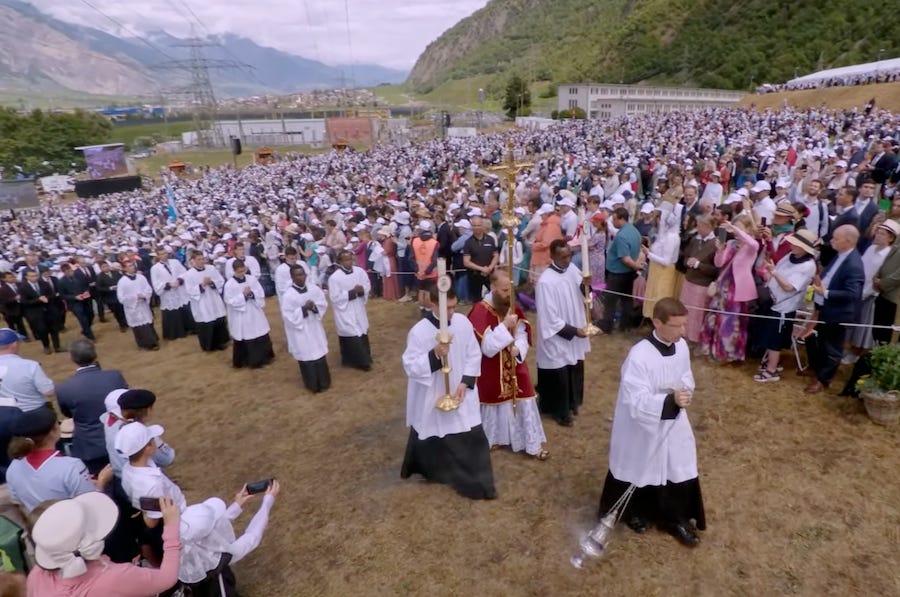
It’s this: it seems impossible to say exactly how many laypeople are currently associated with the organization founded by the French Archbishop Marcel Lefebvre in 1970.
That might seem trivial. But one way of conveying the impact of the consecrations — defined as a “schismatic act” by the Vatican — is to say how many people are directly affected.
This week, media offered wildly different estimates. The Spectator said the Vatican decree would “likely affect more than a million Catholics worldwide,” while the BBC suggested the SSPX had “around 600,000 worshippers globally.”
The Guardian, meanwhile, calculated that the SSPX had “a following of an estimated 150,000 to 200,000 people around the world.” But the traditionalist blog Rorate Caeli said it would be surprising if the SSPX’s total global Sunday Mass attendance reached 100,000.
How many laypeople does the SSPX say are associated with it? And what explains the discrepancies in the reported estimates?
The Pillar takes a look.
The SSPX’s own numbers
It’s worth being clear at the outset about what it means for a lay person to be affiliated with the SSPX. As the organization’s name suggests, it is a priestly society, so properly speaking its members are priests, religious, and seminarians.
But laypeople can associate themselves with the group by attending SSPX Masses, sending their children to SSPX schools, and belonging to its Third Order. Informed commentators therefore refer to “the faithful attached to the SSPX,” rather than “lay SSPX members.” For simplicity, this article will use “laypeople” as shorthand for “the faithful attached to the SSPX.”
One thing that does continue to unite the SSPX and the wider Catholic Church is a somewhat impressionistic approach to statistics.
The SSPX’s website presents official counts for everything from places of worship (447) to retirement homes (5). But when it comes to the number of laypeople worldwide, it simply says 600,000, with 100,000 based in France.
The odd thing is the sources it gives for the lay numbers. The 600,000 figure is attributed to a 2007 statement to Latin American bishops by the late Colombian Cardinal Darío Castrillón Hoyos.
Castrillón, who was then president of the Vatican’s Ecclesia Dei Commission, did indeed give a speech at Aparecida, Brazil, in 2007, in which he said: “Today, the group of the Lefebvrians includes 4 Bishops who were ordained by Mons. Lefebvre, 500 priests, and 600,000 faithful.”
Perhaps the cardinal was quoting statistics meticulously assembled by Vatican officials — or maybe he was giving a back-of-an-envelope estimate. Either way, a number mentioned almost 20 years ago doesn’t seem like the most reliable indicator of the SSPX’s present strength.
But it does explain where the BBC and others got their figure of around 600,000 SSPX laypeople globally.
As for the French laypeople figure, the SSPX site attributes this to “a French-language almanac” and also dates it to 2007. Again, this hardly seems like authoritative sourcing.
Competing estimates
The Rorate Caeli blog offered a helpful explanation of how it calculated its own, far lower estimate of SSPX laypeople worldwide.
First, it asserted that the U.S. was the largest of the SSPX’s districts worldwide. (The SSPX’s website lists a total of 15 districts and three autonomous houses, though other numbers are given elsewhere.)
The blog noted that in 2019, the District of the USA’s website said that a Sunday Mass count performed over several months at SSPX chapels found “numbers just shy of 25,000 faithful.”
The official U.S. site offered a word of caution about its figures, saying: “Unlike in the dioceses, where parishioners attend their local church and belong to a parish, the SSPX chapels are more in the missionary spirit, with less hard and fast numbers.”
The U.S. site repeats the roughly 25,000 figure on its dedicated statistics page, adding that there are more than 1,000 members of the Third Order.
Rorate Caeli said that, among other SSPX districts, only France was comparable in size. This would, implicitly, give us another 25,000 laypeople, taking the total of the two districts to roughly 50,000.
The blog seemed to suggest that the remaining districts combined would add several tens of thousands, taking the absolute total to something approaching 100,000.
The reasoning here is clear, but a few questions remain. Is the District of the USA’s 2018 Mass count still accurate? Surely there has been some fluctuation in the figure, perhaps as a result of the COVID-19 pandemic or Pope Francis’ motu proprio Traditionis custodes, limiting Traditional Latin Mass celebrations worldwide.
Also, is the number of lay people associated with the SSPX’s District of France truly so much lower than the 100,000 number given on the organization’s official site?
The District of France’s website has a statistics page, but while it hails the organization’s continuous growth since 1970, it conspicuously lacks a figure for laypeople.
In 2021, the French magazine La Nef concluded there were around 60,000 traditionalist Catholics in France, not including SSPX laypeople, who it estimated at about 35,000.
If La Nef’s estimate is accurate, France would seem to remain the SSPX’s numerically largest district, though well below 2007’s 100,000 estimate.
Another question arising from Rorate Caeli’s calculation is how many laypeople belong to the remaining SSPX districts. Here it gets murky, as the other districts do not appear to publish figures for associated laypeople.
Let’s assume that each of the other 13 districts has a lower number of affiliated laypeople than either those of France and the USA. Let’s be generous and say there are 20,000 in each. The reason for this generosity is not because there is evidence that each district has that many laypeople, but because we want to see if we can reach a total of 600,000.
Having 20,000 people in 13 districts would give us a total of 260,000. Adding this guesswork figure to the French and U.S. figures (35,000 and 25,000), we get a grand total of 320,000.
Even though we have erred strongly on the side of generosity, our figure is barely half of the 600,000 estimate given in 2007.
It’s questionable whether some districts can muster as many as 20,000 laypeople, given that some have far fewer priories and chapels than others. But given the lack of official statistics, it is difficult to be sure.
Another way to test the 600,000 figure is to divide it by the number of SSPX places of worship, given officially as 447. This would amount to an average of 1,342 laypeople per chapel. If there are roughly 320,000 laypeople, there would be 715 per place of worship.
Whether you find an average of 1,300 laypeople or 715 laypeople per chapel more plausible likely depends on where you live and your personal experience of the SSPX.
By now, it is clear why there are vast discrepancies in the number of SSPX laity. The official total rests on rather doubtful evidence, but it’s hard to come up with a credible alternative. There is some evidence pointing to a much lower estimate, but it is not conclusive.
One consequence of the absence of trustworthy, up-to-date figures is that the SSPX is able to reinforce the impression that it is a global force more than half a million strong.
The uncertainty is also arguably helpful to the Vatican. If someone accuses the Holy See of imperiling more than half a million souls through its tough response to the consecrations, it can cast doubt on the figure without providing a solid estimate of its own.
Who doesn’t benefit from this scenario? Journalists and their readers — and anyone who wants to have a clear numerical sense of what’s at stake in the Church’s latest crisis.
