Pope Leo last Friday urged Catholic lawmakers to develop policy that would provide transparency on the use of AI, and protect families from the economic, moral, and social harms that might be caused by the disruptive potential of artificial intelligence.
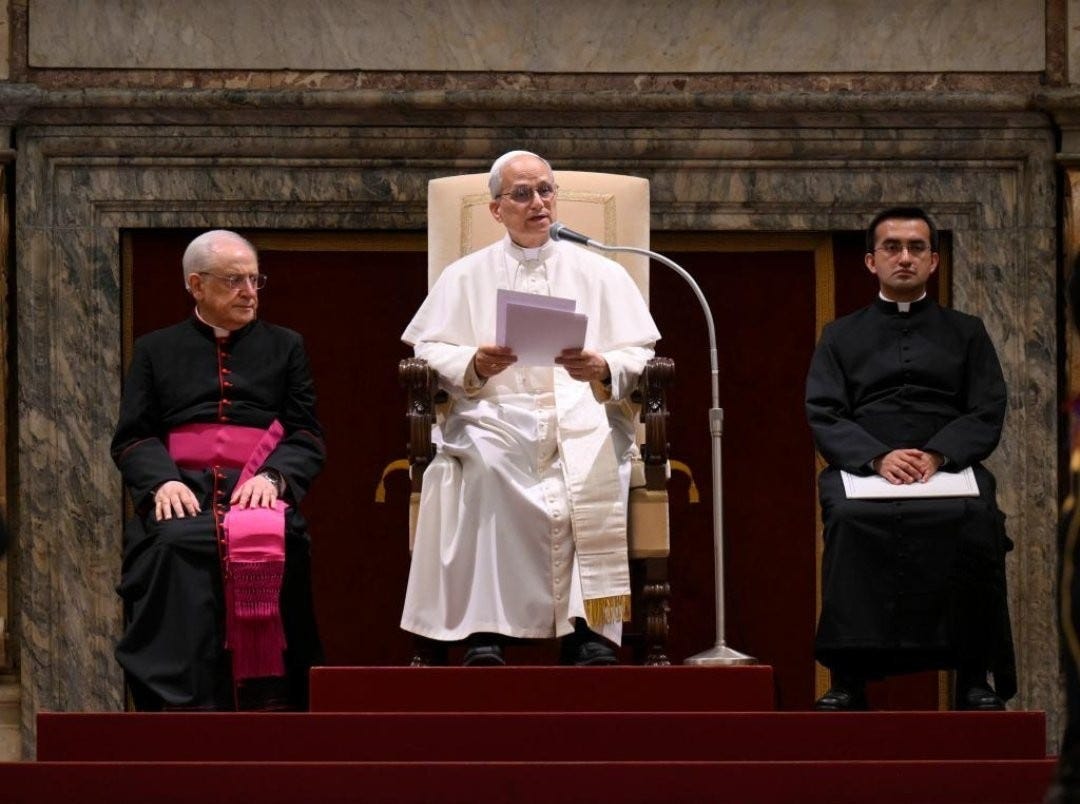
The pope warned of “a subtle form of domination when algorithms decide who is seen” and who is not, “when digital platforms shape public discourse without accountability, and when the dignity of workers is subordinated to the optimization of systems.”
The role of lawmakers, Leo said, is to “encourage scientific and technological creativity while safeguarding fundamental human rights and freedom,” and to “protect users from exploitation, preserve personal privacy, ensure transparency in the use of emerging technologies.”
But while the pope was talking to lawmakers, he wasn’t just doing so as a pastor — he is himself a legislator, the lawmaker of the universal Church, and thus his words of advice might well be taken to apply to the ecclesial society, and its body of law, as to any other society.
The territorial state governed by the Holy See - the Vatican City State - is on the path to legislation concerning AI. In January 2025, a decree came into effect from the Pontifical Commission for Vatican City State which created a commission on AI, meant to propose laws for the regulation on the use of AI with the Vatican City.
The decree also contained ethical principles for the use of AI, with a particular focus on avoiding manipulation, being transparent in the use of AI, and taking care to avoid the creation of social inequalities or the encouragement of criminal conduct.
Eventual legislation from the commission — which would be formally approved by the pope — would impact city state administrators, the Vatican Museums and gardens, the Vatican health service and court system, police and firefighters, and property managers, along with other clerical workers and contractors within the Vatican City State.
But while that project was already underway when Leo was elected, it could be seen as a smaller-scale test case for his bigger role, as universal legislator of the universal Church.
To date, the pope has not yet indicated that he is considering a revision to the Church’s universal canon law, in response to the disruptive technology of AI.
But as AI manifests new challenges for parishes, dioceses, and for the universal Church, dioceses, especially in the U.S., have already begun developing policies on the use of AI in their own work. And other Catholic institutions have begun doing the same, with Catholic Charities USA issuing this month, for example, an “ethics guide” for diocesan Catholic Charities apostolates and their use of AI.
Some dioceses, however, are likely looking to the Vatican for guidance, or hoping that the Holy See will promulgate universal laws that give at least a framework to more local efforts, or that backstop policies which may not be immediately welcome — however they shake out — among Catholics with strongly held opinions on the subject.
A thorough regulation of AI in the Church’s life would doubtless touch on many areas of canon law.
To many Catholics, the most pressing issue for the Church to address is the use of generative AI in the creation of sacred images, hymn texts, and especially liturgical preaching. While the topic was not raised in Pope Leo’s Magnifica humanitas, many Catholics have noted in recent months the rising prevalence of AI-generated sacred images in parish or diocesan worship aids or catechetical material. And an increasing number of Catholics have reported to The Pillar in recent months the experience of hearing homilies delivered in parish liturgies which bear the distinctive rhetorical patois of AI-generated text.
Given that liturgical preaching is an act so closely correlated with the charism and power of sacred orders, it seems an obvious place to begin, if the pope decided to address the prevalence of AI-generation in sacred contexts. Revisions to Book III of the Church’s Code of Canon Law, for example, could specify that since preaching is a human act, a human being should be the principal author of a text.
Similarly, there is growing dissatisfaction among a number of Catholics with the use of “AI slop” in the generation of sacred images — and clearly disparate expectations between those producing the images in parish and diocesan images, and those pushing back against them.
Of particular import on that question is what it means for images of divine and sacred persons to be created without the involvement of human beings — especially given the Church’s long history
If the current dispute over Rupnik-generated images has a lesson, it is that sacred art matters to people, and how it is created matters to them — which means that however the pontiff decides to address that, the conflict over “AI slop” Catholic images is unlikely to resolve on its own, absent some ecclesiastical guidance on the subject.
Two AI issues of key importance to Leo seem as relevant to ecclesial life as to any other sphere of society, and thus of particular import for legislation — transparency, and AI/human interaction. On the question of transparency, there is not presently any ecclesial guidance on when curial or diocesan offices should disclose the use of AI, and existing diocesan policies do not seem to consistently require it. But the guidelines of the Vatican City State, along with other Vatican texts on the subject, emphasize frequently the importance of transparency about the use of AI, suggesting that Leo could include in the Church’s on the munus docendi — its teaching function — some regular disclosure in ecclesial documents and policies about the use and scope of AI.
In addition to transparency, Leo has emphasized the dignity of workers, and while that issue encompasses a variety of topics, they include a topic under discussion now — whether employees, students, and others in Catholic contexts have the right to opt out of AI-interaction, when it is used in instruction, assessment, the provision of services, or training. Leo has been clear that the anthropomorphizing of large language models poses particular moral and anthropological problems, and that the contours of engagement of LLMs with people in the course of work merits particular and ongoing reflection. As that unfolds, it seems reasonable to conclude that ecclesiastical authorities will have to make some judgement about whether engagement with LLMs can be considered compulsory for ecclesiastical employees and officeholders, and whether workers whose productivity proceeds at a more human rate because of the way they choose to make use of AI — or not — will be penalized.
While those things pertain mostly to ecclesiastical personnel, the place where LLMs seem most likely to be used in day-to-day diocesan operations is in the diocesan tribunal, where personnel write voluminous amounts as they adjudicate marriage cases — petitions for declarations of matrimonial nullity — and where, in some dioceses, parties and witnesses are asked to complete lengthy questionnaires.
To many tribunal personnel, it seems obvious that generative AI has little place in the legal work of tribunals, but that opinion is not universally held. And as tribunals face unrelenting pressure to adjudicate cases quickly, and with limited resources, some tribunal administrators will, doubtless, hope that AI can help staff do considerably more, and with less. That could likely lead to pressure on those personnel, which might well impact the judgments which they are required to make with genuine moral certitude.
At the same time, some Vatican officials have speculated that the existence of AI, and the way its very existence raises questions about the authenticity of written testimony and party declaration, could spell the end of written questionnaires in tribunal processes — a result that would actually lead tribunals to fuller conformity to procedural law.
But whatever the effects, it seems clear that the Church’s judiciary is a forum in which proactive regulation could prevent deepening inconsistency, and the possibility of challenges to the validity of various legal processes over issues related to AI usage.
From the start, Leo made clear that his legacy would be shaped largely by his leadership on the emerging social problems of AI. It remains to be seen whether he will start with how they impact the internal workings of ecclesial society.


This week when I started seeing saints with six fingers on one one hand show up on my parish's social media graphics I emailed my bishop's office to ask if the diocese intended to draft guidelines on AI use. In terms of scope, I imagine it would almost be like writing guidance on the proper use of electricity: yes, you can use it to light the church; yes, you can use it to run a pump in a baptismal font to keep the water flowing; no, you cannot assign the penance of sticking a fork in an electrical outlet. Yes, that last one is a bit silly, but in their podcast episode last week JD and Ed. posited a scenario where a confessor asked AI how to counsel a penitent, so...
I think for the general discussion around AI use to be useful, we need to be very clear about what is being discussed. For example, delineating between agentic AI and generative/predictive AI tools, and what type of work these tools are being used for. Is it a creative or spiritual task? A clerical task? If we are more clear in what specifically we are talking about, we can better make judgements. For example: use of generative AI in writing judicial opinions versus use of generative AI to gather all documents pertaining to a case. The more clear and specific the Church and it's pundits can be, the more productive the conversation.