
Brazil’s presidential election campaign took a bizarre turn last week, with controversy over the official status of the country’s patron saint – Our Lady Aparecida – winding up in court.
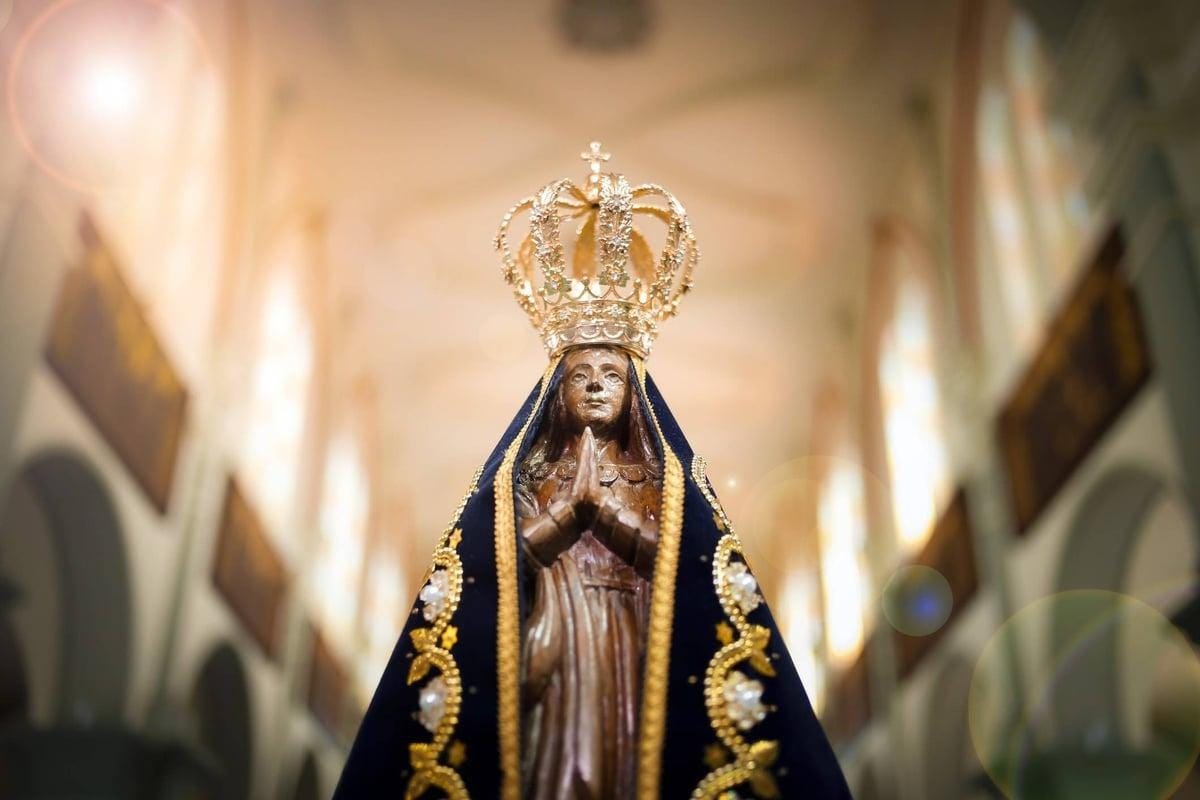
Incumbent president Lula da Silva’s supporters began by accusing challenger Flávio Bolsonaro, son of jailed former president Jair Bolsonaro, of plotting to demote Our Lady of Aparecida from her legal status as Brazil’s patron saint.
Bolsonaro’s campaign reacted immediately to say there was no such plan, and that Lula had spread fake news with the help of the Catholic Church.
The controversy resonated strongly in what is still the largest Catholic country in the world in demographic terms, even as the number of Evangelicals in the country has increased greatly over the past decades.
According to the 2022 census, 56.7% of Brazilians identify as Catholic, with Evangelicals at 26.9. That represents a drop from 65.1% of self-identified Catholics in 2010, while self-identified Evangelicals rose from 21.6%.
Politically, Catholic and Evangelical voting intentions form almost a mirror image, with 50% of Catholics and 26% of Evangelicals saying they would vote for Lula, and 52% of Evangelicals and 32% of Catholics saying they would vote for Bolsonaro.
Lula, who hails from the left-wing Workers Party, describes himself as a Catholic, saying frequently he does not attend Mass as often as he used to, but receives communion when he does. The right-wing Liberal Party candidate Bolsonaro, on the other hand, is a practicing Evangelical.
Regarding the current controversy, there is in fact no record of Bolsonaro, or anybody from his campaign, having made any statement about Our Lady Aparecida. So how did the rumor begin?
A statue in the net
Aparecida literally translates as “appeared.” The name was given in 1717 to an image of Our Lady of the Immaculate Conception found in a river by fishermen in São Paulo, which was considered to have appeared miraculously in their nets.
Due to its prolonged immersion in the water, and possible exposure to smoke beforehand, the image had turned black, which also took on significance in a country with a varied racial composition.
In 1980, the Brazilian legislature passed a federal law officially decreeing October 12 a public holiday in honor of “Our Lady Aparecida, patron saint of Brazil.”"
In 2008 Victório Galli, an Evangelical congressman, proposed a bill that would change the wording to “patron saint of Brazilian faithful of the Roman Catholic and Apostolic Church.”
The bill went nowhere, but Galli himself later joined the Liberal Party and became a close ally of the Bolsonaro family.
That and the fact that Bolsonaro’s Evangelical pastor has made controversial statements about devotion to Our Lady Aparecida in the past – saying that “God hates the worship of the Queen of Heaven” and arguing for her removal from the role of patron saint – led some Lula supporters to accuse Bolsonaro of wanting to “demote” the Blessed Virgin from her traditional role.
But the issue took off after a September 24 social media post from Brazilian comedian António Tabet, who said that: “The militia-linked family hates black women so much that they have even attacked Our Lady Aparecida.”
The use of the term “militia” was interpreted as a reference to the Bolsonaro family, because Jair Bolsonaro was convicted last year of plotting a coup against the government, following an election loss to Lula.
For his part, Flávio Bolsonaro reacted furiously to Tabet’s post, saying that the rumor that he wanted to change Our Lady Aparecida’s status was the biggest case of “fake news” in the elections.
Tabet, who is famous for his character “Peçanha” — a racist, violent and corrupt police officer who plots against the country’s government — issued an ironic apology for his post, saying: “I publicly apologize to the militia-linked family for calling the militia-linked family a militia-linked family.”
Court-side confusion
The Sept. 24 post was followed by a series of contradictory court rulings.
On Sept. 25, Brazil’s Supreme Electoral Court ordered social media accounts to remove any posts inferring that Bolsonaro had attacked Our Lady Aparecida. Two days after that, a judge from the Federal Supreme Court suspended the SEC’s decision, and, the very next day, on Sept. 28, another FSC judge suspended his colleagues’ decision, saying the issue should be resolved in a plenary session of the Supreme Electoral Court.
In their plenary meeting, the SEC judges ruled that any post which directly states that Bolsonaro had planned to change the legal status of Our Lady Aparecida should be removed. That ruling left wiggle room for posts which did not name the candidate directly, including Tabet’s, which remains visible.
In the meantime, Bolsonaro began publicly pushing back, blaming “people within” the Brazilian bishops’ conference for helping the Workers Party to spread fake news.
The bishops responded by saying that “you cannot fight one lie with another,” and assuring Bolsonaro that they had played no part in rumor-mongering. While the candidate thanked the bishops for the clarification, the perception that the conference had been involved had already begun to spread.
On Sept. 28, the controversy became a battle of dueling statues.
On that day, Bolsonaro was handed at an outdoor rally a small Aparecida figure by a Catholic supporter. He smiled and raised the figure in the air, to the applause of the crowd.
But on the same evening in Pará, Lula da Silva tried to capitalize on the controversy, telling a campaign rally crowd that “as long as I am president, nobody is going to get rid of Our Lady Aparecida.”
Soon after that, a local politician presented Lula with an image of Our Lady of Nazareth, the patron saint of Pará, asking that she might “bless his victory.” Lula proceeded to lift the image above his head, and solemnly process across the stage with it.
No war between religions
That such a deeply religious issue should have become central to the election comes as no surprise to Alex Villas-Boas, a Brazilian theologian who teaches and does research at the Portuguese Catholic University.
“What we’re seeing here is a polarization that is common in the west, but that takes a stronger tone in the Americas,” he explained, adding that Brazil lacks a tradition of a solid center, with power swinging between hard-left and hard-right.
Brazil’s political polarization is reflected in Church life as well, especially since the rise of Pentecostal Evangelicalism, whose pastors did not hesitate to get involved in party politics. But it works both ways.
“When Jair Bolsonaro was elected president, his first act in office was to liberalize gun laws, and the second was to go to the headquarters of Canção Nova, a major Catholic TV network, to be blessed by its founder Fr João Henrique, who was still alive at the time,” Villas-Boas said.
The country’s Catholic bishops tend to be more circumspect in their political involvement, but Villas-Boas said that there are supporters of both political factions within the episcopate.
Many people in the country, he said, “believe that Latin America has its own theology, marked by a preferential option for the poor, and even if they tend to steer clear of politics, the lack of options tends to drive them into the arms of the Workers Party. On the other hand, there are those who identify with the anticommunist rhetoric of the Cold War era, who tend to support the right.”
“Finally, there are those who try to take the middle ground, and encourage greater common sense, but they end up being attacked from both sides,” the theologian added.
For now, official statements from mainstream religious groups have been conciliatory. On Sept. 28, an association representing some 10,000 Evangelical pastors slammed Lula’s campaign for trying to “spark a conflict between Catholics and Evangelicals.”
The Brazilian Interdenominational Council of Evangelical Ministers strongly condemned “the use of fake news by Lula and his followers to target a political opponent and, what is worse, to promote a religious war between Catholics and Evangelicals.”
“Evangelicals and Catholics live in peace. There is no initiative on the part of evangelical leaders, together with any candidate, to try to cancel holidays or religious services of any religion,” the statement said.
On Sept. 30, the Archbishop of Aparecida said in a homily that “electoral theatrics” involving Our Lady of Aparecida are “inadmissible.”
He asked that “peace, harmony and respect” prevail despite the proximity of the elections, and that “our devotion to Mary should be sincere.”
Voting is mandatory in Brazil. After both Bolsonaro and Lula failed to gain absolute majorities in an Oct. 4 plebiscite, the two are headed for an Oct. 25 runoff.
With the Marian controversy cooling, Our Lady Aparecida appears like to remain Brazil’s officially recognized patroness, regardless of who takes the election.