
Attendees at a papally convened summit on Amoris laetitia told The Pillar that while the gathering of bishops did not resolve disagreement about the document, it did bring to the fore differing views and priorities on the Church’s ministry to married people, and that Pope Leo might eventually issue a document on the topic.
The meeting concluded Oct. 14, with its final days coming after Pope Leo announced that he would undergo lung surgery, and the Vatican confirmed that the pope had been diagnosed with cancer.
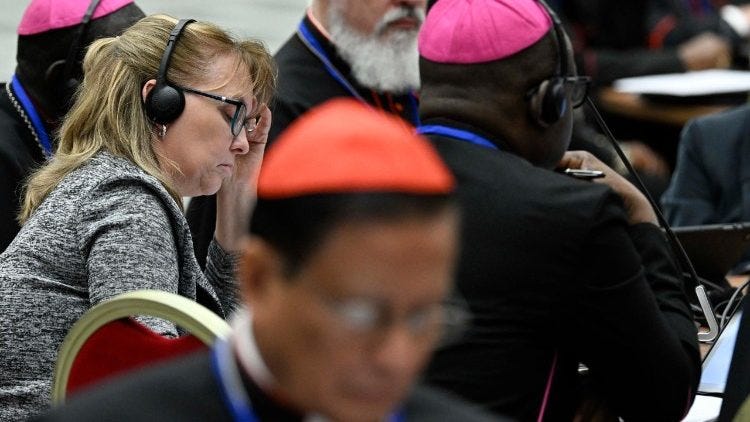
Attendees at the Amoris laetitia meeting in the Vatican. Credit: Vatican Media.
The discussions were kept mostly confidential at the pope’s request, but most participants agreed that the tone was largely non-controversial.
A single day of sessions was dedicated to the potentially controversial subject of “accompanying families in difficult situations,” which included discussing the footnote of Amoris laetitia that seemingly opened access to the sacraments for couples in irregular unions. However, the rest of the week-long meeting’s sessions focused on different topics, such as accompanying couples and the spirituality of marriage.
After the pope announced on Sunday he would undergo surgery for lung cancer this week, participants were united in prayers for the pope’s recovery, but many told The Pillar they were still able to have sincere, open conversations — even if they ultimately did not lead to any specific conclusions.
“I’d describe the discussions as robust but not conflictual, it wasn’t a debate, it’s more about listening because the synodal format favors friendly discussions,” one of the meeting’s experts told The Pillar.
“It’s not that the controversy on the sacraments for the remarried was ignored, but the discussions went beyond that, the document and its application was discussed as a whole,” the expert added.
However, some participants expressed disappointment at the lack of clarity or direction in the meeting.
“I think there’s still ambiguity surrounding chapter VIII [of Amoris], the same ambiguity that we had 10 years ago,” an African bishop attendee told The Pillar. “There’s not enough talk about conversion, about penance. It’s all about listening and accompanying, but listening it’s not an end in itself, we listen with the goal to help the person convert. We can take the initiative and meet people where they are, but it also takes a step from the person in question towards conversion. The prodigal son came to the Father asking for forgiveness.”
“It felt a bit like the synod on synodality,” said the bishop. “I don’t dislike the synodal methodology; it helps to have more calm conversations, it’s enriching to hear experiences from all over the world. But it seemed like they were imposing the same language as in the synod, the same experts, the same approaches.”
“It seemed a bit too much under control,” the bishop added.
While some expected that the meeting would consolidate the interpretation of Amoris laetitia as allowing access to the sacraments for some people in irregular unions, one Latin American bishop told The Pillar this was “still an open question.”
“It’s too difficult for priests to ask them to do this discernment. This is something that we still need to mature and it seems to be that the parties are still too closed in their position, both those who are more concerned with the pastoral question and those who are more attentive to canon law,” the bishop said.
But most participants consulted by The Pillar agreed that it wasn’t Pope Leo’s intention to correct or reinterpret Amoris laetitia during the meeting, but to evaluate its application after a decade.
“The pope doesn’t want to go back,” Marcela Mazzini, one of the meeting’s invited experts, told The Pillar. “This meeting wasn’t about returning to how things were before Amoris laetitia, but about evaluating it and seeing where we are now.”
Mazzini, vice dean of theology at the Catholic University of Argentina, also took part in the 2015 synod on the family, which preceded the publication of Amoris laetitia.
“The tone was more open, more dispassionate than in 2015. Back then we were talking about families in a more theoretical manner as ‘the’ Christian family, now I think most people see families concretely, as they are, with their wounds and fragility,” she added.
“The methodology helped, the 2015 meeting promoted polemics [in the] plenary sessions, the synodal methodology promotes listening. I noticed for example that bishops exchanged experiences in their dioceses, of movements that helped with family apostolate, which encouraged bishops to invite these movements or start similar movements in their dioceses, or bishops who invited married couples to participate in seminary formation,” Mazzini added.
Mazzini also said that part of the pope’s intention was to make clear that Amoris laetitia was not a break in doctrine, but a continuation, which he made clear when he mentioned Gaudium et spes and John Paul II’s Familiaris consortio in his initial address.
“Amoris laetitia was never intended as a break, and it’s important that this became abundantly clear. The graduality principle in Amoris laetitia is already in Familiaris consortio, 34. So, I think we focused too much on the issue of the sacraments, and not on other issues addressed equally by Amoris laetitia, which calls the couples and priests to discern elements such as how did the previous relationship ended, even if there was a declaration of nullity, there’s a duty of justice towards the other person, especially if there were children,” Mazzini added.
“Jesus in the Gospel is very merciful, but also very demanding, which is I think what Amoris laetitia calls us to.”
Fr. Shaji Kochuthara, CMI, another invited expert at the meeting, told The Pillar that the original controversies surrounding Amoris laetitia were more circumscribed to the West.
“In India divorce is rare, couples living together before marriage is rare, so it was not a big discussion back in 2016, so the document was accepted without much controversy. I think one misconception that was mentioned is the fact that Amoris laetitia doesn’t support Communion for all people in irregular situations, but that we should take it on a case-by-case basis. It’s not a blank slate, and we saw different approaches, but we still need time. These documents need time to be implemented,” Kochuthara said.
“But the discussions were more about other things. We discussed a lot about how to accompany couples before and after marriage, and that looks very different in different contexts, because, for example, in India, different forms of arranged marriage are still very common, many families are separated by migration, so challenges prevail,” said the priest.
One of the main points of discussion was the catechesis of couples before and after marriage and their engagement in parish communities.
“When a young man enters seminary, or a young woman enters religious life, they have a long itinerary of formation and discernment, that lasts somewhere between six and even 13, 14 years,” one Latin American bishop told The Pillar, “but with marriage we tell people they’re good to go after a weekend or two. Are we taking marriage as a vocation as seriously as we need?”
“Extremely long marriage prep courses are impractical, but we need to start early, by catechizing young Catholics better,” the bishop added.
Many participants discussed the possibility of involving other couples in marriage preparation and family apostolate.
“We need to move from a pastoral activity of ‘preparation’ towards one of encountering families where they are, and starting from our youth groups, starting with the families that we already have and taking care of them,” Mazzini added.
“There’s no better marriage preparation than a happy family, so if we help our families live a Christian life, with dialogue, with love, with forgiveness then the children are already being catechized on what is Christian marriage,” she said.
“We need to rethink marriage preparation, it’s probably more effective to have more experienced couples or married deacons meeting one on one with a few of the couples doing the preparation than the typical marriage prep course. And we need to see that accompaniment is not a thing that exists for specific moments, such as the wedding or crises. Accompaniment should be a constant thing, families need to feel supported and taken care of by the Church, whether they’re going through crises or not,” Kochuthara said.
“If they don’t feel supported when things are doing well, how will they come and ask for help when things go wrong?” he added.
It was originally expected that the summary report would be published at the conclusion of the meeting. However, after the pope announced his surgery, the meeting’s organizers announced that it would remain confidential until Pope Leo had read it and had the opportunity to make his own contributions if he desired.
It is yet unclear whether the report will be published, or whether the pope will modify it, but Mazzini told The Pillar that she expected that Pope Leo would eventually write a document of his own.
“It’s not going to be an apostolic exhortation or anything that long, but at least a letter with his own reflections on the report and the discussions,” Mazzini said.
Very glad The Pillar has Edgar. Really interesting perspectives shared in this report.