
Pope Leo XIV announced on Sunday that he will undergo surgery this week to remove a “nodule” from his lung. The pope made the announcement at the end of his Sunday Angelus address, asking for prayers.
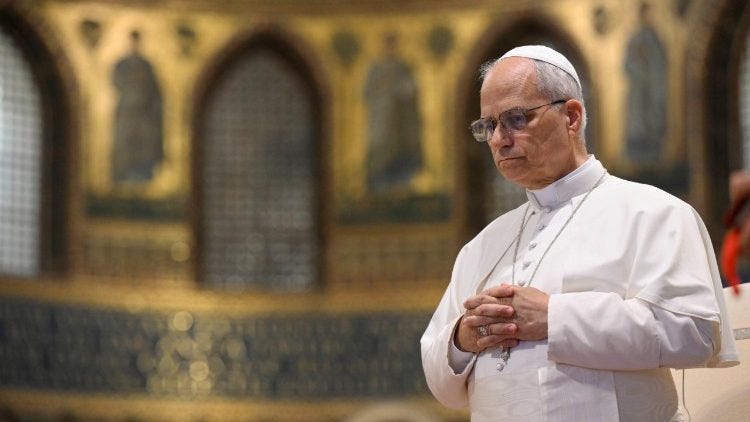
“Dear all, recently, during some checkups, the doctors discovered a nodule in my lung. It was detected at a very early stage and was well-localized,” Leo said. “The doctors felt it was necessary to intervene, and so, following their advice, I decided to have surgery to remove it. The procedure is already scheduled for the next few days. I thank you for your spiritual support and I entrust myself to your prayers.”
The Vatican press office subsequently added that Leo is scheduled to undergo surgery at the Gamelli hospital on Tuesday, Oct. 13. The pope is expected to spend up to a week in the Gamelli recovering, after which, for the moment, he is still expected to undertake his largest and longest to-date Apostolic journey, heading to Argentina, Uruguay, and Peru, beginning Nov. 6.
Prayers have, understandably, poured in from dioceses around the world, accompanied by the best wishes of heads of state and international institutions.
So how worried should Catholics be for the health of the pope? The Vatican’s messaging around Leo’s pending surgery is, in many ways, a new approach to papal health issues. But, despite the pope’s personal candour, the Holy See’s messaging perhaps raises as many questions as it answers.
—
Leo’s decision to announce his own medical status and pending hospital stay during the Sunday Angelus is, it should be said, already something of a big deal.
Traditionally, the health of popes simply hasn’t been discussed publicly or officially, until circumstances made it absolutely necessary. Memorably, in 2023 Pope Francis was rushed to the Gemelli in an ambulance, exhibiting signs of cardiac arrest according to many close to him, only for the Sala Stampa to put out a statement insisting he was merely going in for “pre-scheduled” tests.
That Pope Leo has decided to announce his condition himself, with remarkable frankness, is a significant comms policy shift around the Apostolic Palace. This might reflect a deliberately more open posture, as opposed to the traditional, otiose evasiveness, and the first fruits of an American pope and American prefect of the Dicastery for Communications favoring honesty as a baseline.
Equally, it must be allowed, it could be that the pope’s situation is serious enough that there would be no keeping it under wraps or playing it off, and the decision was made to be as open as possible to head off speculation about the papal health.
Certainly, Leo appeared to make every effort to sound reassuring — stressing that, whatever the diagnosis is, exactly, it is “well-localized” and “early stage.” Of course, for everyone listening, talk of a “nodule” in a lung will immediately send thoughts — and prayers — running to concerns about words not used, like “cancer,” “tumor,” “begnin” or “malignant.”
To be clear, none of those words may yet be medically appropriate. And there is every reason to believe and assume that Leo is giving almost as much information as he may have himself at this stage.
But the context of the pope’s announcement and the timing of his surgery do reasonably raise reasonably serious concerns for Leo.
We don’t know, and this isn’t to say anyone has the right to expect to know, when the routine medical checks made this discovery. It could have been last week, last month, or even earlier. As such, it isn’t really possible to say with what kind of urgency Leo is being brought in for surgery. However, there is clearly some serious urgency to the matter.
Leo making the announcement and going into hospital this week, of all weeks, means he is having to miss the balance and conclusion of his global meeting of the heads of the world’s bishops conferences, which he convened in Rome this week.
That, as the Vatican has announced, has meant some serious changes to the schedule, with the newly minted dean of the College of Cardinals, Cardinal Tagle, subbing in for the closing Mass on Wednesday, and the meeting’s organizers announcing that the final working document/summary of the meeting being delayed until Leo can read and feed into it.
Those changes suggest that the timing of Leo’s surgery isn’t of his own choosing, and he is acting on the best medical advice he can get by moving urgently. Had this issue been discovered weeks ago, it seems reasonable to assume the pope would have seen it dealt with before the meeting began. And were it possible to delay it, even by a few days to allow the meeting to conclude as scheduled, the expectation would surely be he’d have opted for that.
It cannot be excluded that Leo is simply having to fit in with the schedules of his medical team, but a man who occupies arguably the most important and prominent role in Italy, if not Western Europe, could generally be assumed to be the one whose calendar others work around.
All this points to a very recent medical discovery leading to a “days matter” diagnosis, or at least suspected possible diagnosis.
Of course, another factor weighing in the balance is Leo’s upcoming apostolic visit to three South American countries, including a return to Peru, where he spent many years as a priest and bishop.
It is entirely possible that the doctors, and the pope himself, are more concerned about the potential knock-on effects of surgery, and the time needed for recovery, for a 71-year-old — even one as physically sound and actively sporty as Leo.
The pope is due to depart Rome November 6 for his 10-day three-country trip, returning on Nov. 17. It may be that Leo has simply made the decision to allow maximum time for his own post-op recovery, and even allow for potentially unforeseen circumstances, so that he is at full strength for the landmark trip.
While it might be an inconvenience, and clearly a last-minute wrench in the works for the Amoris meeting, it is possible that Leo simply weighs the importance of that conference more lightly in the balance than even the possibility of missing his homecoming trip to Peru, or even having to scale back his itinerary for the trip.
If that is the case, it would suggest a real abundance of caution by the pope approaching his Latin American tour, and a sobering indication of where Leo ranks the non-synodal meeting currently underway in Rome.
In any event, what can be said for certain is that the pope having to take this, of all weeks, out of his schedule for surgery and an extended hospital stay is extremely unfortunate timing. It is clear that this is a decision Leo has made on the advice of his doctors. Together, they clearly consider that the risks of delaying, even by a little as a few days, represents an unacceptable risk for the pope.
Even expecting and allowing for Leo’s full and speedy recovery, that should be a very sobering thought for Catholics everywhere.
I think another thing to be considered: many patients, when diagnosed with a lesion that is concerning for a malignancy, will ask to have the lesion resected as soon as possible. It can be anxiety provoking to have a possible malignancy present in one's body; I would not be surprised if the Pope was having serial CT scans for a pulmonary nodule, the nodule increased in size on a recent scan, and the medical team recommended resection of the concerning lesion. Being a human being, he naturally would want to proceed with curative-intent surgery as soon as possible. I certainly would.
I think what is also not emphasized in this article is that surgical procedures require follow-up; I doubt the Pope would be simply "free to go" after a surgery, without the surgeon recommending follow-up in a few weeks to assess surgical excisions to ensure that there is no post-surgical infection, to ensure that no pneumothorax has developed. Honestly, I suspect that if he did not have his surgery rather urgently, he would have to cancel his trip to South America (it is not ideal to have a post-surgical complication a half a world away from your surgeon), or wait until late November for the operation. I doubt that any thoracic surgeon I work with would advise on an international flight within three weeks of a VATS (any thoracic surgeon on here may disagree with me on this and prove me incorrect), and I would think that the potential for complications that would have to be monitored for appropriately. Thus I suspect that the Pope was given the option to have the surgery earlier or after his trip to South America; I know which option I would choose.