‘I’m happy to be here’: The new nuncio’s new message
Archbishop Gabriele Caccia offered a fresh start between the U.S. bishops and the nunciature.
The USCCB plenary assembly in Orlando opened this week with the customary speeches from the conference president and apostolic nuncio. Unusually, both men were new in post and offering their first addresses.
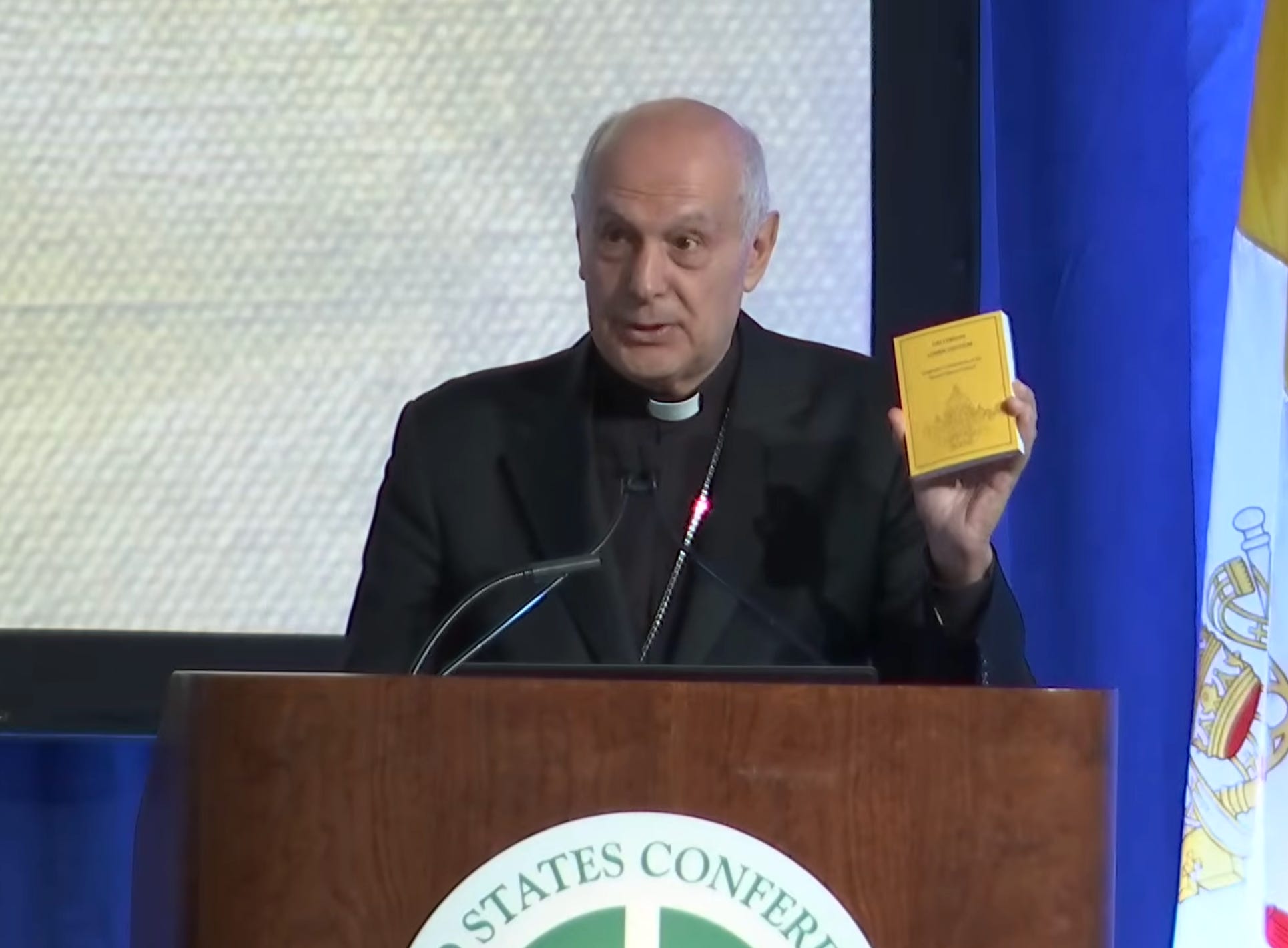
But while USCCB president Archbishop Paul Coakley was new in the role, he’s been a familiar face in the conference senior leadership for several years. It was instead the recently installed nuncio, Archbishop Gabriele Caccia, who presented the real object of curiosity for the assembly.
Arriving from his previous posting to the United Nations, the Milanese succeeded Cardinal Christophe Pierre, the long-serving Frenchman, who survived a decade in office until his 80th birthday earlier this year.
Among the bishops in Orlando, the pope’s new man in Washington sang the praises of continuity yet appeared to strike an audibly different tone. Indeed, to some listeners, his words appeared like a study in contrast to his predecessor’s style, and even substance.
—
Across Pierre’s decade in office, the previous nuncio had an often fractious relationship with the conference itself and its members — and often used his addresses to issue blunt criticisms of the Church in the United States, and the bishops themselves.
Pierre was well known for his implicit, sometimes explicit, criticisms of the USCCB as divided within itself and from Rome. But Caccia, following on from Coakley’s speech emphasizing the solidarity and effectiveness of the conference, offered a literal psalm to the beauty of the fraternal unity among them.
Many bishops reported, for years, the impression that the former nuncio appeared unimpressed with his country of assignment, and cut an imperious presence among them.
His successor, meanwhile, introduced himself by quoting Alexis de Tocqueville on the potential for America to one day become the epicentre of global Catholicism, while remarking on the election of the first American Pope.
Caccia then stressed his desire to be “as a brother bishop who journeys with you,” and offered a willing ear and sympathetic understanding for the “many responsibilities, some of which can feel isolating,” carried by the conference members in their dioceses.
“I hope you will feel free to speak with me in open conversation and dialogue, being assured that my service here is one of listening, trust, and shared discernment within the Church that we are all serving together,” said Caccia.
Speaking to the press after the morning session on Wednesday, Archbishop Coakley said he’d had several conversations with Caccia since his appointment as nuncio and found him to be “very warm,” “very approachable,” and “very open” — not words applied often to Cardinal Pierre, who was known for dispensing individual, semi-public dressing downs to bishops over the conference’s coffee breaks.
But beyond appearances of personal style, perhaps the most striking difference between the new and old nuncios was the substance of his ecclesiastical vision.
And his final address in November was remarkable for its characterization of the Francis pontificate as a kind of year-zero event in the Church, a point of irrevocable departure in a new, unalterable direction.
Well known for his insistence on synodality as the new, preeminent, perhaps exclusive ecclesial paradigm, Pierre signed off his term in Baltimore last November by telling the bishops that “the synod on synodality invites us to a different way.”
“Even if some are inclined to pursue a path that diverges from the pastoral vision of Francis, we know that the way forward is one that does not diverge but advances on the path of Francis is the way of moving forward in the Church,” Pierre said.
Archbishop Caccia’s first address to the conference was, in this context, received as something of a night-and-day contrast. Apart from not mentioning synodality at all, while Pierre was known to season his speeches with quotes from Gaudium et Spes, the pastoral constitution of the Second Vatican Council, Caccia offered the bishops the gift of a pocket edition of Lumen Gentium and Dei Verbum, the council’s dogmatic constitutions to, he said, “remind us who the Church is, and how the Church listens to the Word of God. They bring us back to the sources of our communion and mission.”
“This continuity is important,” Caccia said. “We are not beginning again from zero. We receive a living tradition; and above all, we receive the love of Christ, poured out from his heart for the life of the world.”
The new nuncio signed off by telling the bishops that “I would like simply to say: I am happy to be here among you; I’m eager to walk with you; and I’m ready to serve, as a brother bishop, the mission of the Church in this country.”
If Caccia continues as he has begun, and makes good on that eagerness, it could prove almost as influential for the Church in the United States as an American pope.


That is some good news. Having an adversarial relationship with the Nuncio is never a good thing and seemed very counter-productive from my view WAY outside those hallowed halls.