
During his tenure as pope, Pope Francis was frequently criticized, fairly or not, for a perceived tendency in rhetoric toward ambiguity.
Though Francis did not make the sweeping changes to Church doctrine that his most progressive supporters had hoped for or those that his persistent critics portended, he seemed nevertheless to many people to occupy frequently a rhetorical gray area, which left many statements, documents, and ideas open to competing interpretations.
And while Pope Leo has not openly rejected the ideas of his predecessor, he has offered new interpretations to a number of the controversial concepts introduced by Francis.
Leo continued this practice during his trip to Argentina this week, using the visit to his predecessor’s homeland to present new understandings of some of Francis’ ideas.
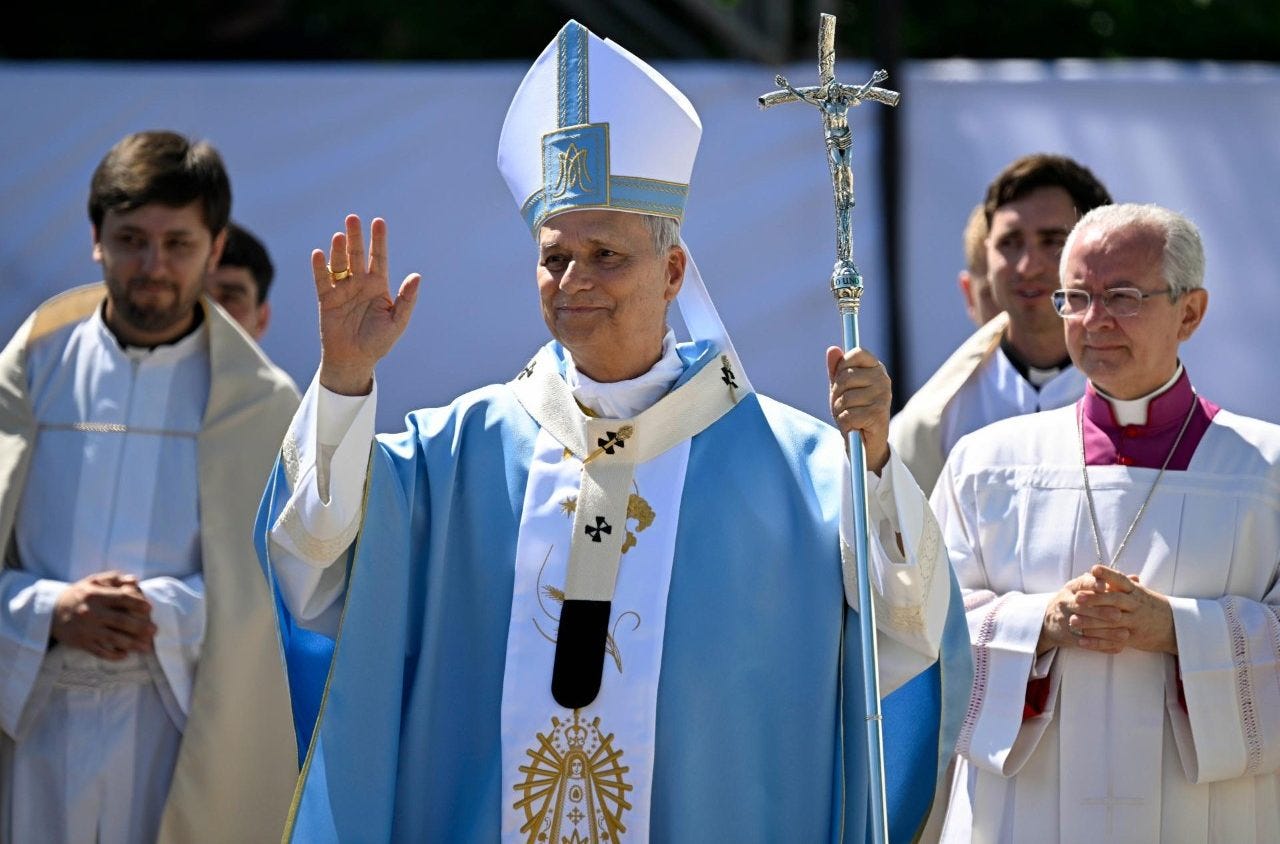
In his speech during last night’s prayer vigil with the youth, Leo quoted Francis’ famous words from World Youth Day 2023: “todos, todos, todos.”
“[Francis] repeated them with his characteristic insistence, as though he wanted to make sure that no one had failed to hear them,” Leo said.
But while Francis’ phrase was often subject to broad interpretations, and seemed sometimes to be used to imply a kind of inclusion-without-conversion, Leo gave the words a definitively Christological interpretation:
“I would like to draw inspiration from those words to speak about what it means to live as disciples of Jesus: ’Todos hacia Cristo, todos con Cristo, todos como Cristo’” — “everyone toward Christ, everyone with Christ, everyone like Christ.”
“Some of you have grown up close to Jesus, and others are only now beginning to seek him. Others still have not prayed for a long time, or have drifted away from the Church, or have been hurt by people who should have accompanied them,” Leo continued.
“To each of you I would like to say that there is a place for you in the Church, with your questions, your wounds and your story. This is your home too. You do not have to pretend that everything is fine or wait until you have your life sorted out before drawing near,” he added.
However, Leo went on to emphasize the need for conversion and repentance as part of the process of drawing near to Christ.
“Christ loves us as we are, but his love is too great to leave us prisoners of sin, of what destroys us,” the pope said. “The fire he came to bring has the power to break our chains and restore our freedom to love. There are wounds to be healed, failings to be acknowledged and, whenever possible, wrongs to be made right.”
“Allow Christ to transform you. Do not be afraid to approach the Sacrament of Reconciliation. How wonderful it is to know that our sins can be forgiven. Pray, read the Gospel and draw near to the Eucharist. The One who gave his life for us awaits us,” Leo said.
The same day, Leo directly warned clergy against the practice of justifying immoral practices in the name of being “pastoral” - a warning which some have taken as a rebuke against the interpretations of Francis which claimed such justification from perceived ambiguities in the late pontiff’s rhetoric.
In his speech to the Argentinian clergy, religious and seminarians, Pope Leo offered a question drawn from the spiritual exercises of St. Ignatius: “What has become disordered within us? In what ways have we failed God?”
“After a few or many years of having said ‘yes’ to the Master, we may have grown accustomed to things that would once have troubled us, such as harshness toward others, resistance to being corrected,” the pope said, before adding, “Something even more serious can happen: that we learn to justify everything, finding ‘pastoral reasons’ or communal or personal motives for doing what we know is wrong.”
Leo has already made it clear that he is not interested in issuing direct repudiations of Francis’ most controversial statements and proposals.
But he does seem comfortable taking the role of Francis’ authoritative interpreter, a decision made easier by the insistence – without evidence – among some of Francis’ most fervent supporters that Leo was the handpicked successor to Francis.
As Leo’s papacy moves forward, it increasingly appears that he intends to clarify some of Francis’ ambiguities by offering interpretations that frame both Francis and himself within the Church’s perennial tradition.
A hermeneutic of continuity, if you will.
Excellent
I think this is a quite fair interpretation of what Pope Leo is doing--but I must nonetheless absolutely insist that on every one of the points listed in this article, Pope Francis himself previously issued exactly the same "clarifications" on numerous points in his pontificate, and indeed habitually. This Pope Leo, a close collaborator of Francis and a continuity candidate though not his handpicked successor, was and is well aware of. That people obsessively focused on their own interpretations pro- and con- of the late Pontiff did not listen to him at the time, and will not listen to him now, does not change that.