The head of the Armenian Apostolic Church faced a courtroom last week, as Catholicos Karekin II faces obstruction of justice charges alongside five other Armenian bishops, as the latest in a long-running and complex dispute between Armenian Apostolic prelates and Armenia’s prime minister.
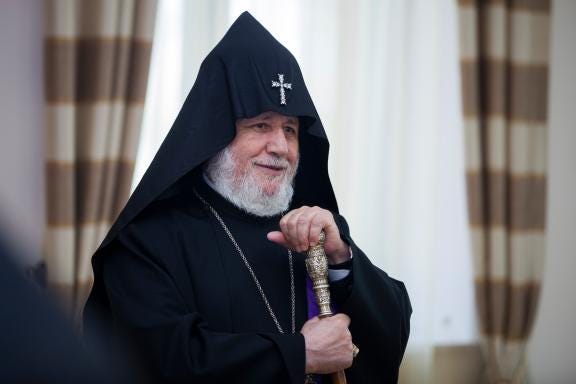
Karekin II and six other Orthodox Armenian Church officials are accused of disobeying a court decision ordering the reinstatement of Bishop Gevorg Saroyan, an ally of Armenian Prime Minister Nikol Pashinyan, who was dismissed from his post and laicized by Karekin II after repeatedly calling for the Karekin’s ouster.
The trial is the high point of a conflict between the Armenian Apostolic Church and the Armenian government which began with Pashinyan’s election in 2018.
Five other Armenian bishops are standing trial alongside Karekin II — Archbishop Nathan Hovhannisyan, Archbishop Haykazun Najaryan, Bishop Vahan Hovhannesyan, Bishop Edgar Hakobyan, and Bishop Artur Hakobyan.
If found guilty, the bishops could face two years in prison.
Armenia, a country roughly the size of Maryland, has a population of around three million people. It is bordered by Turkey, Georgia, Azerbaijan, and Iran to the south. Around 95% of the population belongs to the Armenian Apostolic Church and 0.6% belong to the Catholic Church.
The Armenian Apostolic Church is one of the Oriental Orthodox Churches, a roughly 70 million-strong communion that also includes the Ethiopian Orthodox Tewahedo Church and the Coptic Orthodox Church.
The Oriental Orthodox Churches diverged from the Chalcedonian tradition — represented today by the Catholic Church and Eastern Orthodox Churches — after the Council of Chalcedon in 451 A.D., largely because of differences over formulas used to define Christ’s nature.
Bishop Saroyan was among a group of 10 Armenian bishops who showed their support for a controversial 2025 “roadmap” introduced by Pashinyan to reform the Armenian Apostolic Church, which called for new statutes in the church, and a reform of governance, which he said was meant to ensure greater transparency . The roadmap also called for the election of a new ecclesiastical leader in place of Karekin II.
Support for that plan saw Saroyan dismissed from office by Karekin II in January.
When announcing his dismissal, the Church cited Saroyan’s “abuse of office, failure to fulfil the duties incumbent upon the primate, as well as instances of coercion and pressure exercised against the clergy of the diocese.”
But a court in Armenia ordered the Church to reinstate Saroyan the same month. Karekin II responded by laicizing Saroyan.
Prosecutors then opened a criminal case against Karekin II on Feb. 14 and barred him from leaving the country, accusing him of obstructing the court order.
Pashinyan, who has served as prime minister since 2018, posted a video in early January in which he read aloud a statement setting out his “roadmap” for the reform of the Armenian Apostolic Church.
The video showed eight Armenian Orthodox bishops signing the document at Pashinyan’s residence. Two others, who were not present, also endorsed it.
On Jan. 6 — Christmas Day in Armenia — Pashinyan called for a procession in support of reform from St. Gregory the Illuminator Cathedral to the Katoghike Holy Mother of God Church in the capital, Yerevan.
In a fiery address to participants, he said: “Today, the de facto head of our Church and his upper circle — the narrow group he has formed — are operating with a sectarian mindset, which means that we must liberate the Armenian Apostolic Holy Church from schism and return it to the people.”
One of the 10 signatories of the reform roadmap text was Bishop Gevork Saroyan, head of the Diocese of Masyatsotn. On Jan. 10, Karekin II removed Saroyan from his post, citing abuse of office.
Karekin II’s legal representative described the move as “direct interference in the internal affairs of the Church.”
The root of the conflict is a dispute about the role of the Church in Armenian public affairs, with Pashinyan accusing Karekin II of having problematic foreign ties, and Karekin suggesting the prime minister is responsible for war losses in the country’s long-simmering conflict with neighboring Azerbaijan.
In December 2025, Pashinyan accused Karekin II of having ties to “foreign intelligence services,” through his brother, who is also an Armenian bishop serving in Russia.
In June 2025, Pashinyan also accused Karekin II of fathering a daughter, saying that “If it turns out that Karekin II has indeed broken his vow of celibacy and has a child, he cannot remain the Catholicos of All Armenians.”
Pashinyan then said that the Armenian government “must have a decisive voice in the election of the Catholicos of All Armenians” and that candidates “must undergo an integrity check.”
On May 30, Pashinyan’s then-pararmour, Anna Hakobyan, called the country’s clergy “the country’s chief pedophiles” and “the country’s chief maniacal perverts.”
Pashinyan’s hostility after the Armenian Church has grown after several senior officials, including Karekin II himself have asked for his resignation and issued critical pastoral letters against him.
In 2024, Archbishop Bagrat Galstanyan launched a campaign of civil disobedience called the Holy Struggle, including a large rally in the country’s capital on May 9, 2024 with Karekin II’s support. While Galstanyan said the movement was not political, calls for Pashinyan’s resignation brought together various opposition groups.
The Church issued strong criticisms of the government and called for Pashinyan’s resignation after the 2020 war in Nagorno-Karabakh, a region disputed between Azerbaijan and Armenia. After another major offensive in 2023, Azerbaijan took control of the region and displaced hundreds of thousands of ethnic Armenians, prompting Karekin II to call for Pashinyan’s resignation once again.
—
The trial of Orthodox Church’s head will undoubtedly raise diplomatic and ecumenical flags within the Vatican, even if Catholics represent a tiny percentage of the Armenian population. The Holy See certainly has diplomatic interests in the region though, especially in neighboring Azerbaijan.
The Vatican has been criticized for its ties to the Azeri regime, which is accused by human rights organizations of ethnically-based persecution of Armenian Christians in the Nagorno Karabakh region.
Azerbaijan signed agreements in September with the Bambino Gesù Children’s Hospital and the Vatican Apostolic Library and Apostolic Archives, alarming critics who accuse the Azeri regime of human rights abuses against the Armenian minority and of practicing “caviar diplomacy” by using its cultural and economic power to shape Vatican policy in the South Caucasus region.
The conference was entitled “Christianity in Azerbaijan: History and Modernity.” But Armenian activists and Church leaders called the event part of a broader campaign to erase Armenian Christian heritage from disputed territories.
Promotional materials for the conference included distinctly Azeri reads on West Asian history, including a display of the medieval Armenian monastery of Dadivank, with the claim that it belonged to the “Caucasian Albanian” culture, an Azeri government claim widely disputed by historians.
“This has no basis in reality. They say these are Caucasian Albanian churches, but Caucasian Albanians disappeared in the 8th century,” Orthodox Archbishop Vicken Aykazian, ecumenical director of the Eastern Diocese of the Armenian Apostolic Church of America, told The Pillar back in April 2025.
Despite these controversies, the conference received a letter of congratulations from Cardinal Claudio Gugerotti, prefect of the Dicastery for the Eastern Churches.
Months before the 2020 offensive in Nagorno-Karabakh, Azerbaijan’s First Lady Mehriban Aliyeva was awarded the Order of Pope Pius IX at the Vatican.
Ilqar Mukhtarov, Azerbaijan’s ambassador to the Holy See, received the same distinction on April 3, 2025.
The Heydar Aliyev Foundation lists the Vatican Apostolic Library and the Vatican Museums among its partners and several restoration projects that it is supporting at the Vatican.
The list includes the Roman Catacombs of Marcellinus and Peter, the Catacombs of Commodilla, and the Catacombs of San Sebastiano, the restoration of a statue of Zeus in the Vatican Museums, the restoration and translation of more than 3,000 books and 75 manuscripts in the Vatican Apostolic Library, the restoration of a bas-relief with the encounter between Pope Leo the Great and Attila the Hun in St. Peter’s Basilica, and the restoration of the Basilica of St. Paul Outside the Walls.
According to Italian outlet Irpi Media, the donations amounted to 640,000 euros (around $730,000). But an Azeri official said publicly in 2020 that the figure was “over 1 million euros.” Many of the restoration works came after 2020, suggesting the actual sum could be even higher.
One of the largest restoration projects was unveiled in 2024, when the Vatican City State Governorate announced an agreement between the Basilica of St. Paul Outside the Walls and the Heydar Aliyev Foundation.
Observers suggest links between the Vatican and the former Soviet republic were strengthened thanks to Cardinal Claudio Gugerotti, who is now prefect of the Dicastery for Eastern Churches and was the apostolic nuncio to Azerbaijan, Armenia, and Georgia from 2001 to 2011.
During Gugerotti’s service as nuncio, Azeri authorities signed a bilateral agreement with the Holy See in 2011, appointing an ambassador the same year, and began to have frequent meetings, both in Azerbaijan and the Vatican, with Holy See officials, among them then-Secretary of State, Cardinal Tarcisio Bertone, and Cardinal Gianfranco Ravasi, the then-president of the Pontifical Council for Culture.
According to Irpi Media, Ravasi is another central figure connecting Azerbaijan and the Vatican.
Ravasi opened the doors to Azeri-funded restoration projects in the Vatican with a 2012 agreement to restore Roman catacombs, as well as another to translate and restore manuscripts in the Apostolic Library.

