It’s lunch time on a summer Monday, and yet another group of foreigners is putting on wetsuits at one of the many surfing schools that dot the Praia Grande beach on the coastline of Sintra, Portugal.
A lot of European groups come to ride the waves in Portugal’s surfing hotspot. But there is something different about this group.
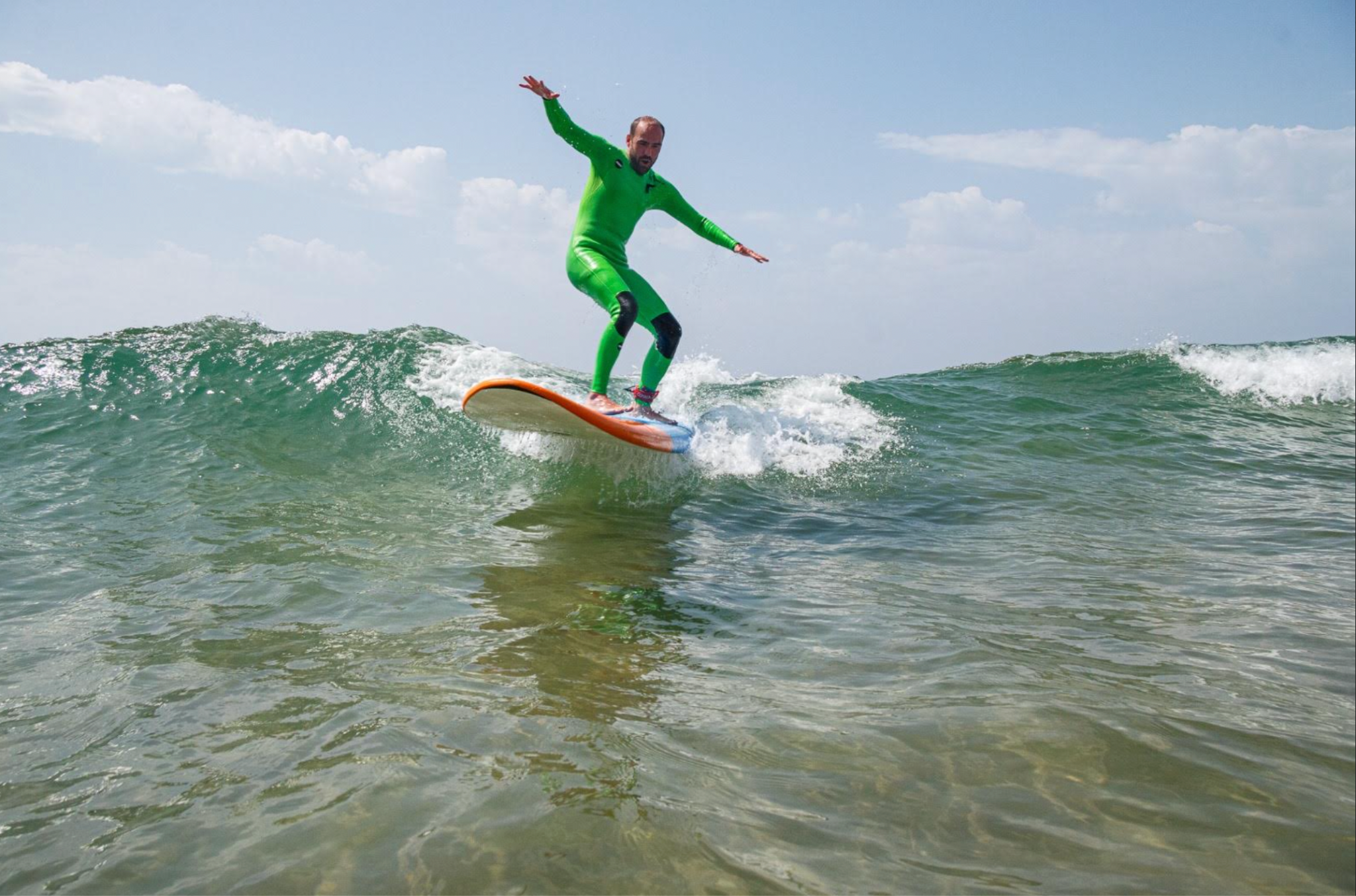
Adults, teenagers and children gather on the sand with their boards and listen to the final advice from the Hope Zones Foundation instructors, but before entering the water they stand in a circle and bow their heads for a blessing from one of the members.
The man giving them the blessing is Fr. Andrew Torrey, 36, who has been for the past three years chaplain of Surf & Pray, an annual formation trip that’s part vacation, part retreat.

“The concept of Surf & Pray is very simple really: to enjoy God’s creation, to go out together as a group, do something that’s a little challenging that you don’t often get to do on vacation, learn something new, and to do that in a community, with moments of prayer, adoration, daily mass and the presence of a priest who is constantly available for confessions,” said Torrey, who makes a point of saying that he is an avid Pillar reader, in a good way.
Torrey is a priest of the Legion of Christ, and the project is an outgrowth of its affiliated Regnum Christi communities in Germany, where the American-born priest is assigned.
For the most part, the participants are very Germanic looking Germans and Austrians. But one man stands out.
Markus Pereira Orlob, a married father of six, is the group organizer. He is shorter than most of the other men, has darker hair and complexion — and he’s built like a tank, from years of practicing Brazilian Jiu Jitsu.
Orlob is half-Portuguese but grew up in Frankfurt. He speaks fluent Portuguese, making it much easier to coordinate things for the group.
“I love the ocean, I love the waves,” he told The Pillar.
Orlob learned to surf when he was 15 and spent a year living in Portugal. It would be several more years before he learned to pray.
“I found God when I was 28 years old, and I thought that to combine the ocean and faith would be a good way to get young people closer to God.”
“The one thing that was very important when I started was to get them to leave their comfort zone. Paddling into the water is tough. A wave comes and knocks you off your board, then another, and another, and you paddle again. And after you have done this, when you are finally in the ocean, you can see the beauty of God, the ocean, what He gave to us,” he explained.
“It’s like life,” he added: “You fall, you stand up; you fall, you stand up; you fall, you stand up and then, in the end, you will see all the graces God has for you.”
Torrey has been through that cycle himself. “I only learned to surf as a priest. It was really cool, not something I’d ever thought would happen or that I thought I would be a part of. It’s obviously a big challenge. The first week my goal was to be able to stand up on the board, and I managed on the very last day. I’m not particularly athletically inclined, but you can learn.”
“And it’s amazing, that feeling when you’re standing on the board. And just being out there in the sea, you see God’s incredible, majestic creation. In Germany, especially in Bavaria and in Austria, we have the Alps, it’s very beautiful there, but there’s something also so beautiful about seeing a sunset on the beach, praying together on the beach, hearing the waves. God bringing peace into your soul through the world that he created. And we’re the crown of his creation.”
‘Swell’ evangelization
That being in the ocean is a spiritual experience is something that most wave riders would agree on, but on the other hand surfing is a very individualistic sport and not the sort that one immediately associates with Church.
In the case of Surf & Pray, however, community spirit is a central pillar.
“There isn’t a common goal in surfing as there is with team sports, that’s definitely true, it is more focused on the individual. But. at least in our experience, we’re not nearly good enough to get to that individual level. We’re all beginners and we’re all together in a group. We all cheer each other on when we see somebody getting a wave; we help the little kids in our group to paddle out; it’s fun to celebrate each other’s successes and also to laugh when people fall. And to not give up; we’re doing it together. So yes, it’s true that surfing does have an individual bent to it, but the way that we live it is very communitarian,” Torrey said.
And Orlob sees their presence on the beach as an opportunity:
“The good thing is that surfers are always open. Of course, sometimes they believe more in this energy, cosmos stuff, but they are open. And I see this with the surfing coaches; they listen to us. They see happy Christians and they start to ask questions.”
“People who are open to something are easier to bring close to Jesus than people who are not open to anything.”
The group — with its joy, family atmosphere and willingness to make public displays of faith, like prayer on the beach — does make an impression.
Francisco Cosme is one of the Hope Zones coaches who has worked with Surf & Pray for the past four years. “We are especially fond of this group, we share a strong connection. We always pray before we go into the ocean, and they make us feel a part of that,” he explained.
“It certainly gives us a different perspective of faith and Catholicism. I really like seeing the younger children here, growing in the faith and managing to connect with nature and with God,” he added
Torrey sees his role not only as accompanying the group, but also as a chance to reach out to those who they meet, and the best way to do that is by building on a relationship of friendship and trust.
“Most of the surf teachers, I would say, are spiritually inclined. Being in contact with the beautiful nature does that to you, right? The challenge for me is how do I bring Jesus to these people?”
“There is one of the coaches in particular, he’s a great guy, he has such a good heart, but he’s sort of distant from the church, and my challenge is how do I get him back? What do I do? I can’t just say you need to come back to the church right away. So my goal this time is to say, ‘hey, why don’t you join us for a Mass?’ Or, just ask what’s keeping him away.”
But the work of evangelization also takes place inside the group. Surf & Pray runs two camps per year, one for young people and one for families. While the young people are generally practicing Catholics — often members of Regnum Christi — many of the families have more complicated situations: One member of the couple might be a practicing Catholic, but not the other, and in some cases the children don’t practice either.
“Having them all here together is a chance for a fun summer holiday activity, but also a way of drawing them closer to God,” Orlob explained.
A standard day at Surf & Pray involves a surf class which can last up to three hours, time for leisure and games, but also morning prayer, a spiritual talk by the chaplain – often at the beach – adoration, and daily Mass. Torrey generally picks one topic for the week’s spiritual talks, and another to explore during mass. The youth camps will include moments for them to break into smaller groups and discuss the topics.
‘There’s a lot of good’
Torrey acknowledged that an apostolate like Surf&Pray is not the impression most people have of Catholicism in Germany — or of his own religious order, the Legionaries of Christ.
The order was plunged into crisis in the early 2000s, following revelations that its founder, Fr Marcial Maciel, had perpetrated or enabled the abuse of dozens of minors, abused drugs and alcohol use, and fathered at least six children with four different women.
The news almost led to the suppression of the Legionaries, and led to Vatican efforts aimed at reforming the institute, with new governing and formation policies and a period of direct Vatican oversight.
Torrey told The Pillar that he joined the community with eyes open.
“I joined after high school, in 2009, actually right after the scandal about the founder came out,” he said. “I loved how they were so joyful, men of deep prayer, fun, intelligent, and friendly. They showed how attractive the priesthood was and I wanted to try it out for myself.”
Impressed by priests he knew, “I wasn’t deterred by the scandal at all, none of us in the summer candidacy program were. Since then, everything that I’ve experienced as a Legionary and Regnum Christi member has been the fruit of spiritual renewal.”
Some observers have argued that the community should have been suppressed, and raised questions about whether the Vatican’s intended reforms have yet had their intended effect.
For his part, Torrey pointed to projects like Surf & Pray as a sign of some renewal in his religious community. And the priest told The Pillar that he believes the order’s history is “a story of redemption.”
He also acknowledged that few Catholics expect to hear stories of evangelization about the Church in Germany.
But various ecclesial movements in Germany, including Regnum Christi, “have been growing as the Church in Germany is becoming smaller, being purified. We are a part of the small, creative, Jesus-centered communities that people are looking for, because they aren’t getting it from the parishes,” Fr Andrew says.
“Most, if not all, of the coverage about the Catholic Church in Germany in the English-speaking world is negative, but that’s not the whole story – there’s a lot of good! Jesus really is accompanying His Church.”


