
Parishioners of St. Andrew in Riverton, Utah have celebrated Mass in a rectory basement, a movie theater and, for the last 18 years, their school gym.
But after two decades without a dedicated worship space, the community is raising $35 million to build a basilica-style church from the ground up — on a 10-acre plot of land in one of the largest walkable, mixed-use developments in the United States.
With mixed-use developments on the rise in the United States, the model being pursued by St. Andrew’s could be a new paradigm in parish campus designs.
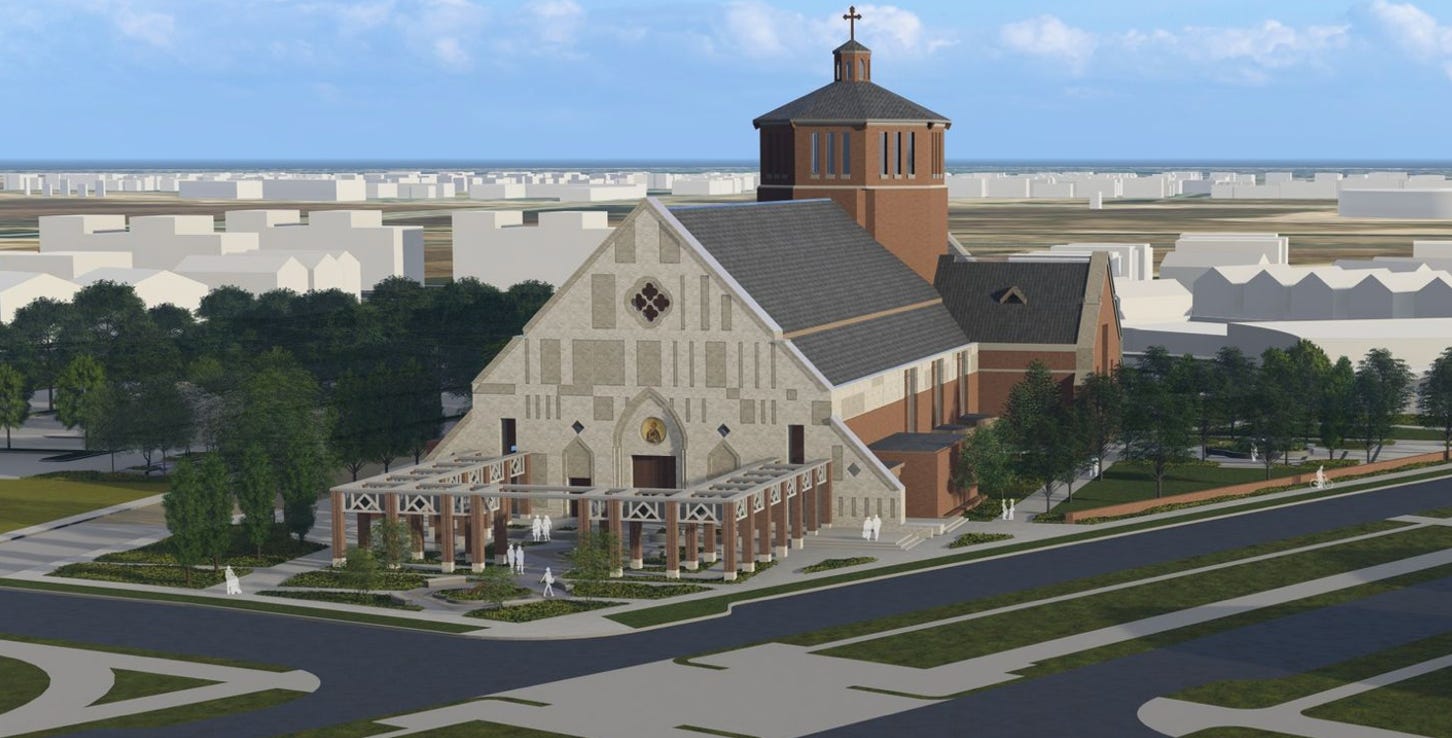
“We see a real opportunity to integrate the parish community into a neighborhood, rather than it just being the place that everybody has to commute to for Sunday Mass,” Kevin Mauer, a member of the parish’s building committee, told The Pillar.
The neighborhood, Daybreak, is a planned community in South Jordan, Utah that first broke ground in 2004 and will continue to develop over the next several decades. Its pedestrian- and cyclist-oriented mix of commercial, residential and recreational spaces typify the values of “new urbanism,” a movement that promotes — as Mauer put it — “walkability and good aesthetics on a human scale.”
As such, the entrance to the new church building will face the street, not a parking lot. And the large campus will be home not only to parish-supporting buildings like a new rectory and social hall, but also a community garden and food bank. Additional spaces are marked for “future Church affiliated development.”
After the initial design phase, which St. Andrew’s pastor Fr. Joseph Delka described as a “sprint,” the parish community’s focus is on raising the funds necessary to complete the project. To date, they have raised nearly $6 million dollars, he said, and they have a long way to go.
“Now we’re settling in for the long haul,” Delka told The Pillar. “Now we’re entering into the marathon stage.”
Nestor Lozano, a member of St. Andrew’s Hispanic community, emphasized the communal nature of the effort, across the varied languages and cultures of the parish. He is helping to plan a fundraising event for Valentine’s Day.
His hope, Lozano told The Pillar, is “that everybody feels like a brick on this building.”
A growing need
Linda Gouffaux, a parishioner since the parish’s founding, remembers the lingering smell of popcorn in the Megaplex theater where the community used to celebrate Mass.
“Occasionally a movie would turn on,” Gouffaux told The Pillar.
A grant from the Alsam Foundation, which funds education, led to the construction of St. Andrew’s school in 2008. The community was “very pleased” to begin using the gym, Gouffaux remembers, which felt more like a home even as a shared space. Delka explained that they keep what they need for Mass in a closet.
“Everything’s on wheels,” said Delka. “Thursdays the middle school helps set up the gym for Mass, and then on Sundays after Mass, the parishioners take it down. And we repeat that every week.”
Like many parishes, St. Andrew saw a decline in Mass attendance during Covid. But since then, the parish community has begun to outgrow their space.
“It just gradually filled and filled,” said Gouffaux, who was one of some 15 people who attended the parish’s first ever Mass 20 years ago.
“And now Masses are so full that there are people out in the hallway and standing.”
St. Andrew’s growth coincides with the increase of the local population — South Jordan’s population has more than doubled since the parish was founded in 2006 — and Delka said he sees new faces almost every weekend. Even so, for many years, building a new church wasn’t much of a priority.
“It was always, ‘We’re going to build something somewhere, someday,” Delka said.
Then two things happened in quick succession: A large anonymous donation revitalized excitement about and contributions to the parish building fund. And the Larry H. Miller Company, which took over the Daybreak project in 2024, reached out to the Diocese of Salt Lake City about purchasing a plot of land in the development. Before long, Delka was talking to architects.
“This whole thing went from zero to 100,” said Delka.
A Catholic design
Delka put out a call to form a building committee, which drew a dozen or so parishioners, Gouffaux and Mauer among them. Together they discussed what the community needed and wanted in a new home.
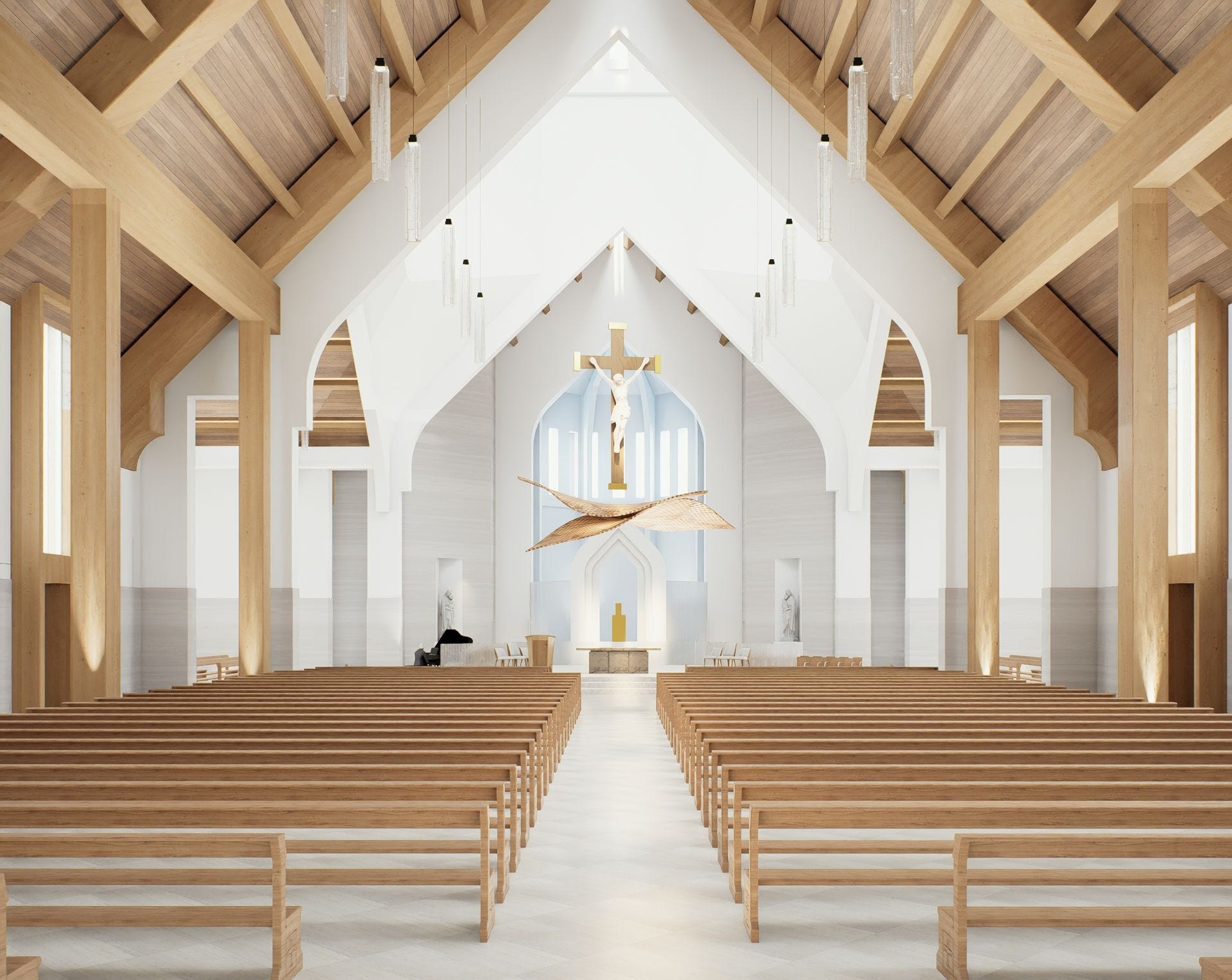
As for the actual building design, said Delka, parishioners “wanted something that really looked and felt Catholic.”
The cruciform, basilica-style church will feature a large octagonal dome in a Byzantine style, a nod toward their patron’s evangelization in the East. The entrance will be preceded by a portico, a courtyard that offers a transitional space before the front doors. Because St. Andrew was martyred on an X-shaped cross, there are Xs included in various parts of the design, like the window near the top of the facade. Delka mentioned that they also talked to sound engineers to optimize the acoustics of the space.
“We want to build something beautiful that speaks to us of the God we worship, and that can speak that language to others as well,” he said.
“We want to have a place that is not just a roof over our heads where we can do things, but an actual home for us, a home where we can encounter God, where we can invite others in to join us. Beauty is important.”
Mauer especially likes the dome. The beauty of Catholic culture and architecture were instrumental in his conversion, he told The Pillar. Baptized Catholic but having grown up “in an evangelical context,” he rediscovered the Church while living in Paris.
“What really struck me, and it was like nothing that I had ever experienced before, was how you could just walk down the city streets and encounter such beauty architecturally and musically and artistically,” said Mauer.
“The church doors would be wide open, and I could just walk in and experience it and experience the love of God.”
‘Missional places’
But not everyone is ready to walk into a church, Andrew Whaley told The Pillar. Whaley founded Calix, which helps Catholics create spaces that foster community and connection.
After a profound experience of Jesus as a teenager, Whaley wanted to share his faith with his friends. But he knew that they wouldn’t come to his church. When he stumbled on a coffeehouse for the first time — a rarity in 1989 — he found himself looking at the answer.
“I looked at these people sitting around, having conversations, writing in their journals, playing chess, reading books — some of them the same books my friends read,” he said. “And I went, ‘Oh, if I had one of these, they would come.’”
Indeed, Whaley has spent much of his life in cafes “one side of the bar or the other, with a missional heart,” he said, and he has witnessed many conversions that began with a personal connection over a shared good. For some people, that might be coffee and conversation; for others, community service or other social causes.
Eventually, he explained, their desires are awakened to higher goods. Questions begin to surface, their hearts increasingly open to answers. In the context of a relationship and a community, many ultimately find Jesus.
Whaley has discussed the St. Andrew project at length with Kevin Mauer, who reached out to him via his website for guidance. Whaley is not focused on the church building itself, but rather the relationship between the spaces on the campus and their relationship to the surrounding neighborhood.
He hopes they can create what he calls a “missional place”: a “set of magnetic spaces,” intentionally related to each other, that “draw people in based on normal human desire, and then awaken the desire for higher and higher, deeper and deeper things within sight of the object of that desire.”
In other words, he said, the non-Catholic who walks his dog near the church’s beautiful fountain may notice and hunger for the community present at the nearby (visible) coffee shop. Perhaps he finds out about the food bank and begins to volunteer. And maybe, one day, he hears people chanting the Liturgy of the Hours from inside the church and asks someone what that’s all about.
It’s slow work, said Whaley. And the work of fundraising and the eventual construction of the church and other buildings will be slow, too. Mauer told The Pillar that he and a few others visit the site weekly on Wednesdays to pray Vespers together “just to consecrate the land as we’re getting everything ready.”
But they are hopeful that what they are working toward will attract people to Christ.
“Taking our cue from our patron St. Andrew, who went out and grabbed his brother and said, ‘We found the Messiah. Come and see,’ we want to have that same kind of approach to the wider community,” said Delka.
“Come and see.”