The first meeting of the German Synodal Conference, originally planned for November, has been postponed indefinitely, because the Vatican has yet to approve the statutes establishing the new body.
The conference was to be the next step in the controversial German Synodal Way. It was to be composed of 27 bishops, 27 representatives of the Central Committee of German Catholics (known as ZdK in German) and 27 other Catholics with equal voting standing to oversee the Catholic Church in Germany.
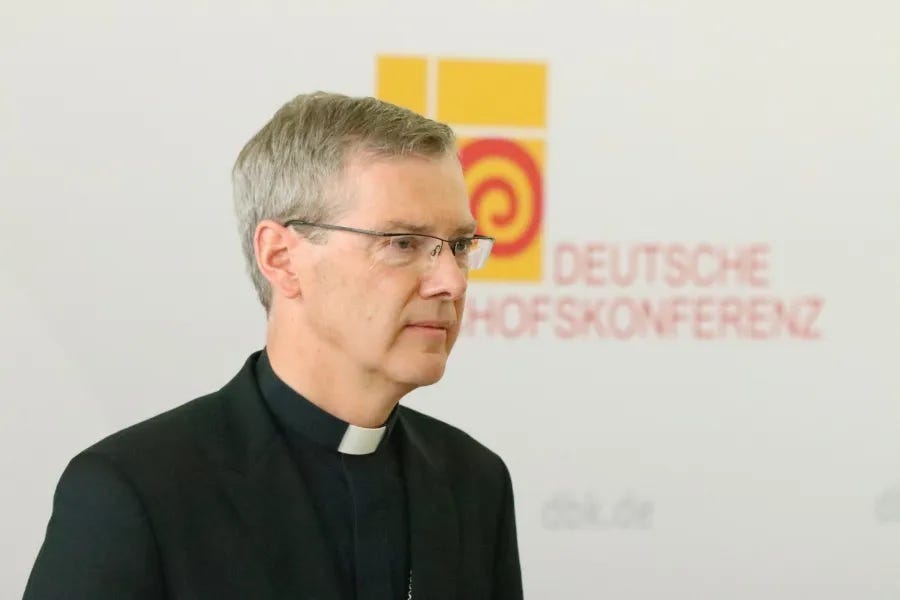
The president of the German bishops’ conference, Bishop Heiner Wilmer, said in an interview last week that he was confident that they “would make progress” but added, “I know from those [in Rome] that it will take some more time.”
Thomas Arnold, a ZdK member, told katholisch.de that he believed that Rome wanted to harmonize the German synodal conference with the 2027-2028 Vatican-led synodal ecclesial assembly.
“I would have preferred a swift start to the Synodal Conference. If Rome now intends to synchronize the processes, the Vatican should also clarify as quickly and definitively as possible what can be decided synodally at the local level in the future,” Arnold said.
Regarding the decision to postpone the meeting more than two months in advance, Britta Baas, ZdK spokeswoman, said that “For such a large meeting, you have to plan the venue and hotel rooms well in advance – at some point, you have to take action regarding the amount of cancellations if you don’t want to throw away significant sums of money.”
The first meeting was supposed to take place in Stuttgart on Nov. 6-7, with a second meeting scheduled in Würzburg in March 2027. It is unclear when the first meeting is now expected to take place and if the second meeting will also be postponed.
Wilmer had already hinted at the possibility of a delay as early as May. During a press conference at a Catholic congress in Würzburg, he said, “I personally do not expect us to meet as early as November.”
Dom Radio reported that participants had not received a formal invitation to the conference but had not received a cancellation either, speculating that “it seems that everyone involved is currently benefiting from keeping the issue low-profile.”
“Both in Germany and in Rome, the personnel constellations have fundamentally changed since the six plenary assemblies of the Synodal Way,” the article said, referring to the new pope, new president of the German bishops’ conference, and new nuncio to Germany since the Synodal Way concluded three years ago.
The German Synodal Way came to an end in 2023 after six heated plenary assemblies and many smaller committee meetings, generating 150 pages of resolutions on everything from women deacons to lay preaching at Masses to priestly celibacy.
The most salient resolution called for the creation of a new permanent national body composed of bishops and lay people, known as the “synodal conference.” If the Vatican approves the body’s creation, it would mark the start of a second phase of the Synodal Way — one that could potentially last for decades.
The synodal conference is intended to replace an institution called the “joint conference,” which has brought together bishops and lay people from the Central Committee of German Catholics, or ZdK, twice a year since 1976.
The statutes for the synodal conference were approved unanimously in a November 2025 meeting of the interim synodal committee established by the Synodal Way in 2023 in an attempt to allay Vatican concerns that the new body would undermine the authority of the country’s bishops’ conference and diocesan bishops.
The finalized text of the statutes said the synodal conference “respects the constitutional order of the Church and preserves the rights of diocesan bishops and the German bishops’ conference, as well as diocesan procedures and bodies.”
The new body was intended to consist of all 27 diocesan bishops and 27 representatives of the lay Central Committee of German Catholics, known by its German initials, ZdK, as well as an additional 27 elected members. All members would have equal voting rights, according to the statutes.
But it is uncertain whether all diocesan bishops would join the new body, as four bishops previously boycotted the interim synodal committee, arguing it was at odds with the global synodal path established by Pope Francis.
Now that they have been finalized by the synodal committee, the statutes must be endorsed at plenary assemblies of the German bishops’ conference and the ZdK. They would then be submitted to the Vatican for recognitio ad experimentum, or provisional approval for trial implementation.
Tension between the Vatican and Church leaders in Germany has been ongoing for years.
When the German Synodal Way in September 2022 first called for the establishment of a permanent “advisory and decision-making body” composed of bishops and lay people, to “take fundamental decisions of supradiocesan significance,” the Vatican responded by telling the German bishops that neither they nor synodal way participants had the authority to establish the body.
The Vatican argued that it would represent “a new governance structure of the Church in Germany which … would place itself above the authority of the German bishops’ conference and would in fact appear to replace it,” undermining episcopal authority as outlined in the documents of Vatican Council II.
When the Synodal Way ended in March 2023, the new interim institution known as the synodal committee was established with the task of setting up the permanent new body “by March 2026 at the latest,” despite the Vatican veto.
German bishops flew to Rome in March 2024 for discussions with senior curial officials, building on talks over the Synodal Way that began during their 2022 ad limina visit.
At a follow-up meeting in June 2024, the German bishops and the Vatican issued a joint statement, saying that a commission created by the synodal committee would “deal with questions of synodality and the structure of a synod body.”
German media said that one point of contention was over draft statutes’ definition of the synodal conference as a body that “deliberates and decides” on important Church matters that transcend diocesan boundaries.
Following discussions, this was amended to “deliberates and decides in accordance with ‘synodal decision-making processes’ on important issues of Church life of supra-diocesan significance.” The phrase “synodal decision-making processes” is drawn from the synod on synodality’s final document.
Another point of dispute was the statutes’ description of the new permanent body’s relationship to the Association of the Dioceses of Germany, a legal entity of the bishops’ conference. The association, known by its German initials VDD, is the central financial and administrative coordinating body of the country’s 27 dioceses.
A synodal committee member proposed that the statutes say that the synodal conference’s finance committee would assume the responsibilities of the VDD’s association council in budgetary matters.
The association council, a body with both advisory and decision-making powers, consists of 18 voting members, including seven diocesan bishops, six vicars general, three diocesan finance directors, and two people nominated by the ZdK.
Bishop Franz Jung of Würzburg and Archbishop Udo Markus Bentz of Paderborn reportedly spoke out against the proposal, while welcoming the general principle of increased lay input in financial decisions.
A declaration approved by synodal committee members said the body “would like to see the basic principle of synodality implemented here too through a reform of the structures and procedures of the VDD.”
ZdK president Irme Stetter-Karp insisted after the November 2025 vote that the synodal conference would not be a “paper tiger.”
She said: “Bishops and lay people unanimously adopted the statutes for the synodal conference. With the formula that has always been important to us as lay people: that we deliberate and decide together.”
But other German Catholics argued the synodal conference’s statutes could provoke future conflicts within the Church in Germany.
A November 2025 op-ed for the Catholic daily newspaper Die Tagespost suggested that lay people involved in diocesan church tax and finance councils would resent interventions from the national synodal conference.
In a November 2025 analysis for the website of the German edition of the journal Communio, journalist Benjamin Leven wrote: “Despite their formal character, the statutes are clearly designed as an intermediate step. The text sets out guidelines, but deliberately leaves room for further increases in the power of lay representatives.”

phew
But it is SUPER IMPORTANT to be obedient to episcopal authority in Germany and not vote for the far right extremists