Iraqi cardinal faces threats after ‘normalization’ remark
The cardinal said he was the victim of a disinformation campaign that included an AI-generated audio clip.
Cardinal Louis Raphaël I Sako has said he received threats following a Christmas address that was misinterpreted as calling for the normalization of ties with Israel — a crime in Iraqi law.
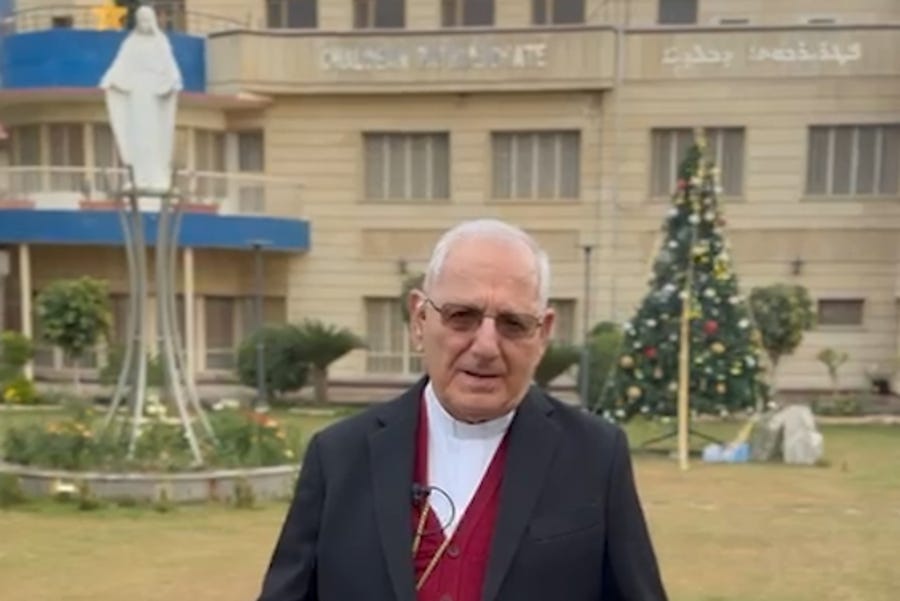
The head of the Chaldean Church, one of the 23 Eastern Catholic Churches in full communion with the pope, clarified that his use of the word “normalization” did not refer to Israel.
In a Dec. 30 interview with the Iraqi satellite television channel Dijlah TV, Sako explained that his reference to normalization — تطبيع (tatbi) in Arabic — was instead an appeal for Iraq to open up culturally and economically to the wider world.
The cardinal, whose official title is Patriarch of Baghdad of the Chaldeans, said he was the victim of a disinformation campaign that included an AI-generated audio clip in which a voice purportedly belonging to Sako discussed visiting Israel.
Sako said this week that while he joined Pope Francis on a trip to Jordan in 2014, he specifically declined to accompany the pope in visiting Israel.
The controversy over Sako’s remarks began Dec. 24, when the cardinal celebrated a Christmas Mass during the Night at the Chaldean Cathedral of St. Joseph in Baghdad, attended by Iraq’s Prime Minister Mohammed Shia al-Sudani.
According to Iraqi media, Sako said: “There is talk about normalization, and I hope from the new government that normalization in Iraq and with Iraq will take place. Iraq is the land of the prophets. Just as the Talmud was written in Babylon, the world should come to Iraq, not elsewhere.”
Iraqi Prime Minister Mohammed al-Sudani has led a caretaker government since 2022, following parliamentary elections a year earlier that resulted in a political deadlock. Sako’s comment about a “new government” appeared to refer to a future fully mandated administration, which could emerge in the wake of the country’s November 2025 parliamentary election.
The cardinal’s reference to the Talmud, the central text of Rabbinic Judaism, highlighted that an authoritative version of the document was compiled in Babylonia, in modern-day Iraq.
Sudani reportedly responded to Sako’s comment at the Mass.
“In Iraq, we do not need normalization; rather, we need brotherhood, love, and coexistence,” he said. “This is a moral, religious, constitutional, and legal commitment that governs our relationships.”
“The term ‘normalization’ does not exist in the Iraqi lexicon, because it is linked to an occupying entity that stands against land and humanity, and which all heavenly religions reject.”
Shortly after the Mass, claims began to circulate in Iraq that Sako had called for the normalization of ties to Israel. These claims were shared along with the AI-generated audio clip, which seemed to include comments from Sako about visiting Israel.
Iraq does not maintain diplomatic relations with Israel. In 2022, the Iraqi parliament unanimously endorsed a law prohibiting any steps toward normalization, punishing violations with life imprisonment or the death penalty.
The law was introduced with support from Iraq’s Sadrist Movement, led by the Shia Muslim cleric Muqtada al-Sadr.
On Dec. 27, Sako sent a two-page letter to al-Sadr, in which he underlined that he did not call for a normalization of relations with Israel, which he referred to as “the Zionist entity.”
The cardinal invited the cleric to issue a statement that would contribute “to calming souls and preserving social cohesion under these delicate circumstances, and to deny the opportunity to those who seek to tamper with Iraq’s security.”
On Christmas Day, the Chaldean Patriarchate issued the first of several clarifications of Sako’s remarks.
It said: “The normalization he referred to is not political normalization with Israel, and His Beatitude has repeatedly condemned the brutal aggression against Palestine (Gaza). Rather, he meant cultural normalization with Iraq.”
The cardinal also gave a series of interviews in which he criticized distortions of his comments.
Cardinal Sako has been a lightning rod for controversy in Iraq in recent years.
In 2023, he clashed publicly with Rayan al-Kildani, the founder of the Babylon Movement, a Christian party politically aligned with the country’s Shia Muslim majority.
Al-Kildani, who claims to represent the interests of the country’s Chaldean minority, accused Sako of “establishing parties, engaging in electoral battles, and jeopardizing the security and future of Christians in Iraq.”
The cardinal, in turn, said that al-Kildani was “self-aggrandizing and wants to become a leader.”
After Iraq’s President Abdul Latif Rashid rescinded a civil decree recognizing Sako as head of the Chaldean Catholic Church, Sako announced his decision to withdraw from Baghdad and settle in a monastery in the Kurdistan Region.
He said he took the step following a “deliberate and humiliating campaign” against him by al-Kildani’s supporters.
Sako returned to Baghdad in April 2024 at the invitation of Iraqi Prime Minister al-Sudani.
In 2024, the cardinal also became embroiled in a dispute with five fellow bishops, whom he criticized for failing to attend an assembly of the Chaldean Church’s Synod of Bishops.
In 2025, Sako denied giving a media interview in which he allegedly disclosed details of the conclave that elected Pope Leo XIV.
In the past, the cardinal said that he intended to resign when he reached the age of 75, when diocesan bishops are expected to tender their resignations to the pope. But he was not required to do so, as he is the patriarch of an Eastern Catholic Church, a post that does not have a standard retirement age.
Sako will celebrate his 77th birthday on July 4.
On Dec. 28, the Chaldean Patriarchate published an article on its website defending the cardinal. The author, Nafi Shabo, argued that Sako had suffered the “deliberate distortion” of his words.
The article described the furor as the latest incident in a long-running campaign to silence and discredit Sako.
“The real aim of these repeated campaigns is to weaken a free national voice, strip the church of its spiritual, moral, and legal role, and transform it into a silent or subservient institution,” Shabo wrote.
