Is a Vatican office ‘investigating’ Benedict's resignation?
As rumors bounce across the internet, let's separate fact from fiction
Vatican City prosecutor Alessandro Diddi is the focus this week of some international attention, this time for reasons outside the ordinary scope of his courtroom appearances.
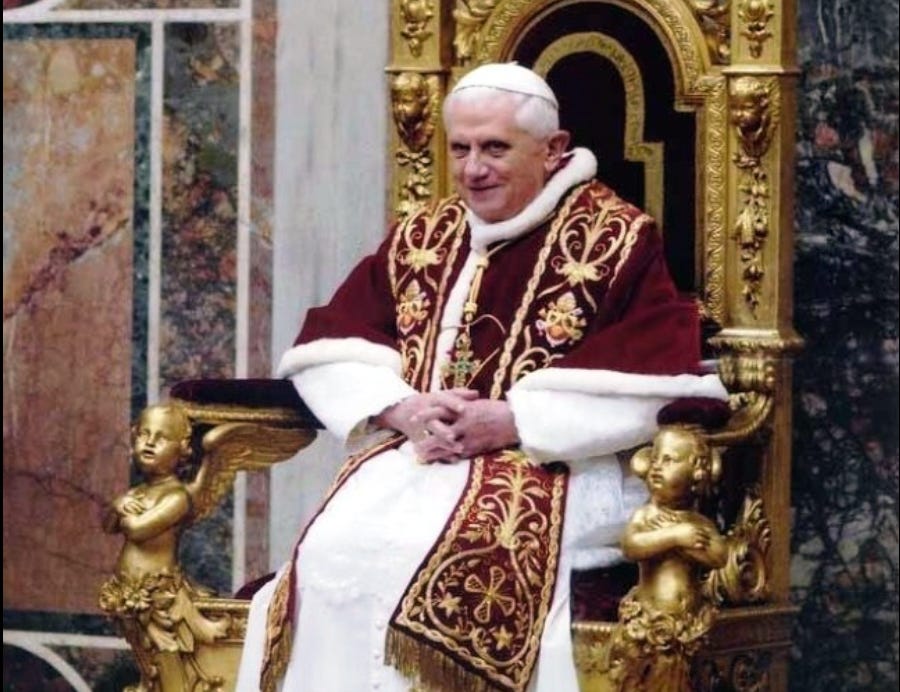
While Diddi usually makes headlines over his efforts to prosecute the Vatican financial scandal, he has this month, seemingly unwittingly, revived discredited conspiracy theories around the validity of Pope Benedict XVI’s resignation in 2013 — despite Benedict’s own frequent insistence that his resignation was freely, validly, and correctly placed.
According to some websites, Diddi denied on March 30 a request sent to his office several months earlier — which had requested access to files pertaining to a formal petition filed by Andrea Cionci, author of the 2022 book “The Ratzinger Code,” which posited the theory that Benedict placed a deliberately coded invalid resignation in 2013.
The request was reportedly filed by an Italian lawyer, Roberto Tieghi, on March 26.
Diddi’s March 30 stated that access could not be granted during an “investigative phase” and that his office “is carrying out investigations and it is not, at present, possible to predict when they will conclude.”
That response has attracted a lot of attention in some corners, especially as its been touted as “a significant development in the ongoing debate over the 2013 resignation” of Benedict. As you can imagine, claims like that have spread this month across social media like wildfire.
But is it significant at all, actually?
The Pillar explains.
OK, remind me, what exactly happened when Benedict resigned?
It was kind of an ordinary Monday morning on Feb. 11, 2013, and Pope Benedict was speaking at an ordinary consistory meeting of the College of Cardinals. At the end of that meeting, the pope began to read from a single sheet of paper, dated Feb. 10, the day before.
In Latin, he addressed the College of Cardinals, telling them he wished “to communicate to you a decision of great importance for the life of the Church.”
“After having repeatedly examined my conscience before God, I have come to the certainty that my strengths, due to an advanced age, are no longer suited to an adequate exercise of the Petrine ministry. I am well aware that this ministry, due to its essential spiritual nature, must be carried out not only with words and deeds, but no less with prayer and suffering. However, in today’s world, subject to so many rapid changes and shaken by questions of deep relevance for the life of faith, in order to govern the barque of Saint Peter and proclaim the Gospel, both strength of mind and body are necessary, strength which in the last few months, has deteriorated in me to the extent that I have had to recognize my incapacity to adequately fulfill the ministry entrusted to me.”
“For this reason, and well aware of the seriousness of this act, with full freedom I declare that I renounce the ministry of Bishop of Rome, Successor of Saint Peter, entrusted to me by the Cardinals on 19 April 2005, in such a way, that as from 28 February 2013, at 20:00 hours, the See of Rome, the See of Saint Peter, will be vacant and a Conclave to elect the new Supreme Pontiff will have to be convoked by those whose competence it is.”
Two days later, on Feb. 13, Pope Benedict presided at his ordinary Wednesday audience, at which the pope emphasized that he had made the decision to resign “in full freedom for the good of the Church, after much prayer and having examined my conscience before God, knowing full well the seriousness of this act, but also realizing that I am no longer able to carry out the Petrine ministry with the strength which it demands.”
“I am strengthened and reassured by the certainty that the Church is Christ’s, who will never leave her without his guidance and care. I thank all of you for the love and for the prayers with which you have accompanied me. Thank you; in these days which have not been easy for me, I have felt almost physically the power of prayer – your prayers – which the love of the Church has given me. Continue to pray for me, for the Church and for the future Pope. The Lord will guide us,” Benedict said.
In the weeks that followed, it emerged that Pope Benedict would live in the Mater Ecclesia Monastery within Vatican City, that he would be referred to as the Roman Pontiff Emeritus.
On Feb. 28, with the world watching, Benedict boarded a helicopter to Castel Gandolfo, the papal farm outside of Rome, where he planned to remain during the conclave to elect his successor. Pope Francis was elected on March 13, and in May Benedict returned to Vatican City, taking up residence in his monastery.
And… he could just do that? It’s allowed?
Obviously it is allowed, since the pope did it, and the cardinals elected his successor. Hard as that is for some people to accept.
The Code of Canon Law explains that if the pope wants to resign from his office, “it is required for validity that the resignation is made freely and properly manifested but not that it is accepted by anyone.”
Why isn’t papal resignation accepted by anyone? Because on earth, there is no higher authority than the Roman pontiff.
In the years after his papacy, Benedict emphasized more than once that he had made his resignation freely. He also made a point to say he did it in Latin, the official legal language of the Church, and to the College of Cardinals, the body responsible for electing his successor.
And, of course, Pope Benedict wasn’t the first to resign. There were at least five papal resignations before Benedict’s, and possibly as many as four others - getting an accurate count is difficult because some early Church records are unclear, and because there’s debate about whether Pope Sylvester III ever validly possessed the office in the first place.
But however many papal resignations you count, the point is that Benedict was not first, even if the last papal resignation was in 1415. The possibility of papal resignation is included explicitly in the Code of Canon Law because it is an office which can be resigned.
Alright, but you don’t ever stop being a priest, sacramentally, even if you are laicized. And if a bishop resigns his office, he’s still a bishop. So can you stop being a pope, or are you a pope forever?
Fair question. Here’s the deal, and it requires understanding the difference between two related concepts in Catholic theology and law – the sacrament of holy orders, and the notion of an “ecclesiastical office.”
According to the Catechism of the Catholic Church, “Holy Orders is the sacrament through which the mission entrusted by Christ to his apostles continues to be exercised in the Church until the end of time: thus it is the sacrament of apostolic ministry. It includes three degrees: episcopate, presbyterate, and diaconate.”
When a person receives ordination as a deacon, priest, or bishop, something changes in him: He is made like Christ in a new way. The sacrament of orders “configures the recipient to Christ by a special grace of the Holy Spirit, so that he may serve as Christ’s instrument for his Church. By ordination one is enabled to act as a representative of Christ, Head of the Church,” the Catechism explains.
In other words, becoming a bishop, priest, or deacon is a sacramental, ontological, and supernatural change; ordination “confers a gift of the Holy Spirit that permits the exercise of a ‘sacred power’ which can come only from Christ himself through his Church.” Once conferred, the identity of bishop, priest, or deacon can’t be lost – even if a person is retired, ill, unassignable, or even if the Church judges a person is no longer permitted to exercise any kind of sacred ministry, through the process called laicization.
Being a priest, bishop, or deacon is not a job, but an identity. Whether a bishop has an important job – Archbishop of New York, say – or no job at all, he remains a bishop because of the sacramental ordination he received.
But being a priest, deacon, or bishop also makes a person eligible to take up certain jobs in the life of the Church. And that’s where “ecclesiastical office” comes in.
According to canon law, “an ecclesiastical office is any function constituted in a stable manner by divine or ecclesiastical ordinance to be exercised for a spiritual purpose.”
In other words, an ecclesiastical office is a particular job in the Church, created either by God, or by an ecclesiastical authority. Taking an ecclesiastical office does not involve a sacramental or supernatural change. An ecclesiastical office is an assignment – and unlike sacramental ordination, assignments can be resigned.
For some ecclesiastical offices, ordination is required. A person can’t become a pastor, for example, unless he is a priest. And a person can’t take up the ecclesiastical office of “diocesan bishop” – Bishop of Exampleville, for example – unless he has first been sacramentally ordained a bishop.
The papacy is an ecclesiastical office – the office of the Bishop of Rome. The Church says the papacy is a divinely instituted office, established when Jesus Christ chose Peter as his vicar.
And it explains that among diocesan bishops, the Bishop of Rome, St. Peter’s successor, occupies a unique place, with unique authority and unique protection from the Holy Spirit.
The Roman pontiff is the Bishop of the Diocese of Rome, “in whom continues the office given by the Lord uniquely to Peter, the first of the Apostles, and to be transmitted to his successors, is the head of the college of bishops, the Vicar of Christ, and the pastor of the universal Church on earth,” according to canon law.
The papacy has the unique charism of infallibility in certain kinds of teaching, a uniquely universal set of responsibilities and prerogatives, and a unique role as the central point of unity of the Church on earth.
But for everything which makes it different from other offices, the papacy is still an ecclesiastical office. It is a function, which can be taken up by a person who has been sacramentally ordained as a bishop, but it isn’t a new sacramental identity that changes a person’s essential nature.
And unlike the sacramental order of bishops, the papacy need not be forever – as Benedict XVI reminded the world almost 15 years ago.
So what’s the argument that his resignation was invalid?
It’s not clear how many people actually think that Benedict’s resignation wasn’t valid, but the idea keeps bubbling up from time to time, and at least a couple of prominent Catholic voices have either flirted with “Benevacantism,” or taken it up directly.
Some people have argued in recent years that Benedict didn’t intend to resign his office itself, but just the duties of the office, which would be taken up by another as a kind of papal delegate extraordinaire.
They point out that when Benedict announced his resignation, he talked about resigning the ministerium (ministry) of the papacy, but not the munus — a complicated Latin word which can mean office, or function, or duty, or even charism.
Those “Benevacantists” note some 2016 remarks from Benedict’s personal secretary, Archbishop Georg Gänswein, which talked about an “expanded” Petrine Office, including “an active member” and a “contemplative.” That speech confused some canonists and theologians, who criticized its content as inconsistent with the theology and jurisprudence surrounding the papacy, and Gänswein soon walked back some of its themes.
But “Benevacantists” have tended to argue that its themes represent Benedict’s views, and suggest that the pope didn’t act freely to give up the papal office itself.
Some people who have argued against the validity of Benedict’s resignation do it from Latin grammar, claiming that Benedict used the subjunctive mood, instead of the indicative, when he announced his resignation. But interlocutors with expertise in Latin have pointed out that reading is grammatically mistaken, and based on a misunderstood Latin “result clause.”
But before his death, Benedict himself frequently affirmed that his resignation was “a conscious choice,” and that there was one pope, namely Francis.
While “Benevacantism” has not been widespread, it has been an issue periodically raised over the last decade, and often by some of the strongest critics of the Francis papacy — some of whom argue that some of Francis’ decisions on governance are indications that he is not really the pope. Catholic theology, for what it’s worth, does not teach that papal governance is protected on matters of prudence or good decision-making by the Holy Spirit.
Some observers have suggested that in the future, it might be more straightforward if a retired pope used a different title, dressed like a cardinal, and lived outside the Vatican. For what it’s worth, Benedict XVI frequently told people that he wanted to be called “Father Benedict,” but for some reason, it never really stuck.
Still, what a future retired pope might do is anyone’s guess — and the rules on such things will be up to him, and to the bishop who next takes up the ecclesiastical office of the papacy.
But what we should really emphasize is that no canonical authority anywhere, of any prominence or rank or academic standing, has supported any of the supposed arguments against Benedict’s resignation being anything other than what he said it was: free, correctly placed, and valid.
OK, we’re all caught up. So why is Diddi’s office even involved?
That’s a good question. When considering the resignation of the Bishop of Rome and the head of the College of Bishops, any legal questions raised are necessarily ecclesiastical and canonical.
Although the territory of Vatican City is a sovereign jurisdiction, it is governed by the Apostolic See — the legal person of the pope and the Roman curia under him — which is a separate legal entity in both canon and international law.
As such, while who the pope is directly impacts the governance of the Vatican City state, his office is not defined by city state law, only its role in relation to the city state’s governance.
Similarly, the resignation of an ecclesiastical office is governed by canon law. While canon law is operative and accepted in city state law as a relevant source of law and jurisprudence, it is not under the city state’s jurisdiction to prosecute strictly canonical matters.
In short, Diddi, as the city state’s chief prosecutor, is not ordinarily competent to investigate what amounts to a question of canon law — did the Bishop of Rome validly resign his office according to canon law?
Of course, this doesn’t prevent people from filing petitions, or criminal complaints, on any matter they may wish to bring to his attention.
In this case, the simplest answer for why Cionci’s complaint was sent to Diddi could be that no more obviously competent canonical authority — the Dicastery for Legislative Texts, the Supreme Tribunal of the Apostolic Signatura, of the offices of the Dean of the College of Cardinals or the Cardinal Camerlengo — would engage with such a petition.
But he is investigating it, right? He said so, right?
It depends on what you mean by “investigating.”
Technically in canon law, whenever a competent authority receives notice that something illegal may have happened, the authority is required to open a file and convene a “preliminary investigation”.
These preliminary investigations are not the same thing as preparing a case to bring charges or file a case, though. They are basic sense-checks of the allegations, to see if they have “the semblance of truth,” as standard of proof defined in canonical jurisprudence as “not manifestly false or frivolous.”
If the petition fails to meet this basic bar of theoretical possibility, it is summarily rejected and the case is closed.
Diddi’s response, then, that the petition is in the investigative phase means, that even this basic determination has not been made yet.
To some, that response gives the impression that the Vatican prosecutor must be taking quite seriously the allegations — since a petition was made in November, and it was still under review in March.
But that isn’t necessarily so.
It could as easily be the case that, having received the petition, no one in Diddi’s office has done anything with it but open the envelope and stick it in a file somewhere to be ignored — that would constitute an “open” investigative phase, technically speaking.
Similarly, if Diddi’s office forwarded the complaint to an office more qualified to handle it, like any of those mentioned about, the same thing could have happened there. This, too, would count as an “open investigation,” technically speaking.
So Diddi was probably just answering the request with a pro forma response, which doesn’t actually tell us anything?
That seems about the sum of it.
Theoretically, if Diddi had received Cionci’s petition in November and passed it around the office for everyone to have a good laugh at before it being left on a coffee table and lost, he might have sent the exact same response.
For all we know, that’s what happened. Or it was forwarded to the Dicastery for Legislative Texts, or the Office of the Promoter of Justice at the Apostolic Signatura and officials there simply never wrote back.
Or, maybe, Diddi has actually taken it on himself to look into the papal resignation, or at least give himself the option to, and is actually keeping the file open intentionally.
Wait, why would he do that?
Well, the thing about Alessadnro Diddi is that he’s been known to enjoy a bit of media attention.
He was something of a celebrity Mafia defense lawyer in Italy before moving to the Vatican City prosecutor’s office, and his handling of the Vatican financial crimes trial has appeared to some observers as more effective at PR than actual prosecution.
In fact, his work on that so-called “trial of the century” in the Vatican has repeatedly seen his conduct fall under scrutiny, even to the point where he was forced to recuse himself from the case at appeal.
He’s also been known to open files on cases bound to bring headlines, even if almost certainly not a result.
In 2023, at the request of the family, Diddi reopened the investigation into the unsolved disappearance of Emanuela Orlandi, a 12-year-old girl who lived in Vatican City and who went missing in 1983.
The Orlandi case has been a source of conjecture and conspiracy theory in Italian media for decades — linked to everything from the Mafia to the attempted assassination of St. John Paul II. But while Diddi hinted at discovering old confidential Vatican files and new information, nothing came of that investigation.
Instead, at the time the investigation was announced, sources close to his office suggested to The Pillar that his interest in the case had less to do with requests from the missing girl’s family and more to do with a popular then-recent Netflix series on the case. One source observed that “if there is a circus, [Diddi] has to be in every ring.”
Having been bounced from his most famous case by the city state appeal court, which is now setting out to take a forensic new look at his conduct of the case, some observers — only some, mind you — might wonder if Diddi is looking for a way back into the spotlight with the “Benevacantism” conspiracy theory.

