Is Peña Parra’s new job an exile, or probation?
Pope Leo's transfer of the sostituto to become nuncio to Italy could prove an open ended appointment.
Pope Leo XIV on Monday ordered the biggest curial personnel change of his first year in office, transferring the sostituto of the Secretariat of State, Archbishop Edgar Peña Parra, to serve as apostolic nuncio to Italy and San Marino.
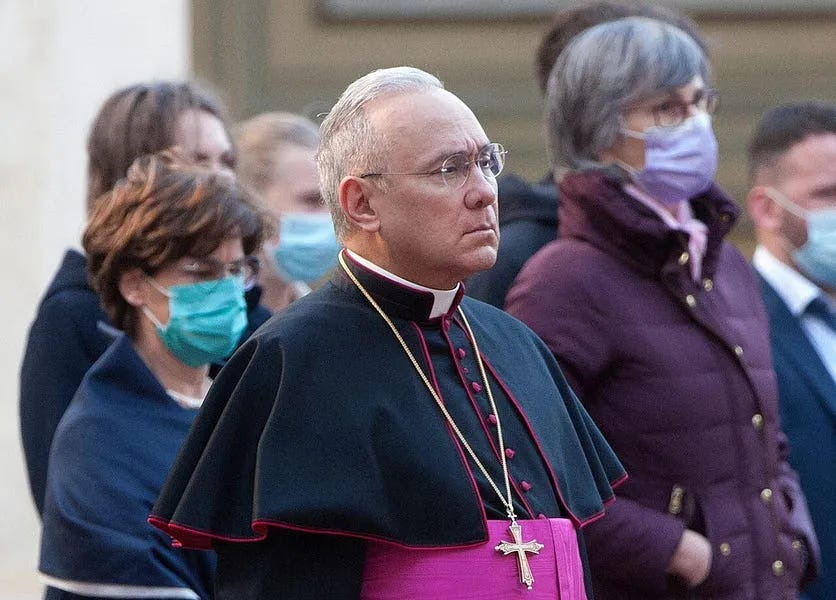
Peña Parra has served as sostituto, who functions effectively as papal chief of staff in day-to-day curial operations, since 2018, when he was appointed to replace then-archbishop, soon to be Cardinal Angelo Becciu, who was promoted to lead the Congregation for Causes of Saints.
The archbishop’s eight year tenure as sostituto was a period of remarkable upheaval, both for the curia and the office, with Peña Parra having immediately to step into the throws of the Secretariat of State’s financial scandal, as well as help bed in a new apostolic constitution in 2021, reorganizing the Roman curia.
During his time in office, he emerged as a quiet pole of obvious influence and power under Pope Francis, clearly trusted by the late pontiff. However, Peña Parra also appeared at the center of several controversies in which he appeared to act well outside his own, or indeed any, legal scope of action.
His new assignment appears to emphasize Pope Leo’s emerging preference for by-the-book governance and the rule of law, though it also provides a position of considerable prestige for the archbishop. And, even if it likely constitutes an effective side-lining for one of the curia’s previously most influential operators, it could yet hold out the promise of prospects for the future.
—
While the announcement of Archbishop Peña Parra’s reassignment was widely hailed Monday as a major move by Pope Leo, it was not unexpected. Having served eight years as sostituto, he served past both the historical norm for the role of five years, and the seven year stint achieved by his immediate predecessor, Cardinal Becciu.
Indeed, even prior to Pope Francis’ death last year, there was widespread conversation within the curia about Peña Parra’s pending departure from office, with an emphasis on where he might be moved to.
The archbishop’s reassignment to a nunciature, even one as diplomatically significant as Italy, represents a step back in the Vatican civil service hierarchy — he replaces Archbishop Petar Rajič, who was in turn promoted to serve as head of the papal household.
This is certainly a break from tradition, with sostituti customarily being given charge of a Vatican dicastery and given a red hat at the end of their term in the pope’s office. But while Peña Parra’s at least sideways reassignment is notable, it would be a mistake to over interpret it as a purely Leonine decision.
In the final months of the Francis pontificate, it was widely understood and accepted around Rome that, following the arrest of Cardinal Becciu and Peña Parra’s controversial appearances in the trial and connected legal processes, he was most likely to receive a face-savingly senior diplomatic posting, rather than a curial assignment in the Vatican.
At different times, the nunciatures in Madrid, Lisbon, and Washington DC were all discussed as possible options. That Peña Parra has ended up moving out of the Vatican, but only literally and metaphorically across the street can be read a couple of different ways.
To understand the loaded significance of his new assignment, it is worth recalling exactly how controversial Peña Parra’s time in office was.
Arriving exactly at the moment of denouement in what became the London property scandal, Peña Parra is often pitched — not least by himself — as the man charged with making sense of a complicated (and illegal) series of investments and disbursements overseen by his predecessor.
By his own telling, the archbishop inherited a department where officials stone-walled oversight, blind-sided superiors with last minute decisions, and deploying accounting sleight-of-hand to cover the true state of the financial affairs.
However, the archbishop also began his tenure by deciding that reporting and correcting corruption risked departmental reputational damage, and elected instead to effect a brute-force separation of the Secretariat of State from its investment managers.
That decision proved costly in the form of serious papal embarrassment for Pope Francis, and the loss of hundreds of millions of euros. It also triggered a still ongoing series of lawsuits in foreign courts, before which the archbishop conceded under oath that his actions were not always honest or necessarily lawful.
Peña Parra’s penchant for no-holds-barred engagement with obstacles and unintended consequences extended to internal Vatican institutions as well.
In one of the more dramatic though less reported episodes of the Vatican financial crimes trial, he admitted ordering illegal electronic surveillance of a Vatican banking official in retribution for his denying the Secretariat of State a nine-figure loan to help bail it out of the London property deal — a loan request that triggered the initial criminal investigation into the affair.
In an extraordinary incident, Peña Parra signed a letter to a local bishop announcing that there had been an “extraordinary procedure” — he did not say ordered by whom or according to what norms — into the case of Alberto Ariel Príncipi, who had been ordered laicized by two separate tribunals under the authority of the Dicastery for the Doctrine of the Faith.
Despite his double conviction for sexual abuse of a minor, Peña Parra vacated the decisions and the laicization, saying the priest was guilty only of “recklessness,” and ordered him reinstated.
As unprecedented as that intervention was — the sostituto’s office and department have no jurisdiction over sexual abuse cases — so too was the response: Archbishop John Kennedy, head of the Dicastery for the Doctrine fo the Faith’s disciplinary section publicly intervened to nullify Peña Parra’s attempt to rehabilitate the abuser.
With this kind of track record, casual observers might be left wondering not at his transfer on Monday but rather why Peña Parra was left in office so long — and why he was entrusted with a senior diplomatic post, even if as a face-saving courtesy position.
—
During the last year of Pope Francis’ reign, especially in the fallout of the Vatican financial trial and the Príncipi affair, three things were separately understood to be true, according to the accepted curial wisdom.
The first was that, having served five years in office — and five years full of controversy at that — Peña Parra was due to move on from the office of sostituto.
Second, it was widely understood that he could not, and would not, be handed the prefecture of a Vatican dicastery with the expectation of further promotion to the rank of cardinal. Instead, he would be handed a new job with just enough prominence and rank that it would not appear too overtly as a demotion. It was widely understood that a senior diplomatic assignment was the pope’s preferred option.
Finally, it was understood that despite — or even because of — his various controversial acts in office, Peña Parra enjoyed a considerable amount of trust and loyalty from Pope Francis, personally.
However unorthodox as were some of Peña Parra’s actions as sostituto, they cannot be considered apart from the context of his directly serving under a pope with his own distinctly unorthodox style of governance — one which clearly at least tolerated the archbishop’s style, if not encouraged it or even directed it at times.
As such, even after Francis’ death and the election of Leo, it was never likely Peña Parra would have been simply summarily dismissed from office, since doing so would likely have provoked some attempts at public self-justification from the archbishop, and could have triggered the release of damaging allegations against the previous pope.
And, whatever else may be said about his time in office, Peña Parra leaves it with considerable institutional influence and insider knowledge of the workings of the curia — every sostituto does, even those who don’t make recourse to private intelligence contractors.
For months around Rome the common understanding has been that there was an effort, then, to find a new assignment for archbishop that was mutually agreeable to both him and the pope. And the Roman nunciature is an interesting means of squaring that circle.
—
The role of an apostolic nuncio is far from a ceremonial job. The triple function of diplomatic representative of the Holy See to the local government, liaison between local bishops and the Roman curia, and pastoral proxy of the pope to the Catholics of a country makes the job both demanding and influential.
And apart from its public facing duties, a local nuncio is also expected (in canon law, not merely by custom) to play a key role in compiling the short list of candidates for episcopal vacancies.
Yet of all the possible nunciatures to which a Vatican diplomat could be assigned, the embassy to Italy could be argued to be the closest to an honorary position there is — or at least the most apt to be turned into one.
As Bishop of Rome, the pope already directly selects the president of the local bishops conference — currently Cardinal Matteo Zuppi — and often plays a more than usually direct role in selecting bishops and keeping an eye on national ecclesiastical affairs.
Similarly, relations between the Italian state and the Holy See are, because of the diplomatic and geographic proximity between the two, often handled or swiftly escalated to the Secretariat of State directly.
Indeed, when friction does arise between the two, as it does occasionally, for example over matters touching the Lateran Treaty or financial indemnity paid by the Italian Republic for the former papal states, it is often treated at the highest levels of the Vatican diplomatic service.
Similarly, unlike in other countries where the distance — physical and metaphorical — between the curia and local dioceses can be considerable, Italian bishops have much less practical need to send communications to and from different Vatican departments care of a diplomatic pouch.
At the same time, the same closeness of the Italian government to the Holy See and the vital importance of Vatican-Italian relations means that the rank of the nuncio to Italy remains a top-tier assignment, at least in terms of prestige.
In this sense, Peña Parra’s new assignment could be seen as a prestigious non-job, or at the very least turned into such by the pope if that’s what he wanted it to be. And perhaps that is the most desirable outcome for a senior curial official with a very different way of approaching governance to the new pope.
Of course, even this assignment, though, comes with certain complications. Although the erstwhile sostituto is, at least on paper, gone from the curia, he is and will remain very much in Rome. However officially distant he may now be from the levers of departmental power, who willing he proves to separate himself from the daily reality of Vatican power politics remains an open question.
Who quietly the archbishop settles into his new assignment may depend entirely on what he hopes could happen next, and so how incentivized he is to impress Pope Leo.
At age 66, Peña Parra would have to serve nearly a full decade in post before reaching the normal and sometimes merely nominal retirement age for a curial bishop.
Departing the job before that, after a five year term, for example, would mean either the prospect of renewed promotion and a possible return across the Tiber to Vatican City, or the relative disgrace of an early pension. On the other hand, serving diligently and successfully as nuncio to Italy for a full double term would itself come with a reasonable expectation of a promotion to cardinal, even if it came along with a notice of retirement.
Both those prospects could serve to incentivize Peña Parra to adapt quietly to his new post, and keep to the Italian side of the river. Whether he does or not could come down to what personal ambitions he may still harbor.


Did the Secretariat of State's financial scandal make commemorative small blankets that Peña Parra had to step into? Stepping into that many throws could be dangerous :D