Is Pope Leo bringing back episcopal due process?
The resignation of Bishop Syukur may show a return to canonical discipline.
The resignation last week of Bishop Paskalis Bruno Syukur of the Indonesian Diocese of Bogor came as a surprise to Catholics in the country and abroad.
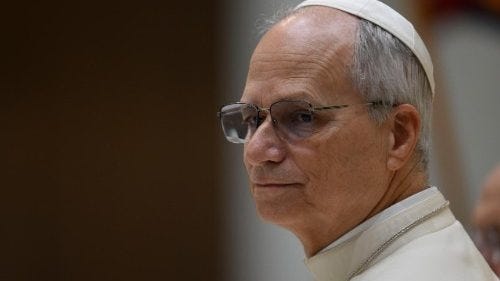
The 63-year old had no health issues and was leaving office without any indication of what he would do next.
Of course, the early and superficially unexplained resignation of a bishop might have passed without wider interest had this particular bishop not already made headlines in 2024 when he famously turned down Pope Francis’ offer to make him a cardinal — after the announcement of his name had already been made.
As more details emerged about Syukur’s departure , it became clear the bishop had a long and controversial track record leading his diocese, and had been the subject of an apostolic visitation in the weeks prior to his stepping down.
While Syukur made it clear he had not been found guilty of any specific act of wrong doing, his resignation followed a trip to Rome earlier this month to, as he put it, “explain” the allegations against him.
The removal of Syukur represents a notable decline in episcopal fortune, going from being named cardinal to being asked to resign in less than 18 months.
For those trying to parse events, and make sense of what — if anything — they might say about the change of leadership style and expectations from Francis to Leo, the Syukur case offers several possible interpretations, any combination of which might be the correct one.
But what does seem to be the case, at least so far, is that Pope Leo is taking a decidedly procedurally transparent approach to dealing with bishops.
—
Amongst the complaint against Bishop Syukur which apparently made their way to Rome, triggering an apostolic visitation and leading to his resignation, he has been criticized for an authoritarian and un-consultative style of governance. Critics of the bishop allege he relied on a close and closed circle of intimate confidants to make decisions, over and around his own officials.
There have also been accusations — vigorously denied by the bishop — of financial impropriety. And, in one locally-notorious incident, he turned over the management of a local Catholic hospital to a lay board, effectively taking it away from the religious order which ran it.
An apostolic visitation, ordered by Rome but carried out by the head of the local bishops conference, reversed many of the bishop’s more controversial decisions without issuing (publicly at least) any specific finding of canonical wrongdoing on his part. But that did not, by all accounts, bring the issues to a close and instead, at least according to some in the diocese, left the bishop further estranged from the people meant to be his collaborators.
Things appear to have come to a head late last year when Syukur mounted a wholesale purge of his diocesan curia, replacing them all in December and leading to some local clergy making further petitions to Rome and issuing public letters listing their concerns. The bishop was then summoned to Rome this month to give his side of the story, and resigned days later.
On the specific issues at play with Syukur, it is not unreasonable to look at his departure as a sign that Pope Leo takes a very different view of effective episcopal leadership from his predecessor.
Local complaints to Rome about the bishop certainly predate the pope’s election last year. And, in his previous position as prefect of the Dicastery for Bishops, Leo would be more than passingly familiar with the details.
While the situation does seem to have worsened in the months since the apostolic visitation, at least making clear that the estrangement between Syukur and his own chancery was irreconcilable, the basic dynamics have been at issue for some years.
As such, it is worth considering what, exactly, Francis saw in the bishop which made him think he was suitable to be a cardinal — perhaps his previous service as a provincial superior for the Franciscans.
Indeed, the former pope had a marked preference for picking religious superiors to become bishops, and the potential tensions in diocesan governance between those used to commanding religious obedience are real. And it may have been out of sympathy for that kind of dynamic that Francis saw Syukur’s problems in the diocese (to which he was appointed by Francis in the first place) as meriting sympathy, even validation.
Whatever the last pope may have thought, Leo, himself a former religious superior turned diocesan bishop and appointed by Francis, seems to have concluded something different. But more interesting than the specifics of the Syukur case may be the way Leo effected the bishop’s resignation — since this is what the bishop himself appears to have confirmed happened. Especially compared to how other episcopal resignations took place under Francis.
While Rome has been vague about the details, what we do know is that Syukur was the subject of years of complaints from within his diocese, and that Rome’s response under Leo was to convene a visitation, and eventually invite him to Rome to ultimately make his case in person before being asked to resign.
This, compared to previous instances of episcopal removal under Pope Francis, appears far more procedurally systematic — even, perhaps especially, if the Vatican’s investigation turned up no specifically prosecutable acts of negligence or misconduct.
On March 9 of 2024, Fernández was “relieved” of the pastoral care of his diocese, according to a Vatican communique released that day, and an apostolic administrator was appointed to govern the Arecibo diocese. It was a rare case of the pope deposing a bishop, seemingly without cause, and according to the bishop himself, without explanation.
At the time, the bishop said he was told by the pope’s representative in Puerto Rico, apostolic delegate Archbishop Ghaleb Bader, that he “had not been obedient to the pope, nor had [he] had sufficient communion with [his] brother bishops of Puerto Rico.”
Correspondence obtained by The Pillar showed that Fernández pushed back on requests for his resignation for months before his removal was announced, and he alleged that several Puerto Rican bishops had pushed for his removal from office because of disagreements over his statement on vaccines, on his decision to send seminarians to a seminary in Spain, and over disagreement about a 2018 lawsuit against the Archdiocese of San Juan, which pertained to archdiocesan pension obligations.
Whatever the actual reasons for his removal by Francis, Fernández was clear that he was never told, despite repeatedly asking the apostolic delegate to the island for clarity while his resignation was being demanded.
He was equally clear that, unlike Syukur, he was not the subject of a formal apostolic visitation. Fernández’s successor in the diocese told local clergy that Cardinal Blase Cupich had conducted a kind of informal, secret, investigation, the purpose and scope of which he did not elaborate upon, though Fernández himself pushed back on that claim saying he had dinner with Cupich in the diocese once, “with the people from the Catholic Extension and discussed topics such as federal aid for hurricane relief, and a brief casual mention of the seminary and vocations – hardly considered an apostolic visitation, let alone a fraternal visitation.”
And he insisted he was repeatedly denied the chance to make his case in person in Rome, and to answer any questions about his leadership of his diocese.
These kinds of informal investigations — or rumors of investigations — followed by sudden demands for resignations from local nuncios, without explanation or chance to make a case, were not uncommon under Francis. So much so that they even became something of a subject for gallows humor. In the U.S., some bishops took to joking about not getting caught alone by the nuncio during coffee breaks at conference meetings.
If what we are learning about Leo from the Syukur case is less what he looks for in a bishop and more that he favors due process, that could prove to be reform with far reaching consequences.


This shows the chaos of Pope Francis' reign, where he would often name Cardinals spontaneously without consultation. When he named Bishop Syukur a Cardinal, someone from the Vatican Curia probably informed Francis of Syukur's mismanagement and so the Pope had the bishop resign from his cardinalate to not cause scandal.
An example of this chaos was Pope Francis naming then Auxiliary Bishop of Lisbon Aguiar a Cardinal. Just a few weeks earlier Francis had already named a new Patriarch of Lisbon and Bishop of Fatima, and therefore the only diocese in Portugal left open was the unimportant Diocese of Setubal (whose bishop had just been named to the more prestigious Fatima diocese). Imagine putting a Cardinal as the new Bishop of Orange (instead of LA) or Bishop of Bridgeport, Connecticut (instead of NYC) less than 2 months after having named new Archbishops of LA and NYC.
I think one of the main reasons in electing Pope Leo XIV was that the Cardinals wanted stability and organization and Cardinal Prevost represented those qualities which Pope Francis lacked.
Let’s think…..who needs to go next?