
The number of people formally leaving the Catholic Church in Switzerland fell significantly in 2024.
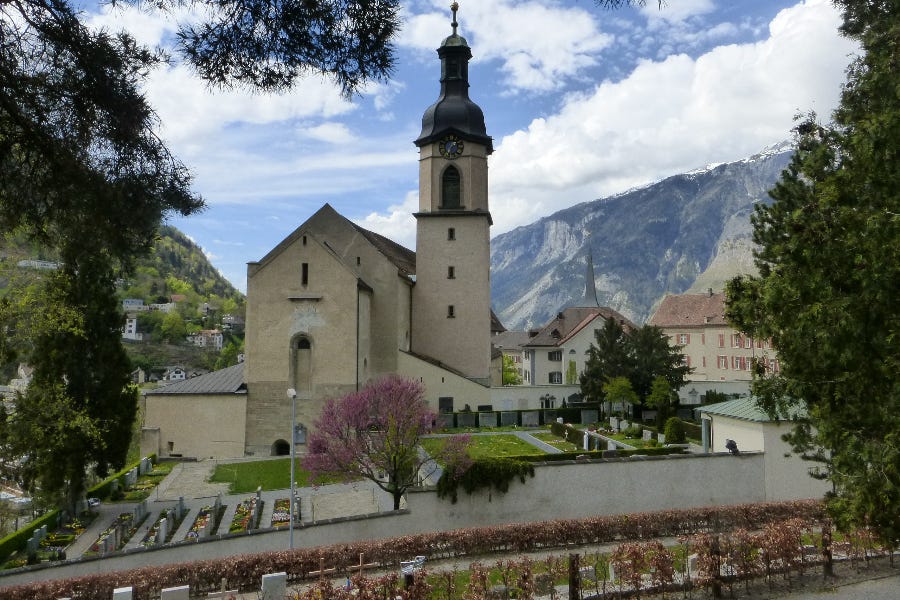
According to figures published Sept. 26 by the Swiss Institute of Pastoral Sociology in St. Gallen, a total of 36,782 people formally left the Church in Switzerland last year, out of a total population of almost three million. That’s 46% fewer Church “exits” than in 2023.
A downward trend in departures is also evident in Germany and Austria.
In Germany, 321,659 people formally disaffiliated in 2024, out of an overall Catholic population of almost 20 million, down 20% from 2023.
The Church in Austria recorded 71,531 departures last year, out of a Catholic population of nearly five million, a year-on-year drop of 16%.
Switzerland, Germany, and Austria have important commonalities. They share borders and have German as a national language (one of four in the case of Switzerland). They are so closely linked, in cultural and linguistic terms, that they are sometimes referred to collectively as the DACH region — an acronym for Deutschland (Germany), Austria, and the Confoederatio Helvetica (Switzerland).
The three countries are at the heart of Europe’s Germanosphere, or German-speaking region, which extends to smaller German-speaking communities in Belgium, Liechtenstein, and Luxembourg.
Does the recent decline in Church “exits” suggest the Church is bouncing back in the region? Or is German-speaking Catholicism still on the rocks?
The Pillar takes a closer look.
The case for
The fall in Church departures in Germany, Austria, and Switzerland is striking because in all three cases there is a sharp year-on-year decline. But the case that the local Church is turning a corner can’t be substantiated solely with a single year’s statistics.
In Germany, disaffiliation hit a peak of 522,821 in 2022. But in 2023, the figure dropped to 402,694. Therefore, 2024 marked the second successive year that the numbers fell, suggesting it’s a trend rather than a blip.
In Austria, Church exits also peaked in 2022, with 90,975 departures, and fell in 2023, down to 85,163 and again in 2024, also implying a trend.
But in Switzerland, disaffiliation peaked a year later, in 2023, when 67,487 people left. This marked a major jump from an annual average of around 35,000, linked to an abuse crisis that engulfed the Swiss Church in 2023.
In September 2023, the Vatican ordered a probe into allegations against six members of the country’s bishops’ conference. The news broke just days before the publication of an independent pilot study on sexual abuse in the Catholic Church in Switzerland since the mid-20th century. The study identified 1,002 “situations of sexual abuse,” involving 510 suspected perpetrators and 921 victims. The allegations and the study together generated a nationwide outcry.
The decline in Church exits in Switzerland in 2024 could therefore be dismissed as a blip. Yet the figure has fallen by such a large margin — almost 50% — that it could mark the start of a multi-year downward trend.
Meanwhile in Belgium, which is on the outer edge of the Germanosphere due to its German-speaking minority, the number of requests for “debaptism” fell from a record 14,251 in 2023 to 4,780 in 2024, a drop of 66%.
The figure for 2023 was exceptionally high due to public uproar following the airing of the documentary series “Godvergeten” (“Godforsaken”) about abuse cases in the Flanders region.
Again, we don’t know if the fall in 2024 is the start of a trend. Next year’s figures will tell us. But the decline is big enough to believe it might not be a one-off drop.
Other recent statistics have given Catholics in the Germanosphere reasons for modest celebration after years of unbroken gloom.
In Germany, there was a slight increase in Mass attendance, First Communions, new Catholics, and readmissions to the Church in 2024, compared to 2023.
In Austria, there was a rise in Mass attendance, adult baptisms, and new Catholics and readmissions (treated as a single category by Austrian statisticians).
In Belgium, adult baptisms continued their sharp upward trend in 2024, while Mass attendance rose almost 4% year on year.
These statistics could be interpreted as the beginning of the end of a long period of decline. They also seem to fit with the increasingly widely held notion that Christianity is witnessing a “quiet revival” across the Western world.
The case against
But there is another way of reading the latest Church figures in the Germanosphere. This is to argue that the positive developments in 2024 are insignificant compared with the overall negative picture.
That is the position taken, for example, by the Swiss Institute of Pastoral Sociology. Looking at the annual figures for Church exits in Switzerland, the institute notes that while 2024’s figure of 36,782 is much lower than 2023’s, it is higher than the 2022 figure of 34,561.
“A comparison over several years shows a slow increase in the tendency to leave the country in Switzerland,” it concludes.
Rather than celebrating the sharp decrease from the exceptional year of 2023 to 2024, the thinking goes, we should worry about the increase in the “normal” years from 2022 to 2024.
The overall number of Swiss Catholics is also declining — seemingly inexorably — due to a higher proportion of deaths compared to births and baptisms. Even if there were eye-catching increases in Mass attendance or adult baptisms, the steady fall in baptisms and marriages would indicate further decline in Church membership in the coming years, barring a spectacular revival.
“Younger age groups cannot replace the dying generations, especially since the younger generation’s commitment to the Church is weaker than that of the older generation,” the institute says.
That statement could arguably be applied equally to Germany and Austria, as well as the rest of the Germanosphere.
While rising Mass attendance is always a cause for celebration, it can also be relativized. It is increasing in the Germanosphere after Mass-going plummeted to new lows during the COVID-19 crisis. But attendance is yet to return to pre-pandemic figures — and there is no guarantee it will.