The Israeli government has declined to renew the visa of a Catholic priest in the West Bank, who was responsible for youth ministry among the region’s Christian community.
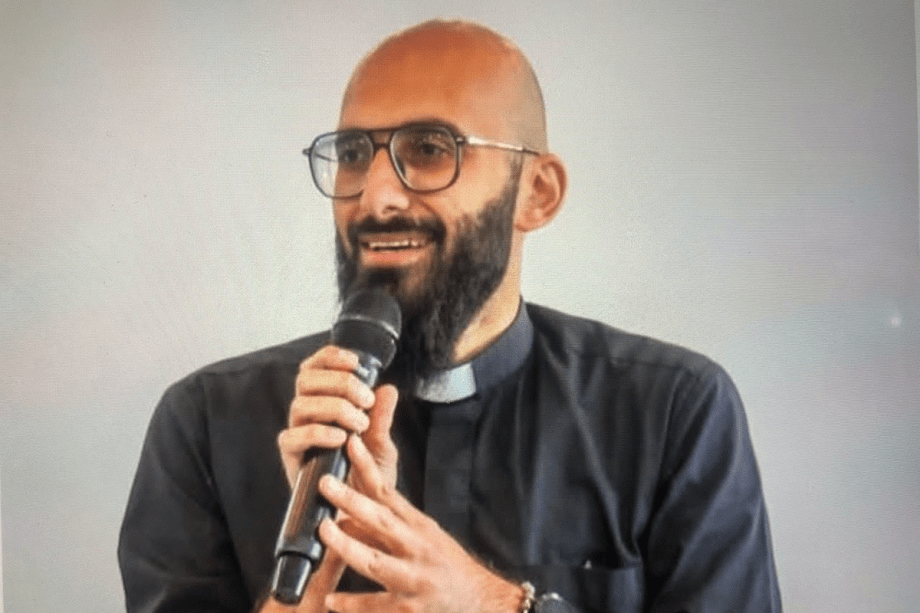
According to sources close to the situation, Fr. Louis Salman was interrogated by Israeli officials in late April, and soon after informed by Church leaders that he would need to leave the country for his safety. Salman was then notified officially that his visa would not be renewed, and that he should leave the country before Monday, May 11.
No official reason was given for the decision.
Hundreds gathered at his parish in Beit Sahour, near Bethlehem, for a farewell Mass on Sunday before the priest left for his native Jordan.
Salman is known for being a very committed and energetic pastor, local Catholics told The Pillar.
As chaplain of the Youth of Jesus’ Homeland ministry he organized frequent events, including yearly summer camps, and led dozens of young Palestinian Christians to Rome in 2025 for the Jubilee of Hope.
But he was also an outspoken critic of the actions of Israeli forces in the West Bank, and the challenges Palestinian Christians faced in their daily lives because of them.
The Latin Patriarchate of Jerusalem, which has jurisdiction over Latin Catholics in the Holy Land, has not made any official comment on the situation. A source in Jerusalem told The Pillar that the patriarchate is declining to make any public comments while it prepares for what it expects to be a drawn-out legal battle over the decision. The source said this is widely believed to be the first time Israel has involved itself in the patriarchate’s personnel decision in such a direct manner.
A person close to Salman confirmed to The Pillar that the priest had left Israel Monday “at the request of the patriarch, and for his own safety,” and that he had decided not speak publicly about the situation.
According to some reports by local press, Israel’s decision was driven by Fr. Salman’s role in organizing a prayer vigil for a Christian journalist working for Al-Jazeera who was killed during a May 2022 Israeli military operation.
Shireen Abu Akleh, who held U.S. and Palestinian citizenship, was shot in the head from a distance while she covered the operation in Jenin. Several investigations concluded that the shots had come from Israeli soldiers, but no charges have been filed in Akleh’s death.
The journalist’s funeral drew crowds and Israeli police intervened more than once during the procession, beating protesters and pulling Palestinian flags from mourners surrounding Akleh’s coffin. Israeli authorities said they were attempting to maintain public order in the face of rioters at the funeral procession.
The deadline given by the Israelis this month for Salman to leave the country coincided with the fourth anniversary of Abu Akleh’s death.
But a Christian source from the Holy Land with knowledge of the situation said that issue was not the main reason for the decision not to renew Fr. Salman’s visa.
“While that event drew significant attention, it is important to understand it was not the primary issue. The core of his problem lies in his vocal positions against daily acts by settlers in the West Bank, and the various measures implemented by the occupation authorities on the ground.”
The reference to settlers includes the activities around Taybeh, the last fully Christian town in the West Bank.
For several months, Jewish settlers have harassed the town’s residents, vandalizing buildings, destroying crops and even setting cars on fire, according to residents. To date, no settler has been arrested in connection to unrest in Taybeh.
“These actions directly impact the presence of Christians in the Holy Land, testing their resolve to withstand overwhelming socioeconomic pressures. This constant strain is stretching the local Church’s resources to their absolute limit,” the source said.
“We cannot ignore the reality that is right in front of us. These issues are visible to all who look, and they form the true context of our current situation, yet the authorities wanted him to close his mouth and act as if nothing is happening.”
Salman’s removal from the Holy Land comes at a time when tension between Israel and Christians are high.
Recent incidents include the reported assault of a Catholic nun in the Old City of Jerusalem; repeated cases of spitting on Christian religious or in the doorways of churches; at least two acts of desecration of Christian images by Israeli soldiers in southern Lebanon and the decision by Israeli police to block Patriarch Pierbattista Pizzaballa from celebrating Mass in the Holy Sepulchre on Palm Sunday.
The backlash against the Palm Sunday events, which drew widespread international criticism, led Israeli prime-minister Benjamin Netanyahu to appoint a Special Envoy to the Christian World, on April 23.
George Deek, an Orthodox Christian Israeli Arab who was the first Christian ambassador of Israel, has weighed in on several of the recent incidents. In an interview with Italian Agenzia Nova, he pointed out that the spitting and violence in Jerusalem “offend not only Christians, but also the principles of dignity and mutual respect for which Israel stands.”
Regarding the desecrations in Lebanon, he told the same outlet that “what matters is how a nation responds. In both cases, the Israeli leadership clearly condemned the acts and took action.” Four soldiers were convicted and sentenced to a few weeks incarceration, as well as facing other disciplinary measures.
But in other high-profile cases no charges have been filed, including the shooting by sniper fire of a mother and a daughter in the Catholic compound in Gaza in 2023, and the shelling of the same Catholic church in July 2025, which Israel attributed to a “technical error.” Three people died in that attack, which took place three days after Cardinal Pizzaballa made a widely publicized visit to Taybeh, to show solidarity with the Christian community there and denounce settler violence.
Despite George Deek’s diplomatic overtures, local Christians charge that the situation has grown significantly worse under Benjamin Netanyahu’s current government and the appointment of Itamar Ben-Gvir as minister of national security.
After the Hamas attack against Israel on October 7, 2023, Ben-Gvir pushed to accelerate weapons permits and to distribute weapons in Israel and in Israeli settlements in the occupied West Bank. Critics argued this empowered extremist groups and would contribute to increases of violence in the region.
Fr. Nikodemus Schnabel is the German Benedictine abbot of the Dormition Monastery in Jerusalem, which also runs a residence in Tabgha that was attacked in 2015 by extremist settlers who set fire to part of the building.
In an interview with AsiaNews, he explained that “the lawyer who defended the arsonists at the time was Itamar Ben-Gvir. This man, who hates Christians – who really hates Christianity – is now in charge of my security, and this is really horrible.”

