Italian bishops cancel Masonic funerals
The interventions are the latest in a series of moves by bishops around the world to reinforce the Church’s centuries-old opposition to Freemasonry.
Two Italian bishops have intervened in the last week to cancel funerals for senior Freemasons scheduled to be held in Catholic churches. The interventions are the latest in a series of moves by bishops around the world to reinforce the Church’s centuries-old opposition to Freemasonry and its canonical discipline on Catholics who join Masonic lodges.
Both the Diocese of Rome and the Diocese of Ventimiglia-San Remo intervened in unconnected cases, after Italian Masonic authorities announced the memberships of two recently deceased men scheduled to be given Catholic funerals in local churches.
The Church has forbidden Catholics from joining Masonic lodges or affiliated groups and organizations since 1738. The interventions by the two Italian dioceses are the latest moves by Church authorities to reiterate and enforce the Church’s disciplinary norms on Masonic membership by Catholics.
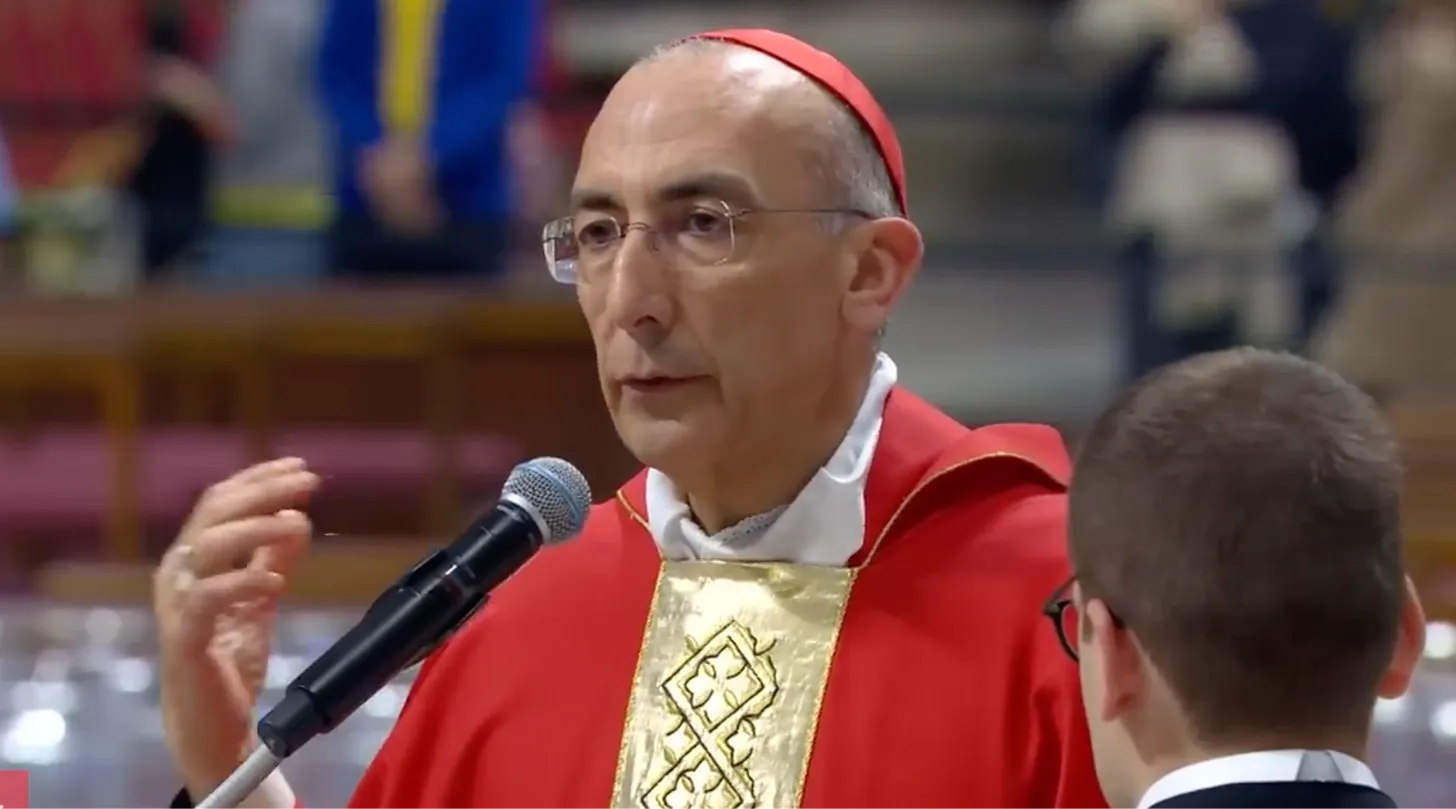
Cardinal Baldassarre Reina, papal vicar for the pope’s own Diocese of Rome, intervened on August 7 to halt a funeral planned for later that day at Santa Maria in Montesanto in the Piazza del Popolo.
The funeral was scheduled for Bruno Battisti d’Amario, a well-known musician most famous for his collaborations with the Italian filmmaker Ennio Morricone — Santa Maria in Montesanto has customarily served as the “artists’ church” in Rome. D’Amario died August 5 at the age of 88 and the rector of the church had no initial indication that there would be any difficulty with the funeral when it was scheduled.
However, the Grand Orient of Italy — the national Masonic body which dates back to the immediate post-War years when American invading forces resurrected Italian Masonic institutions — issued a press release immediately following d’Amario’s death. The statement not only made public his Masonic affiliation but also listed a number of senior positions he had held over the course of his life, including President of the District College of the Venerable Masters of Lazio.
A similar situation unfolded just days later in the Diocese of Ventimiglia-San Remo, when the diocese announced on August 8 that Bishop Antonio Suetta had intervened to cancel a funeral scheduled for that day in a local church in Camporosso. Suetta intervened in the plans for the funeral of Mario Tarducci after having learned “only after the funeral arrangements had already been made, through both a local news outlet and public death notices of Mr. Tarducci’s affiliation with a Masonic lodge, of which he had served as Worshipful Master.”
“In light of a similar case that arose concurrently in the Diocese of Rome—and aligning with the directives issued there by the Vicar of His Holiness, Cardinal Reina—the Bishop, pursuant to Canon 1184, has decided that the ecclesiastical funeral scheduled for today at the parish church of San Marco in Camporosso shall not take place,” the diocesan statement said.
Canon 1184 of the Code of Canon Law provides that “notorious apostates, heretics, and schismatics” are to be deprived of an ecclesiastical funeral, as well as “other manifest sinners who cannot be granted ecclesiastical funerals without public scandal of the faithful.”
It is not clear, from the statements of either diocese, whether Masonic membership was deemed to come under the heading of apostasy or heresy — the full and partial repudiation of the faith, respectively — or if the two men were being denied a funeral as “manifest sinners” who would have caused public scandal had they been granted a church funeral.
From the 1700s until the promulgation of the first universal Code of Canon Law in 1917, eight popes issued encyclicals or papal bulls denouncing Freemasonry and imposing a penalty of automatic excommunication reserved to the Holy See for any Catholic who joined. The canon of the 1917 Code of Canon Law on those to be denied Christian funeral rights specifically included Freemasons alongside heretics, apostates, and schismatics.
The 1983 Code of Canon removed specific mention of Freemasonry, which was treated by name in more than a dozen canons in the 1917 code. While this was widely misinterpreted by some as a liberalization of the Church’s attitude towards Freemasonry, successive decrees from the Holy See, including the Dicastery for the Doctrine of the Faith, have made it clear that the Church continues to enforce an absolute bar on Catholic membership of the Freemasons.
Since the promulgation of the 1983 code, the Vatican, together with several bishops’ conferences around the world, have reiterated the canonical penalties and prohibitions which remain in force for Catholics who join Masonic lodges.
The Nordic bishops’ letter listed four “pastoral and sacramental provisions” for Catholics who need to sever a Masonic affiliation — including the ban on their receiving Communion and the other sacraments until they do so.
In 2023, a doctrinal note signed by Pope Francis and DDF prefect Cardinal Victor Manuel Fernandez called for “a coordinated strategy among the individual bishops” of the Philippines to address “very significant” Masonic membership and sympathy in the country.
The DDF note also identified “a large number of sympathizers and associates who are personally convinced that there is no opposition between membership in the Catholic Church and in Masonic lodges.”
That note was issued as a correction to a public statement on the same issue earlier that year from the Philippine bishops’ conference doctrinal commission, which expressed “openness to the situation of individual Catholics (on a case-to-case basis)” who had joined Masonic lodges, while reiterating the Church’s canonical and theological opposition to Masonic association as a whole.
The Vatican response offered no accommodation or openness to Catholics who have joined Masonic lodges, even on a case-by-case basis, and instead reminded the bishops that “those [Catholics] who are formally and knowingly enrolled in Masonic lodges and have embraced Masonic principles fall under the provisions in the [1983 CDF] Declaration.”
That declaration, signed by then-Cardinal Joseph Ratzinger, was issued shortly before the 1983 Code of Canon Law came into force and stated that “the faithful who enroll in Masonic associations are in a state of grave sin and may not receive Holy Communion.”
—
Masonic lodges began as trade guilds of stoneworkers in Medieval England and Scotland.
Despite historical fictions pretending to find links to ancient Egypt and the construction of Solomon’s Temple, the modern iteration of Freemasonry as a club for alchemists, pseudo-philosophers, political dissidents, and religious non-conformists began in a London pub in 1717.
Shortly thereafter, Masonic lodges spread throughout Europe. In the beginning, Catholics could join as members, too — Francis I of Austria was a patron — since the Church had as yet made no pronouncements about it, one way or another.
That changed in 1738, when Pope Clement XII banned Freemasonry as promoting religious indifferentism — the idea that it didn’t matter what you believed about God, as long as you were a good Mason, because everyone in the lodge was serving a higher notion of natural virtue.
From Clement until the promulgation of the first universal Code of Canon Law in 1917, eight popes issued encyclicals or papal bulls denouncing Freemasonry and imposing a penalty of automatic excommunication reserved to the Holy See for any Catholic who joined.
When the Church’s leaders first spoke about Masonry as “plotting against the faith,” they meant that the Masonic worldview was subverting the teaching of the Church for Catholics who joined, and teaching them that it was equally valid to be a Catholic, a Protestant, some other religion entirely, or nothing at all — and that it was becoming a Mason, not being baptized, which would lead to a person’s spiritual and moral fulfillment.
In 1821, Pius VII’s apostolic constitution Ecclesiam a Iesu Christo repeated the papal ban on Masonic societies, including those attempting to violently overthrow the papal states. But, the pope taught that the true threat came from the Masonic philosophy of religious indifferentism, and promotion of what would today be called “secularism.”
In one of several encyclicals condemning Freemasonry, Leo XIII explained the secularist agenda of Masonry which, he said, included “the State, which [Masonry believes] ought to be absolutely atheistic, having the inalienable right and duty to form the heart and the spirit of its citizens,” as well as the treatment of marriage as a merely civil contract which could be dissolved at will.
Freemasonry often says of itself that it isn’t a religion, that it’s just a society of men who value fellowship, cooperation, natural virtue, “that religion in which all men agree,” according to Leo. However, the pope explained, there are a lot of Masonic rituals which the Church considers to be religious in tone, even quasi-sacramental.
The first ritual of initiation in Freemasonry, to become an “entered apprentice,” involves the applicant stripping down and removing any articles he may be wearing, like a wedding ring or crucifix. Then he’s told to get half dressed, wearing a shirt on his right side, one trouser leg rolled up, one slipper and blindfold.
Then a noose is placed around his neck and he’s led into the lodge hall where he’s announced as “Mr. X, who has long been in darkness and now seeks to be brought to light.” The candidate is then told to embrace the “principle of Freemasonry that the natural eye cannot perceive of the mysteries of the Order until the heart has embraced the deep spiritual and mystic meanings of those sublime mysteries.”
For his part, the aspiring apprentice also affirms that he is in search of “the light” which only Masonry can give him. The rest of the ritual involves moments where the candidate is made to process through the hall blindfolded (sometimes at swordpoint), kneel, be prayed over, and eventually be admitted to the lodge.
Higher degrees of Masonic initiation involve explicitly anti-Catholic rituals. In the thirtieth degree of the Scottish Rite (which is actually American), the Mason is presented with a skull wearing a papal tiara and told it “represents the tiara of the cruel and cowardly pontiff” and “is therefore the crown of an imposter.”
At one point in the ritual, a senior Mason stabs the skull with a dagger, while the candidate yells “Down with imposter, down with crime,” before stamping on it.

