
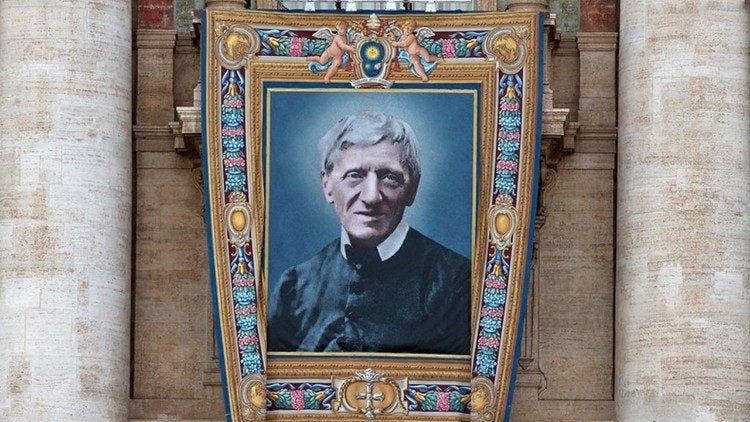
There is a tradition of naming a doctor with a title, something like Thomas Aquinas’ doctor angelicus, it comes from a scholastic habit of summarizing the work of a theologian with the word that best expresses their particular contribution to the life of the Church.
Since the news broke that Newman will be declared a Doctor of the Church, there’s been speculation on what his title might be. Any list of possibilities is sure to include the title doctor conscientiae (doctor of conscience).
In The Pillar the Archbishop of Birmingham, Bernard Longley, suggested doctor amicabilis (doctor of friendship), mentioning an address I gave at the WeBelieve festival in Birmingham earlier this year on Newman and friendship. Now that Newman has been formally declared a doctor of the church, I am pleased to share this address here.
One of the things that is striking about Newman’s work, is how prescient so much of his thinking was for the time in which we live now. By “prescient,” I mean “farsighted” – a gift for grappling with particular issues before they have been recognized by the world at large. One example of Newman’s prescience is his witness to the importance of friendship for the life of faith.
Newman reminds us that friendship often proves decisive in a great many ways for living in faith.
Friendship is nearly always involved in people being brought to the Catholic faith.
Friendship is nearly always involved in the deepening and renewal of Catholic faith among individual believers.
Friendship is often, moreover, a source of support for believers who are weathering the challenges and tribulations experienced in faith.
For Newman, good friendship is ultimately one of the fruits of the Catholic faith. It serves for him as a sort of compendium of the gifts of the Spirit listed by St Paul. What characterizes meaningful friendships? “love, joy, peace, patience, kindness, goodness, trustfulness, gentleness” and so on.
And what are the rocks on which friendships flounder? Well, those other things St Paul lists as opposites to the fruits of the Spirit – “feuds and wrangling, jealousy, bad temper and quarrels;…factions, envy” and so on.
The importance of friendship to faith is easily neglected today. If you were to ask many of today’s Catholics which relationships are most central to their life of faith, I think they’d understandably refer to those relationships most commonly spoken of in Catholic life. These include relationships with an institution or an office or offices – most obviously the hierarchy, and for priests and religious perhaps the home diocese, the order, the religious house and its superior, etc.
For the laity, I can imagine many would answer that the central relationship of their life of faith is with their spouse, as well as with their offspring, and indeed with their own mother and father.
Friendship is interesting for Newman because it has a marked character of freedom. That is, we don’t have a set of clear and well-recognized teachings provided for us by Scripture and Tradition outlining exactly what our responsibilities as friends are. Upon entering the Church, by contrast, we make formal promises, or our parents and godparents make them for us.
If you find yourself at variance from your local bishop or priest, there are ample resources out there to tell you what is required of both parties according to the dictates of the Church. Similarly, marriage is a formal covenant, parenting the baptized likewise, and should you not get on with your parents, scripture leaves us in no doubt about the responsibility still owed to them in all but the most extreme circumstances.
Not so with friendship. There are no formal pledges, no vows, no stipulations in canon law, and no court of appeal should things go wrong.