
Joy, fidelity, humility – Peoria’s bishop on Fulton Sheen’s message to America
“His relatability, his humor, the way in which he just entered people’s lives was such a great joy for him…”
When Bishop Louis Tylka was appointed to lead the Diocese of Peoria, he didn’t know much about Archbishop Fulton Sheen.
Born in 1970, he was too young to remember Sheen’s iconic television shows, which went off the air in the late 1960s. But leading the home diocese of “America’s bishop,” Tylka quickly got to know Sheen— and the great devotion of many Americans to the late archbishop.
Now that the Vatican has announced Sheen’s beatification, Tylka will be leading the process of planning the beatification Mass and surrounding celebrations.
Tylka spoke with The Pillar about what that planning process entails, as well his own experience of getting to know the man beyond the camera, and what he believes Sheen has to say to Catholics today.
This interview has been edited for length and clarity.
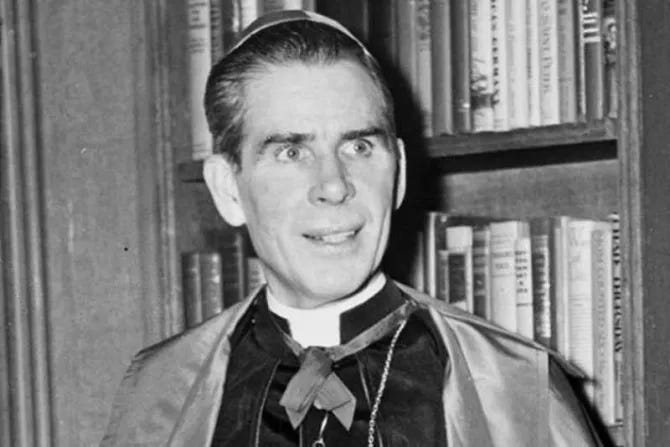
Your Excellency, like me, you are not old enough to have watched Fulton Sheen on TV, or to have much living memory of him.
I’m curious about your own devotion to Fulton Sheen, and how that’s grown over the years.
What is your personal path, Bishop Tylka, with Venerable Fulton Sheen?
I encountered Fulton Sheen, but really more as a curiosity, in my years in the seminary. I would not say that I had a devotion to him or even that I knew a ton about him as a seminarian or as a young priest.
Obviously, I was surprised to be named a bishop here in the Diocese of Peoria. And on the first day, when the announcement was made, I started to get asked questions — questions about when I was going to make Fulton Sheen a saint — and I realized I was going to have to, in a sense, get much more up to speed.
I knew he was a prolific writer; I knew that he had the TV show; I’d seen a couple of the episodes, but now I was going to have to really begin to learn much more about him and his life, and to also understand the whole cause for his canonization.
When I had to answer that question on the first day of being announced as the bishop, I said: “Making him a saint is above my pay grade. I believe that he is a saint, and we just have to catch up to him. But what I can do is always push the cause forward as well as try to promote his legacy.”
I’ve come to learn so much in my own reading of him and the things he wrote, by certainly watching more of the episodes from his program, and in hearing the stories of how he’s impacted so many people’s lives.
Anywhere I go in the world, when I say I’m the Bishop of Peoria, it leads to a conversation about Fulton Sheen. And to hear so many wonderful stories from people of how he impacted their lives has been a great blessing to me.
The first time I celebrated Mass in front of his tomb was December 9, 2020, and I said then that I was discovering a new friend. Now, almost six years later, I’d say I feel I have a pretty good friendship with someone who’s really quite an inspiring figure to look up to.
Many of us have a sense of Fulton Sheen as a media figure. But far fewer people know Fulton Sheen the man, or Fulton Sheen the priest.
What have you learned about the man beyond the camera?
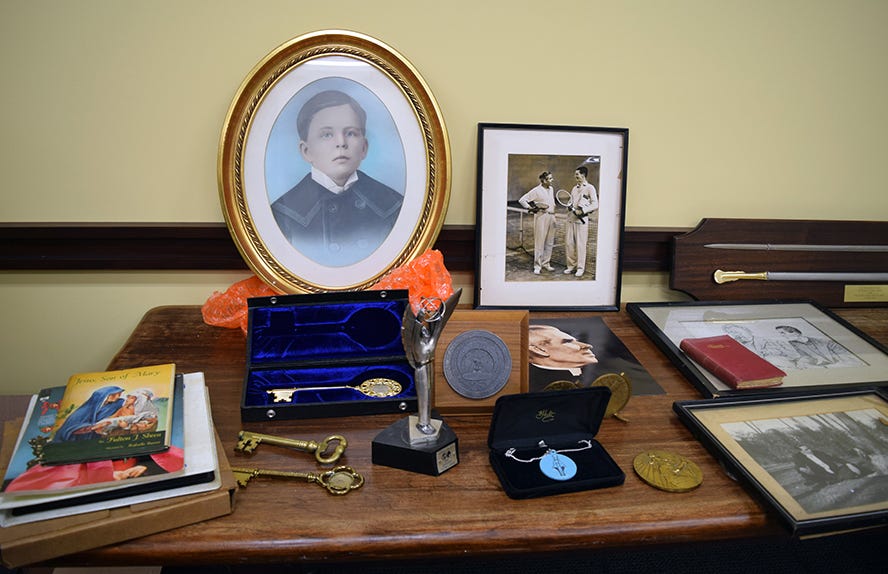
First off, his humanity and his humor. I was very blessed, shortly after coming to the diocese and beginning to work on the cause, to connect with his niece, Joan Cunningham, who had not been back to Peoria since 2019 when his body was moved to the cathedral here. And so we invited her to come and to just tell stories.
She brought us some treasures to donate, and I remember sitting there kind of going through these boxes and there was a picture of Bishop [Sheen] with his dog and her remembering: “Oh, he loved dogs, and I think the dog’s name was Chumley.”
That was kind of hysterical. Where did he come up with that name?
Joan actually wrote a little book: “My Uncle Fulton Sheen,” that just shared more of those experiences.
[There was] also getting to know Dolores Sheen — she married into the family and was of Polish descent. Fulton always used to tease her about being the “Polish influence” in the family.
So just getting to know those personal things. No matter where I go, people always seem to have a story to tell. Most of them just obviously encountered him through his writings or the TV or radio, but those who have known him personally, just share of his warmth, his humor, that he was an ordinary guy that people related to, and he certainly related to people in such a powerful and unique way.
How does Bishop Sheen inform your own ministry as a diocesan bishop?
I have taken many things from him.
I did holy hours before I became a bishop, but as a bishop, they’ve become much more meaningful.
I would say that the sense of just being yourself. When I look at the life of Fulton Sheen, I think sometimes: “Wow, how could I ever be like him? How could I ever do what he did?”
But he offers that I don’t have to — I have to be the best version of myself; I have to be the best disciple of Jesus [as] myself.
I can learn things from Sheen. I can certainly be inspired by him, but if I’m going to be successful and fruitful in my ministry as a bishop, I shouldn’t spend my time trying to be somebody other than myself.
And so I look to Sheen — and I think he had many strengths, which of course is what we tend to look at. But we also see that he had challenges and difficulties, his own personal struggles that he had to deal with over the years.
Being authentically who we are, and genuinely trying to live as disciples of Jesus and share our faith in the Lord — for me as a bishop, for anybody who is a follower of Jesus, that’s what we’re called to do.
What were those crosses Sheen carried? What were his own struggles?
Well, obviously he had some struggles when he was first ordained a priest. He was assigned to be a parish priest, and yet there was this awareness of his ability, with his intellect, to do so many more things, and so there’s some humbling in accepting that first assignment — and of course, [Sheen’s] bishop said he wanted to teach him humility.
I think as he went on, there were sometimes difficulties in dealing with other leaders in the Church.
Right. He had long-standing struggles with Cardinal Spellman in New York, right?
Yeah, there were some challenges there in that relationship.
And even when [Sheen] went to Rochester, he had hopes and dreams of doing some things and the people just didn’t really want to follow him. So not everything he did was, in terms of this world, successful, which I think is the case with all of us.
We all have dreams that we want to accomplish, but not every one of them is going to come to fruition.
One of the cliches about Sheen is that he was a masterful communicator but a somewhat hapless administrator.
Is that a fair accounting, or is there more to the story?
Well, I imagine there’s certainly more to the story. As I said, all of us have gifts and talents and charisms. Some do better at some things, and others do wonders with other things.
So I think there’s no doubt about his charism as a speaker, as a presenter, as a teacher. But if you look at his time in administration, like I said, there were some struggles.
I was just reading recently that he had a dream of building some housing and a hospital up in Rochester and just couldn’t seem to get traction behind any of that — despite his best effort.
So we’re grateful because he was a great orator and a great presenter of the faith, an apologist. And if he was, as you say, haphazard in administration, the best thing is to know what your strengths are and what your weaknesses are, and find people to help you in your weaknesses.
Bishop Sheen is such a big figure in American Catholic history, and now it will be you, as Peoria’s bishop, to be the diocesan bishop at the center of this big, historic beatification.
That’s got to be humbling, and a little bit daunting too, I suspect.
Yes, that’s a very fair characterization.
I didn’t ever dream of being a bishop at all, especially as I spent 24 years as a parish priest before being named a bishop, and I saw the challenges that bishops face. It’s not a position I think anybody would be envious of having.
And so the fact that I was called to any of this ministry by the Church, and by the Lord, and given this opportunity, that’s a humbling thing in itself.
I think about that question when I was made bishop: “When will I make him a saint?” And that’s not for me to do, not at all. That’s for the Church to do. And I’m very humbled by the fact that I’m here at the time this is going to move forward.
What can we expect from the beatification? I have to imagine the number of pilgrims who want to be a part of this will be record-setting.
Well, I would say that as we have begun negotiations with the Holy See on finding the date for the beatification, we are also considering multiple places where the beatification might take place.
My goal is to maximize the availability for people to participate in the beatification.
And I think that happens in many different ways.
One way, of course, is preparing for that, not just in the practical sense of planning the beatification Mass, but also inviting people to learn more about his life and to invite people to come to a deeper appreciation of his heroic witness of faith to us.
Obviously, with the media available to us, we could do things in a lot of different ways: You could do the beatification Mass in the bishop’s private chapel, and with a camera there, the whole world could see.
The point is that we have not settled on a location. We have not settled on a date because we’re looking for how we can best maximize people’s participation and invite them to be present, whether physically or in other ways in which we’re able to share it with the world.
Will there be other Sheen events at the time of the beatification Mass?
My hope is that people are going to take the opportunity not only to celebrate the beatification Mass, but to come and visit the tomb, and to really make a pilgrimage of it.
There are a number of sites here in Peoria that are connected to his life. People can visit the tomb, visit St. Mary’s Parish in El Paso [Illinois] where he was baptized, they can come to our museum, we are looking to develop the “Sheen experience,” as I call it — we want to make that much bigger and a much more immersive experience into his life.
The hope is that people will join us from a number of events surrounding the beatification Mass to celebrate his life.
Peoria is a small rural diocese of limited means. When the diocese learns it will host a beatification Mass, how do you afford it? I mean, this is going to be expensive.
Yeah, it’s a big expense. We will be reaching out for donations, and we are looking for sponsorship in various different ways. It’s only going to happen because of the generosity of the people of God who contribute to this.
And so we’re going to do our best to be able to plan a fitting celebration, but we’ll also be limited based upon whether we can also raise the funds to cover all the expenses.
So we can dream of lots of different things that we could do with and around the beatification, but some of them might have to be scaled back based upon whether we can come up with the donations.
But even as a parish priest, I have always been surprised and blessed how generous the people of God are. So I’m sure those who have a devotion and have been supporters of the cause are going to help, come forward so that we’ll be able to do a good celebration in honor of him as we move through this stage.
It has been a long road to Sheen’s beatification — a legal fight between Peoria and the Archdiocese of New York over the archbishop’s burial place, and then the 2019 scheduled beatification that was delayed. All of that led to real tension among bishops.
Does there remain tension among bishops about some of that history?
Well, I was just a parish priest when a lot of those things were going on, so I can only speak from my experience — and my experiences is that from the time I became Bishop of Peoria, I have experienced nothing but support and encouragement from my brother bishops to continue to push forward and to move the cause forward.
My first encounter with Cardinal Dolan was at a bishops’ meeting, and I went and introduced myself to him as the new bishop of Peoria. I said “I hope we can work together to move the cause of Fulton Sheen forward,” and his response was: “Nobody wants to see him canonized more than me.”
So I don’t sense any bad feelings or residual feelings, and I look to God’s providence, that this is the moment we’re going to move forward: The beatification of the man who was once dubbed “America’s Bishop” in the midst of the 250th anniversary of our country and the 150th anniversary of our diocese.
So I mean, in God’s time, all of these things come to fruition. I just look forward to continuing to work with my brother bishops, since we publicly announced that we’re given the green light to move forward, I’ve gotten nothing but support.
Part of what allowed for the beatification Mass to be scheduled now is the resolution of bankruptcy proceedings in the Diocese of Rochester.
Do you have a sense of what other factors have led the Holy See to approve the beatification now?
Well, first and foremost, I think that the environment in 2019 in the state of New York, with the attorney general and the lookback period, was not conducive [to the beatification].
Time has gone by, and we’ve been able to review all the records and once again they’ve shown that Archbishop Sheen was providing good leadership and service. I think the resolution of some of those issues opened the door.
And again, being able to speak to a number of bishops over the last six years, I have been hearing always that there’s… there’s not been opposition to the cause, it’s only been concern about the timing, and now there is a vote of confidence from [all] the bishops to move forward.
I’ve been thinking about Sheen and technology lately.
The archbishop jumped straight into newly available technologies to convey the Gospel. Today, Pope Leo is encouraging Catholics to be prudent and discerning about the use of AI and related technologies.
Are there guiding principles we can draw from Sheen about the discernment over using new technologies?
What we take for granted was something new: Radio had been around for a bit, but TV was a whole new endeavor. But when you listen to what he had to say, that was drawing you [to something] more than just what you saw on the screen.
What he said was drawing you beyond the screen, into a human relationship, encouraging people to celebrate the sacraments, to go to Mass, to go pray in front of the blessed sacrament for a holy hour.
So, I think as we struggle with the new technologies of today, which are wonderful opportunities but they’re also significant challenges, what we have to never lose sight of with things like AI, is that we can use them and we should use them, but we have to do so with caution.
We don’t want them to ever replace the need for human relationships that come not from speaking across a screen, but from actually physically being present to one another.
And so I think the biggest lesson to take away from Sheen was that a part of his ministry was indeed using new technology, but that was not the whole of his ministry or the point of it.
In fact, he spent more time going around preaching retreats in person, going around, giving talks, reflecting, doing the reflections on the seven last Words of Christ, and Good Friday for how many years in a row. He spent more time visiting the missions and being present to people in a direct way in their lives than he ever did on TV or on the radio.
So we always have to keep that human dimension in the forefront of our minds and not allow the technologies to take over.
Sheen lived in a very different time from us, and yet he remains immensely popular now. What is Sheen saying to Catholics now?
Well, I think there’s several things to take from his witness. One is a deeply personal relationship with Jesus.
He began his priesthood making a commitment to a daily holy hour. And for 60 plus years, he remained fervent in that desire to spend the time with the Lord. That shines through everything he did, everything he wrote, everything he said. All of that came because he had a deep personal relationship with the Lord. I think what we can take away from that is our own need to spend time with the Lord, especially given the opportunity to pray with the blessed sacrament.
The next thing I would say is that Sheen was authentic in his witness. What we can draw from that is, I think, a sense of our being authentic to who we are, and speaking clearly with charity and conviction about our faith and sharing our faith with each other.
Sheen could talk to high political leaders and movie stars, and he would talk to the guy on the street all the same way. He had a deep respect for humanity, an understanding that it didn’t make a difference to him who you were, so to speak, you’re a child of God and a brother and sister. Relating to one another with that sense of respect for human dignity in each other is something that we should take away, especially in a polarized culture that we live in today.
The other thing I would hope we take away from Sheen’s example is the great joy and happiness that he shared in doing the work of the Lord. His relatability, his humor, the way in which he just entered people’s lives was such a great joy for him, and it brought a great joy to others.
“Right. He had long-standing struggles with Cardinal Spellman in New York, right?
Yeah, there were some challenges there in that relationship.”
After reading John Cooney’s biography of Spellman, and Times Publishing’s forcing Cooney to water down contentions about Spellman’s “natural law adherence”, I was grateful to read this.
https://www.cia.gov/readingroom/docs/CIA-RDP90-00552R000606360002-0.pdf
Glad to hear that it sounds like the beatification will be in Peoria!