July’s other illicit episcopal consecration
Who are the Transalpine Redemptorists, exactly?
This month is likely to see in the Church not one but two sets episcopal consecrations without a papal mandate, though taking place under very different circumstances.
The first, publicized worldwide, took place July 1 at Écône, Switzerland, when the traditionalist Society of St. Pius X illicitly consecrated four new bishops, despite an explicit prohibition by the Holy See.
The second, less likely to resonate in the global media, is scheduled for July 25 on the remote, wind-blown Scottish island of Papa Stronsay.
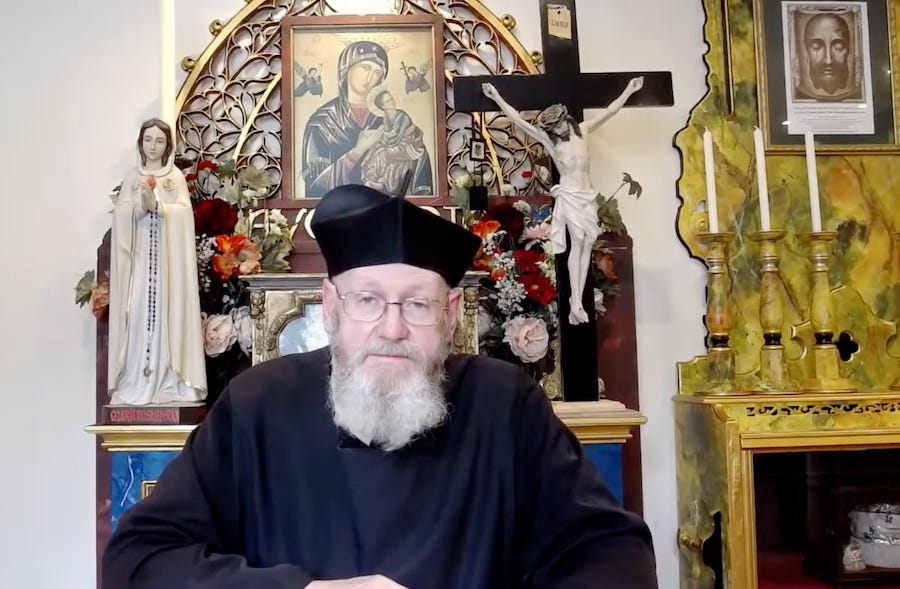
On that day, the Canadian sedevacantist Bishop Pierre Roy will consecrate the New Zealander Fr. Michael Mary illicitly as a bishop.
Fr. Michael Mary, 72, is the superior general and founder of the Congregation of the Sons of the Most Holy Redeemer (Transalpine Redemptorists), which has been based on Papa Stronsay since 1999.
The community — not to be confused with the Redemptorist order — grew out of the SSPX but was reconciled to Rome for 18 years, before it gravitated toward an even more schismatic sedevacantist position.
Who are the Transalpine Redemptorists? Why are they planning an illicit episcopal consecration? And what is likely to happen next?
Who are the Transalpine Redemptorists?
In 1987, Pope St. John Paul II appointed the Canadian Cardinal Édouard Gagnon as apostolic visitor of the SSPX, after the group’s founder, Archbishop Marcel Lefebvre, announced plans to illicitly consecrate bishops.
In November 1987, Gagnon, president of the then-Pontifical Council for the Family, began a month-long tour of SSPX institutions, gathering information to help Rome assess whether a canonical solution could be found to avert the planned consecrations.
According to the Transalpine Redemptorists’ website, Gagnon encouraged the foundation of a new congregation combining a devotion to the Traditional Latin Mass with the spirituality of St. Alphonsus Liguori, the founder of the Congregation of the Most Holy Redeemer (Redemptorists).
With Lefebvre’s blessing, Fr. Michael Mary, then a young Redemptorist priest, together with an SSPX seminarian, and several other aspirants to religious life formed on Aug. 2, 1988, a community that became known as the Congregation of the Sons of the Most Holy Redeemer (Transalpine Redemptorists).
The first monastery was established on the Isle of Sheppey in Kent, England. The community moved to the Scottish Orkney island of Papa Stronsay in 1999, drawn by its history as an ancient monastic settlement. The group established another foundation in Christchurch, New Zealand, in 2007.
After Pope Benedict XVI expanded access to the Traditional Latin Mass, the Transalpine Redemptorists were reconciled with the Holy See in 2008.
In 2012, Bishop Hugh Gilbert of Aberdeen, the diocese that oversees the Orkney Isles, erected the community as a clerical religious institute of diocesan right.
Bishop Barry Jones of Christchurch formally invited the group to establish a canonical house in the diocese in 2014.
The community also established a foundation in the Diocese of Great Falls-Billings, Montana, under its then-Bishop Michael Warfel.
But relations between the Transalpine Redemptorists and Church authorities began to unravel publicly in 2024, when current Christchurch Bishop Michael Gielen announced that the group would no longer be allowed to minister in the diocese and were required to leave its territory.
Gielen said he took the step following a Vatican-ordered inquiry into the community and recommendations issued by the Holy See, though he did not offer a full public accounting of the reasons for the measures or details of the inquiry.
The Transalpine Redemptorists later claimed they were victims of “flagrant injustice and persecution.”
In October 2025, the group issued an open letter declaring that it repudiated several major documents issued under Pope Francis, including the 2016 apostolic exhortation Amoris laetitia, the 2021 motu proprio limiting the Traditional Latin Mass Traditionis custodes, and the 2023 declaration on blessings Fiducia supplicans.
“We repudiate the Synodal Church as distinct from the Divinely constituted Catholic Church,” said the letter, which had 27 signatories, offering an indication of the community’s size.
Bishop Gilbert responded by saying that the text was “incompatible with the Catholic sense of the Church’s unity.”
“The competent dicasteries of the Holy See are also studying the situation and will provide canonical and doctrinal guidance,” he wrote.
In April 2026, a 24-year-old member of the community went missing. In May, police confirmed that his body had been recovered from the water near Papa Stronsay and there were no suspicious circumstances surrounding his death. He was buried May 13 in the community’s cemetery on the island.
Local media reported May 20 that three members of the community had left the island without their superior’s permission. The Press and Journal said the trio allegedly used a monastery laptop without permission to contact Bishop Gilbert and arranged a late-night boat departure from the island without informing other members of the community. The newspaper said the three members had since cut off all communication with the Transalpine Redemptorists.
On May 26, the community issued a declaration describing post-conciliar popes as “papal pretenders.”
The text expressed regret at the 2008 reconciliation, saying the Transalpine Redemptorists had still found themselves “forced by faith to resist the Conciliar authorities, although in a different manner.”
“We cling to the Magisterium of the Catholic Popes before Vatican II, after the example of the Saints and our Fathers reigning now in glory,” the declaration concluded.
Why an episcopal consecration?
On June 18, the Transalpine Redemptorists published an announcement by sedevacantist Bishop Roy that he would serve as the principal consecrator of Fr. Michael Mary at an episcopal ordination ceremony on July 25.
Roy explained that he had been in contact with the community since June 2025, establishing “a true communion of faith” with the Transalpine Redemptorists. But he could not serve as the community’s bishop because it would require constant inter-continental travel, in addition to his other commitments. He said it therefore “seemed reasonable and necessary to give the [Transalpine] Redemptorists a bishop who could properly care for a flock that already knew the sound of his fatherly voice.”
He congratulated the community on surviving “the nauseating stench of the conciliar hydra” and embracing a position that asserted “the current vacancy of the Apostolic See.”
“Last year I received their Profession of Faith, which I wished to recite with them, and we have since collaborated until their recent declaration, in which they put an end to all ambiguity by affirming before the entire Church their Faith and their rejection of modern errors along with their perpetrators,” Roy wrote.
Roy acknowledged that Fr. Michael Mary would be consecrated without a papal mandate, arguing that this was because “the See of Rome is clearly occupied by the enemies of God.”
After his consecration, which will take place in the privacy of the community’s Golgotha Monastery, Fr. Michael Mary will live primarily in his native New Zealand. Roy expressed gratitude that “Oceania and its 50 million souls” would finally “be able to count on the presence of a Catholic bishop.”
On the same day as the announcement, Bishop Gilbert issued a statement underlining the stakes.
“This ordination would be celebrated without a papal mandate, by a group of bishops who deny that Our Holy Father Pope Leo XIV is actually the pope,” he noted.
“Since this consecration is due to take place within the geographical boundaries of the Diocese of Aberdeen, I am obliged to make clear to the faithful of the diocese that any such episcopal ordination would be unlawful and a grave act of disobedience, separating those taking part from communion with the Catholic Church.”
Gilbert urged Catholics to pray that those involved would have a change of heart.
What will happen next?
Bishop Gilbert’s appeal appears to have had limited impact. On July 8, Fr. Michael Mary issued a declaration justifying his upcoming episcopal consecration without papal mandate.
In it, he evoked the Catholic world of his childhood in the early 1960s and justified his new path with the argument that Vatican Council II had established “a new religion” incompatible with the pre-conciliar Catholic faith.
He concluded by expressing his belief that God had called him, “in this late stage of my life,” to offer guidance as a bishop to “youths without a teacher” and “priests without a leader.”
The planned consecration appears to be causing some confusion in the wider Catholic world because of the word “Redemptorists” in the community’s name.
On July 7, the Congregation of the Most Holy Redeemer — the Redemptorists, founded by St. Alphonsus in 1732 — released a statement clarifying that the Congregation of the Sons of the Most Holy Redeemer (Transalpine Redemptorists) is “a distinct juridical reality and does not belong to the Congregation founded by St. Alphonsus.”
“It is also necessary to clarify that the Redemptorists present in Scotland who belong to the Congregation of the Most Holy Redeemer are not schismatics,” the statement said.
Unless there is a dramatic last-minute reversal, Bishop Roy will consecrate Fr. Michael Mary on the last Saturday of this month. The Church authorities will recognize participants as being outside of the Catholic communion. And the Transalpine Redemptorists will slip back into what one writer described this week as “the fissiparous demi-monde of schismatic Catholic sects.”

> “It is also necessary to clarify that the Redemptorists present in Scotland who belong to the Congregation of the Most Holy Redeemer are not schismatics,”
Reminds me of the US Senate candidate who put out an ad in which she stated, "I am not a witch."