Keeping the heat on - Finances in the Diocese of Fairbanks
“Roughly 85% of all of our funding comes from outside the diocese.”
It takes a lot of money to run a parish or diocese.
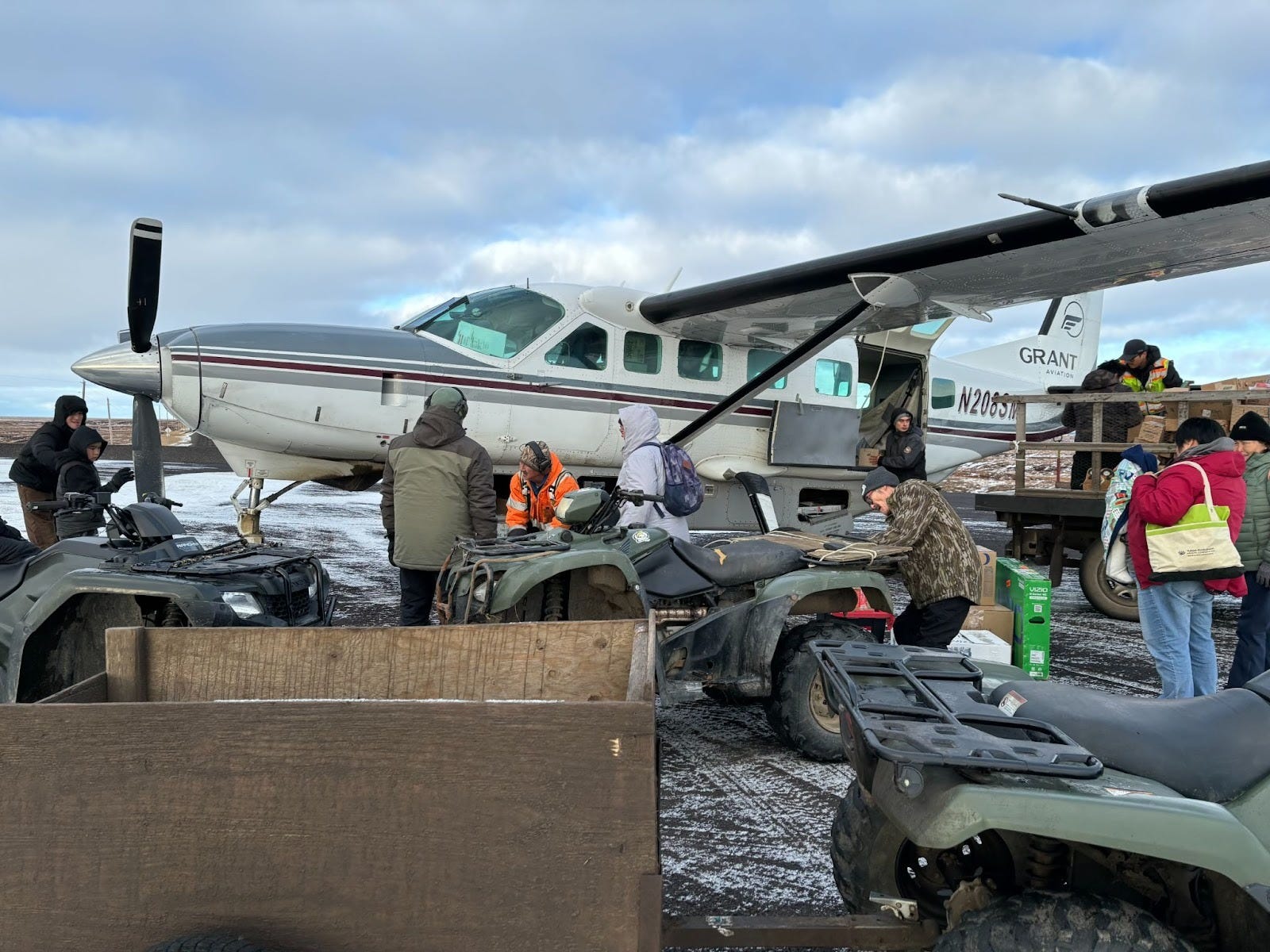
Personnel, property, and insurance costs quickly add up, no matter where you live. But few dioceses have a budget line for snowmobiles and bush plane flights, or operating costs for remote parishes that cannot be accessed by road.
The Diocese of Fairbanks has that.
Spanning the northern 409,849 square miles of Alaska, The Diocese of Fairbanks is by far the largest diocese in the country. It has 46 parishes — only nine of which can be driven to — served by 24 priests.
There are about 10,000 Catholics across the diocese, half living in Fairbanks, the other half living in rural and remote villages dotting the Alaskan wilderness.
To reach some villages, it takes a full day of travel with an itinerary looking like flights from Fairbanks to Anchorage onto Bethel via Alaska Airlines, then a bush plane flight to a remote village — an expensive journey.
Only three priests are incardinated in the diocese. The others are mostly from foreign countries, whose presence requires legal and other fees for the immigration process which makes it possible for them to be there.
And then there is the cold.
For eight months of the year, the temperatures plummet well below freezing, causing heating costs to soar.
Yet, only 15% of operating revenue comes from within the diocese as the Diocese of Fairbanks is an international mission diocese — the last one in the country.
“Roughly 85% of all of our funding comes from outside the diocese.” So when we talk about our capacity to self-generate, we can only self-generate for 15% of our operating expenses,” Bishop Steven J. Maekawa, O.P. told The Pillar.
“And that doesn’t even go into the long-term endowment funds to help plan for the future when our buildings are going to develop.”
Another particular challenge is that only eight of its 46 parishes are financially self-sufficient, meaning the diocese must fund the rest. In most other dioceses, parishes support the diocese.
“All of the donations that come in primarily support the parish missions, [rather than] the chancery,” diocesan vicar general Father Robert Fath told The Pillar.
“This is completely different from what other dioceses do. Typically, your chancery office is supported by the local parishes through diocesan appeals — and our self-supporting parishes do help us a bit. But even those parishes that are self-supporting, several of them are essentially break-even parishes. They bring in just enough to keep the parish running.”
Most of the dependent parishes are in the remote villages — referred to as “the bush” — where 24% of Alaskan Natives live at or below the poverty line.
That means responsibility for keeping the lights on falls to the diocese, chancellor Carolyn Dukes told The Pillar.
“In the Diocese of Fairbanks, many of our rural parishes can’t support the parish financially. So the responsibility falls on the diocese to provide subsidies back to those parishes so that they can afford to heat the building so that it doesn’t freeze up and so that they can ensure the priest has a salary,” Dukes said.
The expenses
Living in Fairbanks is already expensive; the cost of living is 21% higher than the national average.
The villages are even more expensive. In the bush, a gallon of gas can go for $8 and higher, and in some places, a gallon of milk can reach almost $20, because of transportation costs.
High prices increase expenses for the diocese dramatically. Priests need to be fed, buildings repaired, snow machines purchased.
Alaska winters are harsh, inflicting damage to buildings at a heightened rate. Thus, there are always projects to be completed.
“The environment is harsh,” Maekawa said. ”It doesn’t take much to really beat up our buildings. Just one winter can do a lot of wear and tear on our buildings in Fairbanks and in the villages.”
Even getting the materials to a location is an expensive ordeal.
“Everything has to be barged into the villages or flown in, sometimes a third or 50% of the cost might be freight alone, just getting supplies and out there for maintenance on established infrastructure is expensive, labor is expensive. Building an entire new structure is even more pricey,” Maekawa said.
And because of the remoteness, shipping material for repairs and projects is an ordeal. Often even simple — renovations need to be planned 6 months to a year in advance.
Maekawa learned that lesson during his first staff meeting in the diocese.
“It was early July and they mentioned that a rural church needed new roof trusses. I thought, ‘Oh, great, it’s only July, we’ve got plenty of time to get it fixed before winter,’” Maekawa said.
“They looked at me and said ‘No, all the supply barges went out in the spring, and you order all that material during the wintertime to get it repositioned and put it on the supply barges that leave in May.’”
“Any big major movement of material, unless you choose to fly it in, which at this particular location would’ve been immensely expensive and difficult, has to be planned out in late winter.”
“The building sequence cycle for this year is planned and done. It’s being executed right now. All the work crews out there are also occupied. They’re all committed that everything’s been blocked out ahead of time. And I’m thinking to myself: ‘It’s early July and you’re telling me that we can’t start moving on this until next May?’ I was surprised.”
While it may be easier to send personnel to the villages, it is also expensive. Priests stationed in the bush make at least four trips back and forth every year, three for clergy days in Fairbanks, and one for the annual convocation in Fairbanks. Each of those trips costs about $1,200. And between those trips is travel between villages themselves.
“Travel is probably the single largest expense that we have. So to get from Fairbanks to a majority of our parishes, which are in western Alaska — along the Bering Sea coast — requires an Alaska Airlines flight from Fairbanks to Anchorage and then Anchorage typically to the hub village of Bethel. In Bethel, we would switch over to one of the small bush airlines to fly out to the villages,” Fath said.
“When you look at traveling to the lower 48, even to cross the country, it’s actually cheaper for me to fly there to do fundraising than it is for me to travel to the parishes in my own diocese.”
Once priests are in the bush, the travel expenses keep adding up.
“Traveling, getting personnel in and around the bush is very expensive. It’s very common for us to have one priest covering three different churches. He will be two weeks in one church, two weeks in the next church, two weeks in another church, and he’ll be rotating,” Maekawa said. “Whether it’s on bush planes, a boat and certainly in winter time you use a snowmobile which requires fuel.”
Then there is the problem of getting priests to the diocese. With only three priests incardinated, the diocese relies a great deal on foreign priests. But immigration visas are expensive.
“We spend several thousand dollars per priest to bring them over from another country on an R1 visa,” Fath said. “And every time that we start the process and pay the money, there’s no guarantee that they’ll get the visa.”
“We have had one or two priests over the years that have gone through the whole process, they get to the interview, and for whatever reason, they don’t get the visa approval — but we don’t get the money back.”
Even once they are approved for a visa, there are a number of other fees and costs.
“There’s the cost of flying them here. And then we treat them like we do our other priests. They receive a salary and they receive retirement. We want to make sure that their time here hasn’t had a negative impact on their future,” Dukes said.
“We want to make sure that we do what we can to take care of these priests when they’re here because it is such a generous thing to come here and spend five years as a missionary here.”
“Beyond that we have an immigration attorney that helps us with the petitions to make sure that we are filing everything correctly. So there’s expenses associated with that.”
It has become increasingly difficult in recent months to help priests secure visas for ministry in Alaska, due to immigration policy changes and an ever changing slate of executive orders related to immigration, the diocese said.
“A lot of the countries that our priests come from, Nigeria, Zimbabwe, Uganda, Cameroon, are places where the Trump administration has either threatened to or has put in place travel bans of some form. We’ve seen over the past year visa appointments that have been canceled. We have seen guys who have been able to go in for the appointment and then are told they can’t have the visa,” Dukes said. “Things have gotten a lot harder.”
“I hold everything very lightly until the priests have cleared customs at the border. I’m very hesitant to say,’ yes, we have a priest’ or ‘no, we don’t.’ It is all very tenuous until I know they’ve cleared customs these days,” Dukes added.
In recent months, Dukes says there has been increased scrutiny of applications and a more extensive process.
“The process takes longer,” Dukes said.”There are more questions being asked. That’s not necessarily a bad thing. But it just makes it more difficult to get priests to Alaska in a timely manner.”
When they do arrive, many new priests have never experienced the cold, harsh Alaska winter before, and they need to be outfitted for the weather.
“I take the new priests out and buy cold weather gear for them, and that can cost anywhere between $2,000 and $3,000 to clothe them with proper gear,” Fath said.
“We have to acculturate them and not just to American culture, but to Alaska Native culture. How do you travel in the bush? How do you interact with people? How do you run a parish without staff? Things like that. [And] that training also has some costs.”
The funding
Fundraising is a critical asp[ect to the diocese’s economic health. The diocese relies on donors and grants to fund the diocese from the lower 48 and across the world.
“We’re the last international mission in the United States, which means that you know, the majority of our resources to be able to run the diocese are coming from outside sources,” Fath said. “We are asking people in the lower 48 to support our mission financially, which we are really grateful for their help.”
Fath takes multiple trips to the lower 48 every year for mission appeals. He will meet with longtime donors, host mission appeals, asking individuals and groups to support the diocese.
Another main fundraising source is the diocese longstanding quarterly newsletter — the Alaskan Shepherd. Released four times a year, it highlights the stories of priests and laity serving in the remote missions, recently completed projects and upcoming goals for the diocese.
“We have a very, very healthy newsletter that has been published for decades. It goes back to the 1950s; it was first cultivated first by the Jesuits,” Maekawa said. “It became very, very grounded and very well done. That’s one of our primary outlets and then we have an online footprint for people who are curious about the diocese and we have long-term relationships with donors that get established over many years.”

Operating a diocese on an 85% subsidy is virtually unheard of in the U.S. And while it may not make sense on paper, Maekawa knows who to attribute the ongoing financial success to.
“People say, ‘you guys have run on an 85% subsidy for decades, how can anything exist?’” Maekawa said. “Well, it’s only by faith in God’s grace and the aliveness of the Holy Spirit and the faithful that we can sustain operations.”
Even with a plethora of regular donors, the economy is always a concern for Maekawa. A sudden economic downturn could have immediate and lasting fiscal impacts for the diocese.
“Although we might have a good year, we don’t know where the economy’s going to be a year or two from now,” Maekawa said. “If we go through a recession, we need to budget for a rainy day. We really need to be good stewards of the gifts given to us.”
Maekawa and the other priests said they are grateful for those donors, as they know without them, ministry in Alaska would become even more challenging, if not impossible.
“By the generosity of the faithful and their tremendous support not just those in the lower 48 but sometimes around the world,” Maekawa said. “We are very grateful for that.”


