Leo and the patriarchy
Is the pontiff planning a change in Kiev?
As the Ukrainian Catholic Church continues to form Catholics more than four years after the country was first invaded by Russia, there are signs that Pope Leo may be considering a long-awaited change of status for the second-largest Eastern Catholic Church in the world.
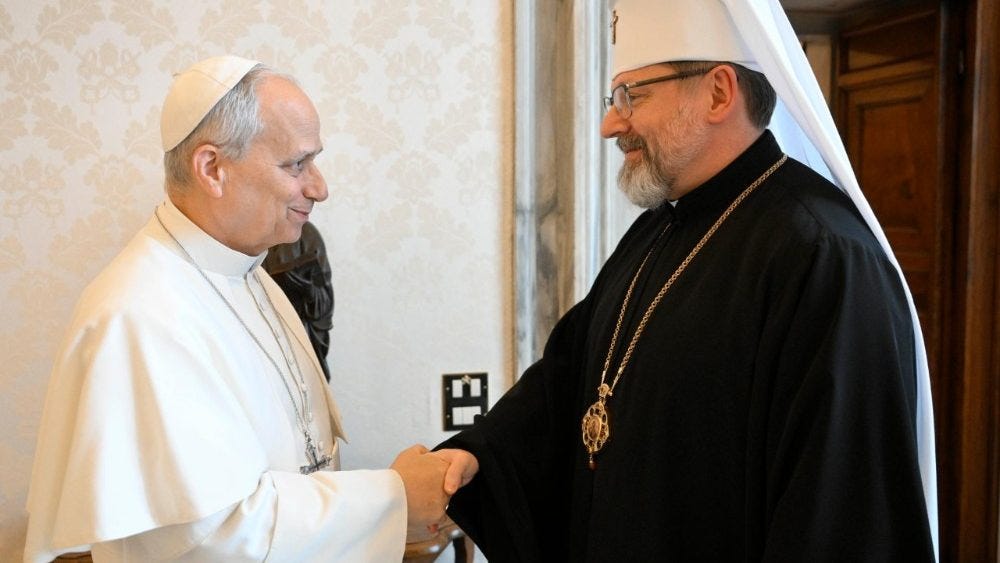
The change — if it were to happen — would see the leader of the Church elevated to the status of a patriarch, highlighting the historical and contemporary importance of the the 4.5 million member Church, and is now headed by a “major archbishop” rather than a patriarch.
—
Since his 2025 election, Leo has made some moves to emphasize his support for beleaguered Ukrainian Catholics enduring the hardship of long-standing warfare in their country. The most recent move was Leo’s dispatch of Cardinal Matteo Zuppi to Ukraine last week, to continue the peace mission Pope Francis entrusted to him in May 2023.
The war itself has claimed almost 500,000 lives, left millions displaced or homeless, and become Europe’s deadliest conflict since the peace of 1945. Peace seems a distant prospect, with negotiations now at a standstill and the war claiming lives every day. Which is why Leo sent Zuppi to continue calling for peace, urging leaders to find a path to that peace, and working toward a prisoner exchange and other small gains.
More to the point, the Vatican has said it is weighing the prospect of Leo himself visiting Ukraine, studying “the conditions necessary to determine the right time and the most appropriate way for such a visit to bear the greatest possible fruit for Ukraine and for peace in the world,” according to Archbishop Paul Gallagher, the second-ranking diplomatic official at the Secretariat of State.
If he does go, some Ukrainians have asked whether Leo might take the opportunity to make a move long-desired by the Ukrainian Catholic Church itself — to recognize Kiev’s Major Archbishop Sviatoslav Shevchuk as patriarch of the Ukrainian church.
The prospect of that recognition has reportedly been under some discussion in recent years at the Dicastery for Eastern Catholic Churches, according to sources close to the dicastery, especially after Archbishop Borys Gudziak, the Ukrainian Greek Catholic Archeparch of Philadelphia, presented in 2022 a report on the possibility of establishing new patriarchates among the 22 Eastern Catholic Churches.
But Ukrainian Catholics have been raising the prospect of that recognition for far longer.
The idea has been under discussion since shortly after the 1596 Union of Brest-Litovsk, which formally began Eastern Catholicism in the territory of Ukraine.
The notion was floated as the newly unified Ukrainian Catholic bishops engaged in ecumenical dialogue with those bishops who remained part of the Orthodox communion, many of whom were concerned that the Latin Catholic Church would not respect their history and customs.
Both Orthodox and Catholic bishops agreed then that recognizing a patriarchate in Kiev could be a source of unity in the Church, with the move conferring some certainty that the Vatican would not impose a kind of Latinization on the region’s Christian traditions.
The idea didn’t come to pass — though it came under discussion again in the 1800s, when it was seriously considered by Pope Leo XIV’s own namesake, Leo XIII.
And it almost happened at the time of the Second Vatican Council, too — largely at the urging of Ukrainian Archbishop Josyf Slipyj, who spent 18 years in Siberian labor camps.
Slipyj was freed by Soviet authorities in 1963, and went to Rome to attend the Second Vatican Council. There he urged that a Catholic patriarch be recognized in Ukraine. Many council fathers supported the idea, and Pope Paul VI was said to be open to it.
But it didn’t happen — and largely because of concerns that the idea would be offensive to the Orthodox Patriarch of Moscow, with whom the Church hoped to deepen ecumenical relations. Instead, the pontiff recognized Slipyj with the term “major archbishop” — a new phrase which seemed designed mostly to denote that he was patriarchish, without being a patriarch.
From there, the sense that a Catholic patriarch in Kiev would be an ecumenical disaster has become conventional Vatican wisdom.
And Vatican sources have told The Pillar that those same ecumenical concerns are what prevented Pope Francis from making the same move, even when some hoped it would happen in the early days of the war.
But things have changed in recent years, especially as immediate hopes for better ecumenical relationships with Patriarch Kirill in Moscow seem to be waning.
Further, Pope Leo, as a canonist, is acutely aware that “patriarch” is an ancient title of real significance, while “major archbishop” has always been a pragmatic concession to hopes for better friendship with the Russian Orthodox.
Practically speaking, there are few differences between an Eastern Catholic patriarch and a “major archbishop,” like Shevchuk. While the election of a major archbishop by an eastern church’s synod of bishops must be confirmed by the pope, and a patriarch does not need that confirmation, there are few other noticeable distinctions.
But the title “patriarch” is an ancient one, used since the early centuries of the Church. While the term is used more commonly today in Orthodoxy, not Catholicism, in Eastern Catholic Churches the term denotes respect and authority.
And it has long been desired by Ukrainian Catholics.
Indeed if Pope Leo is considering the prospect of making Shevchuk a patriarch, the most helpful signifier comes from the major archbishop himself.
The Ukrainian Catholic Church announced earlier this month that it had developed a codified set of legislation for its entire Church, designed to be used in concert with the universal Code of Canons for the Eastern Churches.
In remarks about it, Shevchuk said essentially that his Eastern Catholic Church had developed comprehensive and codified law because that’s what the hierarchs of big, well-functioning, serious bodies of believers do.
“This Code of Canons is a sign of our Church’s maturity,” Shevchuk said.
“A sign that our Church has taken another decisive step toward the development of patriarchal structures and the patriarchal dignity of our Church.”
It is not clear whether Shevchuk was offering some wishful thinking, or was telegraphing a move already known to him. In either case, he has said publicly that his Church has a patriarchal dignity will ought to be recognized. Whether Pope Leo will agree remains to be seen.

