
When the Vatican’s synod on synodality concluded in 2024 — if synods can ever really come to an end — among the remaining tasks to be taken up in Rome was a commission to suggest changes to the Code of Canon Law occasioned by the Church’s experience of universal synodality.
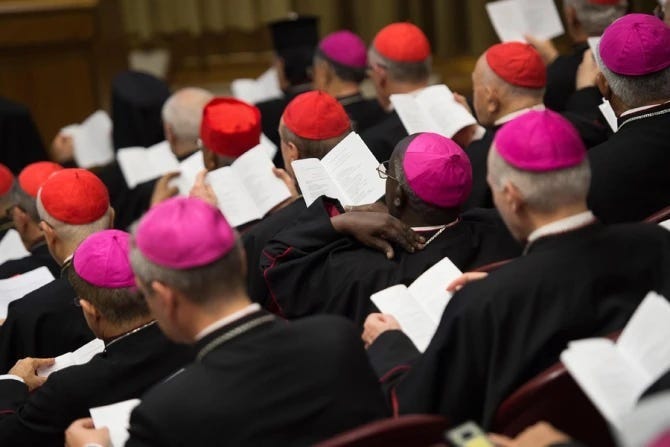
After years of quiet work on the subject, the commission released a final report this week, ripe with proposals intended to enshrine the commission’s understanding of synodality’s lessons into the Church’s positive law.
The concrete suggestions have been met with mixed reactions by canon lawyers, and some represent particularly controversial viewpoints in long-contested questions about the power of orders and the nature of ecclesial authority.
But the very existence of the report poses a challenge for Pope Leo — himself a canon lawyer. And how the pontiff responds to the suggestions will give a clear indication of whether the canonical momentum of the Francis era was a flash in the pan for the Church, or the start of a new chapter in the Church’s legal history.
—
The final report proposes a series of amendments to canon law which seem mostly intended to increase both the voice and presence of laity in the life of the Church. Some are small and technical — dropping a requirement, for example that a priest notarize certain official acts of the Church, rather than a layperson appointed by the diocesan bishop.
But others are decidedly more controversial.
The proposed amendments would allow, for example, a diocesan bishop to permit a single lay judge to serve in place of a collegiate tribunal in trial processes — the current law allows only for a cleric to serve as a sole judge, and only with the permission of the conference of bishops. Such a change would seem to obviate the distinction often made in canon law between those who possess by sacred orders the “power of governance” in the Church, and those who do not.
Further, the proposed amendments would seem to allow laity to serve functionally as episcopal vicars, under the title of episcopal delegates, overseeing a territory or group within a diocese, or exercising more-or-less vicarious episcopal authority (while avoiding that precise term) for some specific facet of governance.
Again, the change would seem to allow laity to exercise the power of governance historically understood as correlated to sacred orders. That idea has already been taken up in some parts of central Europe, but it’s been widely seen to stretch the boundaries of ecclesiastical possibility, and — until now — many canonists have expected it to be among the practices Leo would eventually begin reining in. The canonical commission report might call into question whether that expectation is wholly accurate — and would seem to put some pressure on the pope to nip the practice in the bud, if he intends to do so at all, before the momentum of the practice and the report make it all more widespread.
It is worth noting that the proposed amendments are not comprehensive. Canon law is a connected web of canons, all of which reference and depend upon one another, and place restrictions on the meaning of their precise terms. A change in one canon often requires changing two or three more just to make the intended change actually stick.
In other words, modifying canon law effectively is a painstaking process, which must be undertaken with rapt attention to detail by experts in the field. There is no evidence the synod’s canonical commission has done that work.
But the intended effect of their proposed changes is clear — that, as the synod’s final document explained, laypeople “be given greater opportunities for participation, also exploring new forms of service and ministry in response to the pastoral needs of our time in a spirit of collaboration and differentiated co-responsibility.”
Under the guidance of Cardinal Gianfranco Ghirlanda — a canonical star of the Francis era — those opportunities seem to involve a formal proposal for flattening the distinctions between clerics and laity when it comes to the daily work of governing the Church.
And, in fact, those proposals are only the first step in the commission’s set of recommendations. The group was clear that in the long term, “there is an obvious need for a complete revision of the two Codes to reflect the theological and ecclesiological issues that have emerged” through the synodality process.
That idea was first floated in a July 2025 L’Osservatore Romano essay by Luigi Guzzo, an Italian legal theorist — not a canon lawyer — who argued that the contemporary Code of Canon Law reflects a more hierarchical society than was the early Church, in which, according to his view, authority centered on charisms more than ecclesial or sacramental offices.
Leaving aside questions about the accuracy of that historical account, Guzzo’s argument, taken up by the commission on which he sits, will strike many theologians and canonists as confirmation of their biggest concerns about synodality — that it would deviate from the actual documents of Vatican Council II — whose theology is meant to be reflected in the 1983 Code of Canon Law — and reshape the council as the beginning of a theological evolution, rather than a concrete and deliberative act of ecclesiastical magisterium.
In short, the report issued Tuesday by the synod on synodality’s canonical commission would seem for the most part to represent some of the most controversial camps in the synodality movement, and to stand therefore in contrast to Pope Leo’s decidedly more irenic and tempered approach to synodality, which has tried to incorporate the broad notion of common consultative prayer and conversation into the Church’s life, without framing synodality as some kind of populist ecclesial revolution.
In some ways, it might do for the pontiff to simply give the report little heed, to acknowledge it with a promise to take it under consideration, and to let its ideas stew before taking up even the mildest suggestions. But one problem for the pope is that the coordinator of the commission is Archbishop Filippo Iannone, the pope’s own handpicked successor at the Dicastery for Bishops. Iannone’s name on such a controversial text is sure to raise questions about whether the pope’s chosen collaborators — and therefore the pontiff himself — would be supportive of the ideas contained within the commission’s recommendations. The other problem is, again, that some of the floated ideas are already being tried in Germany and other parts of Europe, and failing to respond to them with alacrity, especially in light of the report, might seem increasingly to represent tacit papal support.
By all available evidence, Pope Leo is trying to restore peace, normalcy, and a sense of stable governance to the life of the Church. Nothing about his papal comportment suggests that he likely desires to advance the agenda of the synodal canonical commission. But if the pope wished to ease synodality gradually toward a more stable position in the Church without much disagreement along the way, the audacity of the commission’s report would seem to make his job all the more challenging.
This is just more proof that if those who promote synodality get their way, everyone will have to choose between synodality and the teachings of Vatican II.