Leo: Sexuality not ‘only moral issue’
‘We should seek to build our unity on Jesus Christ’
Pope Leo XIV criticized on Thursday a German cardinal’s recently unveiled plans to move forward with same-sex blessings, while urging Catholics to broaden the scope of moral issues under discussion in the Church.
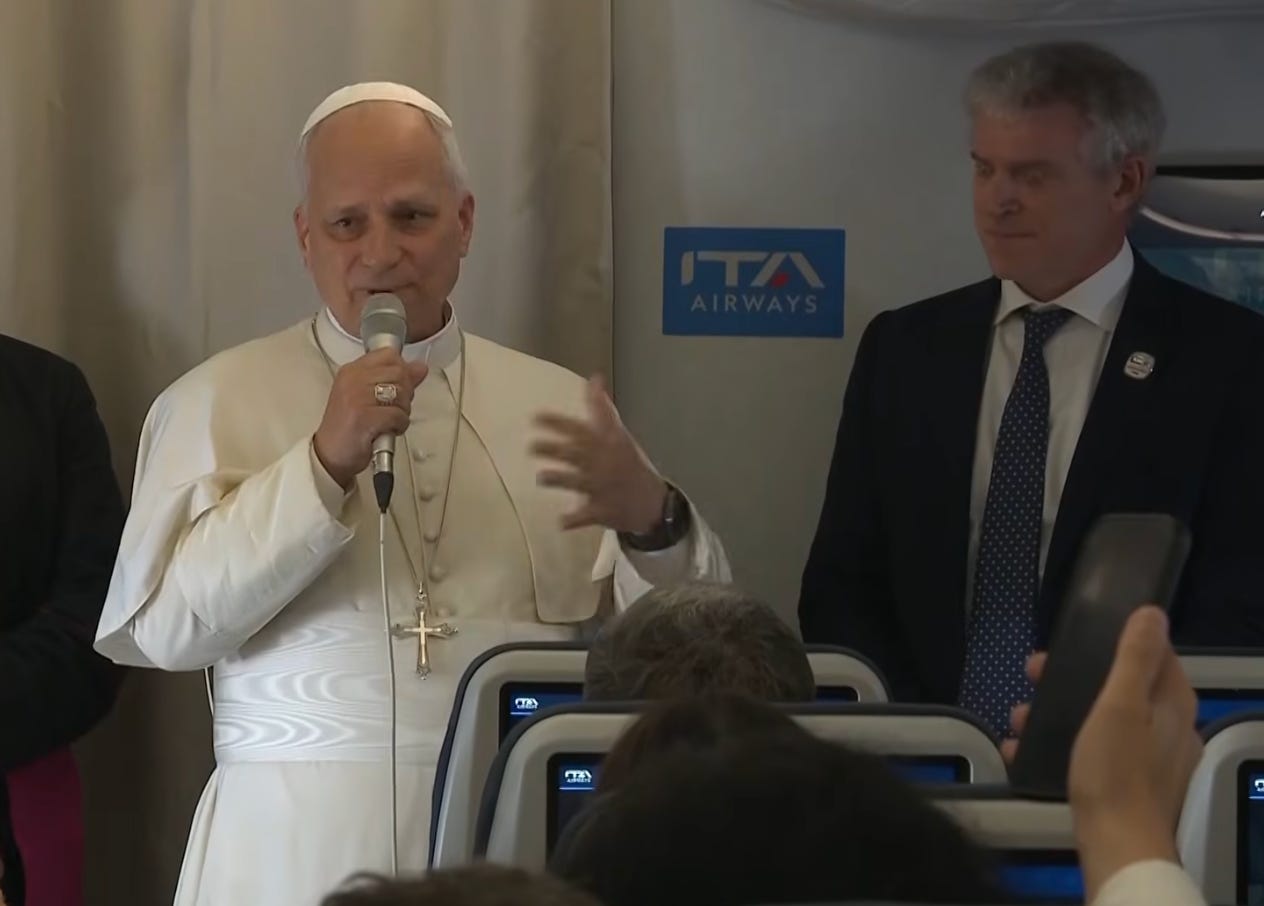
“The Holy See has made it clear that we do not agree with the formal blessing of couples, in this case, same-sex couples… or of couples in irregular situations, beyond what Pope Francis has specifically permitted by saying that all people should receive the blessing,” the pontiff said during an April 23 press conference aboard the papal plane returning from his 11-day trip to Africa.
Leo was responding to a question about plans announced by Cardinal Reinhard Marx, to formalize blessings for same-sex and other irregular couples in the Archdiocese of Munich and Freising, while requiring clerics unwilling to perform them to refer those requesting a blessing to another priest or pastoral worker.
While addressing the German issue, Leo also called Catholics to a wider focus of attention.
“I believe it is very important to understand that the unity or division of the Church should not revolve around sexual issues. We tend to think that when the Church speaks of morality, the only moral issue is a sexual one,” the pope said in response.
“In reality, I believe there are much larger and more important issues—such as justice, equality, the freedom of men and women, and religious freedom—that should take priority over that particular issue,” he added.
But on the acute issue, Leo explained that “the Holy See has made it clear that we do not agree with the formalized blessing of couples, in this case, homosexual couples, as you asked, or couples in irregular situations, beyond what was specifically, if you will, allowed for by Pope Francis in saying all people receive blessings.
“When a priest gives the blessing at the end of Mass, when the pope gives the blessing at the end of a great celebration like the one we had today, there are blessings for all people,” he said.
“Francis’s infamous, famous, well-known, expression, ‘tutti, tutti, tutti,’ expresses the Church’s conviction that everyone is welcomed, everyone is invited, everyone is invited to follow Jesus, and everyone is invited to seek conversion in their own lives,” he added.
The pope concluded his reply by saying that “to go beyond this today, I believe, could cause more disunity than unity, and that we should seek to build our unity on Jesus Christ and on what Jesus Christ teaches.”
German newspaper Die Tagepost reported April 20 that Cardinal Reinhard Marx of Munich had instructed priests and pastoral workers in the archdiocese to use a handout called “Blessing Gives Strength to Love” as the basis of pastoral care to LGBT people and people in irregular unions.
Priests who refuse to carry out blessings are obliged to refer couples to other priests or pastoral workers, according to the instruction.
The letter also says that in June several archdiocesan offices will begin to offer training about the specifics of the blessing “celebrations” for all priests and pastoral workers.
The handout was voted upon during the fifth session of the controversial German Synodal Way in March 2023 and was approved with 92% of the votes.
Several other dioceses have issued official recommendations on applying the handout and celebrating the blessings, while other dioceses such as Cologne, Passau, or Augsburg, have rejected it, using the Vatican’s 2023 declaration on the pastoral meaning of blessings, Fiducia supplicans, as a justification.
While highly controversial in itself, Fiducia supplicans states that blessings of should not be “ritually determined by the ecclesiastical authorities… so as not to cause confusion with the blessing of the sacrament of marriage.” and that blessings cannot be celebrated “in direct connection with a civil celebration.”
Pope Leo’s answer mostly re-stated what he already said on the subject in his first longform interview in September.
Back then, he said an Eastern cardinal once spoke with him about the West being “fixated, obsessed with sexuality.”
“A person’s identity, for some people, is all about sexual identity, and for many people in other parts of the world, that’s not a primary issue in terms of how we should deal with one another.”
“For now… I’m trying not to continue to polarize or promote polarization in the Church,” he said.
The pope highlighted his desire to welcome people into the Church without changing the Church’s doctrine on sexuality and marriage.
“Everyone’s invited in, but I don’t invite a person in because they are or are not of any specific identity. I invite a person in because they are a son or daughter of God,” he said.
“I think we have to change attitudes before we even think about changing what the Church says about any given question. I find it highly unlikely, certainly in the near future, that the Church’s doctrine in terms of what the Church teaches about sexuality, what the Church teaches about marriage, [will change].”
During the September interview, Leo criticized the German push to formalize same-sex blessings.
“In Northern Europe they are already publishing rituals of blessing ‘people who love one another’... which goes specifically against the document that Pope Francis approved, Fiducia supplicans, which basically says, we can bless all people, but it doesn’t look for a way of ritualizing some kind of blessing because that’s not what the Church teaches,” he said.
“I think that the Church’s teaching will continue as it is… The family is father, mother, and children. I think that the role of the family in society, which has at times suffered in recent decades, once again has to be recognized, strengthened,” he added.

