Leo’s consistory, Francis’ legacy
Leo has understood that defining his pontificate will mean defining that of his predecessor, too.
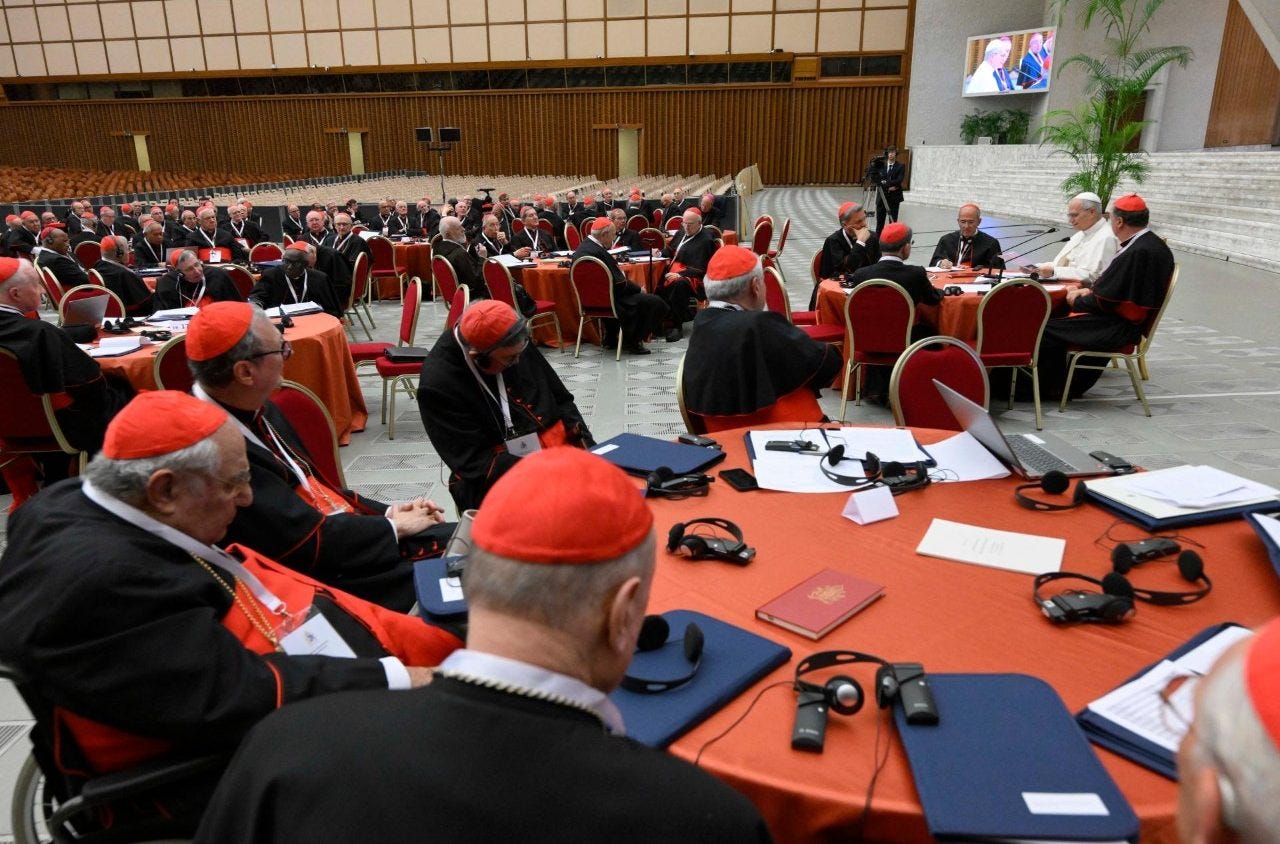
The world’s cardinals are gathered in Rome this week for the extraordinary consistory of the college, convened by Pope Leo XIV to mark the beginning of his first full year as Bishop of Rome.
Cardinals, bishops, and curial staffers across the Vatican have, in the months since the conclave which elected Leo, reported that the new pope consciously decided to close 2025 before embarking on any major tone-setting or shifting projects.
Many within the close curial orbit have reported that Pope Leo saw the Jubilee Year as a deeply significant moment in the life of the Church, in addition to being a kind of legacy period of Pope Francis, deserving of its own time of special focus, prior to a more dynamic beginning to the Leonine era.
Leo’s decision to open 2026 with an extraordinary consistory — a consultative practice largely eschewed by his predecessor — is itself a kind of self-evident turning of the pontifical page.
But, as the world continues to try to get the measure of Leo and where he will stand in relation to his predecessor, the pontiff seems to have chosen to open 2026 with a collective discussion among the cardinals on exactly that subject.
By all accounts, the consistory is set to have the cardinals discuss, first in small groups and closing with an open plenary session, key themes to assist Leo in his responsibilities leading the Church, including universal governance, the liturgy, and synodality.
Any of these three themes might be expected to generate lively, even heated, conversation among the cardinals — almost at any time. But, as Leo begins in earnest to chart his course as pontiff, those three issues combined would appear to summarize exactly the as-yet unsettled legacy of his predecessor.
It seems reasonable to ask if the pope has called the cardinals together as much to discuss how the Francis era of the Church will be concluded as how the Leonine era will begin. Indeed, those may prove two sides of the same coin.
—
Almost from the moment that Pope Leo emerged on the loggia over St. Peter’s Square, pundits and prelates have debated to what extent Leo XIV could be framed or understood as a kind of Francis II.
Leo, for his own part, has appeared eager to set himself as in line — if not in indistinguishable continuity — with Francis, issuing his first major document in the autumn, largely drawing on an unfinished Francis text, and eschewing any major curial shakeups.
At the same time, perhaps Leo’s biggest reforms have been subtle but emphatic changes of tone and style, bringing a renewed formality to papal dress and, while continuing to interact spontaneously with journalists, offering decidedly measured and carefully worded responses to hot-button issues.
The new pope has also made unity within the Church an early point of rhetorical emphasis, and pointedly received in private audience cardinals like Raymond Burke and Joseph Zen who had difficulty seeing the last pope, while also entertaining equally totemic figures of the Francis era like Fr. James Martin, SJ.
This hasn’t stopped constant expectations of some kind of “big break” to emerge, either through a major Vatican appointment or replacement, or some wholesale reversal of a key Francis policy — perhaps nowhere more so than on the liturgy.
Pope Francis’ motu proprio Traditionis custodes, restricting the celebration of the Extraordinary Form of the liturgy has continued to prove divisive in many dioceses, either through perceived overzealous and praeter legem enforcement in some places or denial by Rome of latitude for local bishops seeking to more generously accommodate traditionalist communities.
While anticipation and clamour has been constant for Leo to either double down on the motu proprio or repeal it entirely, the pope has so far opted for a more subtle and accommodational approach, instructing that dispensations and permissions be granted and renewed by the Diacastery for Divine Worship well beyond previously hard limitations.
At the same time, there has been renewed discussion of how the results of a consultation of world’s bishops on the liturgy were not incorporated — or even apparently much considered — in Traditionis custodes.
In short, Leo’s decision to put the liturgy on the agenda for the consistory seems deliberately intended to air the tensions and divisions over one of Francis’ signature and singularly divisive acts.
Perhaps in a nod to how far the mood has shifted already on the issue, the Vatican press office announced Wednesday that a majority of the working groups had opted to discuss the themes of mission and synodality — though this by no means precludes the issue from being raised later.
How Leo chooses finally to resolve the divisions and tensions around Francis’ liturgical legacy remains an open question. But having allowed the full College of Cardinals to meet and discuss the issue and feed back their individual and collective feelings in a more-or-less public forum is already more than the issue received under Francis and allows the pope a great degree of latitude to act on Traditionis in what can be framed as a collegial manner, as opposed to one pope reversing another as a matter of personality and preference.
And, with even some of the most progressive voices of the Francis era already openly predicting a much more “flexible” accommodation for the TLM in the future, it appears that Leo could oversee a kind of reversal for a signature Francis act while carrying the support of arch-Francis cardinals in doing so.
Evaluated simply and absent any other context, that kind of outcome would normally confound analysis, beyond a superficially cynical conclusion that cardinals’ views on even the most profound aspects of Church life can change completely with a new pope.
–
But within the context of Leo’s consistory, the way is clear for something more interesting to develop: a consensus-based assessment of a highly controversial issue followed by a significant papal action in line with those discussions. In its way, such an approach would appear to model a second theme of the consistory’s discussions, and another key part of Francis’ legacy: synodality.
Since Francis’ death, cardinals and bishops from around the world have repeatedly stressed the value of the synodal process which came to define the second half of the Francis pontificate. Prelates from all corners of the world, and from across the ecclesiological spectrum, have consistently hailed the utility and pastoral value of open, collaborative discussions at various levels of the Church.
But, however much “synodality” is likely to be remembered as a slogan of the Francis-era, the actual legacy of the synodal program remains difficult to pin down.
The sessions of the synod of bishops in Rome over the last 10 years have consistently courted controversy and division, with delegates repeatedly trying to focus attention on issues of settled Church doctrine or sacramental theology, while others complained of a gerrymandered process which excluded or minimized figures that dissented from the progressivist synodal leadership.
At the same time, those synodal discussions and divisions have yielded little in the way of resolution — with neither consensus positions making their way into synodal assembly texts nor eventual papal exhortations bringing matters to a close.
On the contrary, by the end of the synod on synodality, Pope Francis took to adopting the synodal assembly’s final documents to himself, effectively signing his own name to what appeared to many to be confused and contentious treatments of issues like female ordination without imposing himself on them.
Leo, on the other hand, appears to be using the consistory this week to model an alternative kind of synodality in the holding of the consistory this week, encouraging fraternal discussion of even disputed issues and themes, like synodality itself, but framed within the explicitly consultative function of the college of cardinals.
While many at times wondered — or even claimed out loud — that synodality meant a new kind of parliamentary approach to Church affairs, the consistory this week seems already to be modeling different kind of consultation, one which takes place more directly and visibly under the direct headship of the pope and is more tangibly universal through the participation of the entire college of cardinals.
It seems reasonable to expect that the college will offer a frank assessment of the synodal experience of the last few years. This, in turn, will likely afford Leo the opportunity to settle on a workable version for a “synodal Church” which can be credited to Francis’ vision, even if it ends up bearing little resemblance to the synodal experience of the Francis era.
—
Of course, the overarching theme of the consistory is meant to be the Holy Father’s governance of the universal Church, and in what direction and style Leo chooses to develop that governance will be the most important point of distinction, or not, between him and his predecessor.
Pope Francis, despite frequently antinomian rhetoric, proved to be one of the most prolific legislators in modern papal history, issuing a steady stream of new laws, revisions to whole sections of the Code of Canon Law, and revising completely apostolic constitutions for institutions like the Roman curia.
Those reforms, as has been seen in the ongoing confusion about how the Church defines and handles cases involving so-called “vulnerable adults,” have at times left canonists, bishops, and Vatican officials with no clear understanding of what is required of whom in legal processes.
Along the way, Francis acquired the reputation as a pope willing to dispense with norms, even his own, when he wanted to.
In cases like those of Fr. Marko Rupnik, Bishop Gustavo Zanchetta, Bishop Juan Barros, and the laicized priest Ariel Alberto Principi, the wheels of Church justice appeared to grind to a halt, or even jump off the rails entirely, when sufficient personal papal interest could be obtained.
Meanwhile, prelates like Bishop Daniel Fernández Torres and Bishop Joseph Strickland were summarily removed from their offices with no apparent legal process at all. In some instances, like the previous pope’s effective defenestration of the leadership of the Sovereign Military Order of Malta, Francis’ willingness to exercise power without process came close to triggering actual real-world diplomatic crises for the Church.
To the extent that Pope Francis left a legacy in universal Church governance, it would be hard to summarize or characterize without using words like “dramatic,” “arbitrary,” and “confused.” It is a legacy which seems sure to feature among cardinals’ conversations this week, and filter back up to Leo in some form — though the pope is himself no doubt aware of the same issues.
But, unlike with the liturgy or the concept of synodality, it is hard to see how Leo could craft a swift or comprehensive corrective to his predecessor’s legacy without some kind of in-terms negative assessment of it.
Instead, Leo, who is himself as a canonist and a former prefect of the Dicastery for Bishops more than casually aware of some the more famous cases of the Francis era, will likely hope the consistory itself is a kind of signal of how he aims to govern. Having brought back the general meeting of the College of Cardinals, long left unused by Francis, the new pope has already signaled a kind of return to institutional norms.
How much and how clearly Leo chooses to communicate to the cardinals this week his own ideas for a new normal in universal Church governance remains to be seen. But what is sure is that papal authority is — as Francis showed — as much defined by the doing as the talking. Re-establishing global confidence in the Church’s laws will take years, and largely be the fruit of cases being resolved clearly, and coherently.
What does seem clear already is that Leo has understood that in defining himself and his pontificate, he will necessarily be defining that of his predecessor, too.
It’s possible that in future years people will be more inclined to ask if Francis was authentically Leonine, rather than if Leo is some kind of Francis II.


I have a great many thoughts about Francis’ legacy - many of them rather negative. Like Pope Leo XIV, I wonder about how effective it is to be open about that, so I’m not usually.
But I think this article points out what has to be his worst quality, which is so glaring there’s no politeness able to be applied: the law, processes (even those he created), and the institutional realities of the Church’s governance meant very little to him. It’s not glamorous, but people need to understand that everyone in ecclesial authority, from your parish’s pastor to the Holy Father, eschew the principles of good governance at their own peril. It always backfires. It never works. It’s a huge reason why the Church at large is so ill-equipped to engage even with its own issues, let alone the issues of the modern world.
If Leo proves himself a good governor, even if we don’t agree with the acts of governance themselves, he will already be significantly more credible than Pope Francis ever was, and that will constitute a massive improvement.
I'm increasingly convinced that how you do something matters nearly as much as what you do, because how you do something, especially in a position of authority, communicates a lot about how you actually regard norms, laws, and your own power. Ironically, Pope Francis seemed to take a very absolutist approach to his office, freely dispensing with his own laws when it suited him, or arrogating power to himself and his curia that seemingly belonged to diocesan bishops or even pastors (eg, the infamous "no TLM times in the parish bulletin" directive from the DDW). This made it hard to take his reforming efforts and statements about synodality seriously, because his own actions seemed to undercut his words. In fairness to our late pontiff, I do think he was sincere in his statements and genuinely desired to make improvements through his actions as pope—but I also think he was prickly, emotionally driven, prone to favoritism, inconsistent, and very bad at speaking off-the-cuff.
My hope for Pope Leo is that he continues to operate in the manner he's shown so far: cautious, considered, genuinely consultative, and respectful of existing norms, laws, and structures. While this likely won't bring change to some hot-button issues as fast as many people would like, I think that this approach communicates an attitude of "the law exists, and the Pope follows it, and so should everyone else", which will ultimately bear more fruit for the Church in the long term. Stability is a very good thing, especially in an institution which, like Delta Tau Chi, has a long tradition of existence. (And which, unlike Delta Tau Chi, also has a commission from the Son of God Himself to evangelize all mankind for their salvation)