‘Let Jesus do the heavy lifting’ — Lessons of the National Eucharistic Revival report
How do you measure revival?
In 2021, the United States Conference of Catholic Bishops announced an ambitious goal — reignite Eucharistic devotion within the American Church through a National Eucharistic Revival.
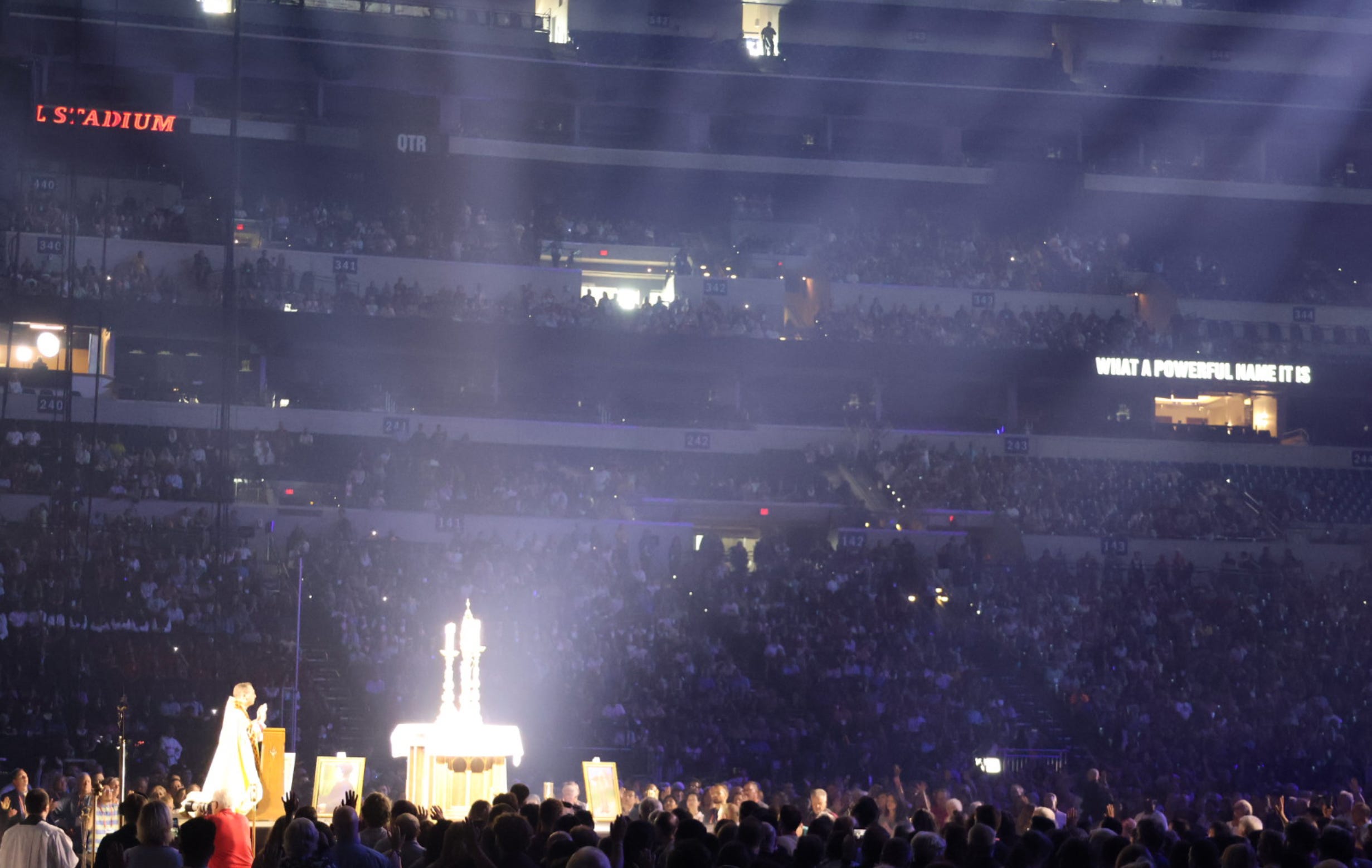
Over the next three years, the National Eucharistic Revival planned and organized resources, programs and events to spark revival at the parish, diocesan and national level.
It culminated with the four routes of a National Eucharistic Pilgrimage that crossed the country, convening in Indianapolis for the National Eucharistic Congress attended by more than 60,000 Catholics.
In the summer of 2024, Catholics across the U.S. were enthusiastic, showing up in droves to events along the pilgrimage routes and at local parish gatherings, and organizing trips to the Congress.
But was it successful? How does anyone even measure revival?
After the Congress wrapped and the next phase was announced, organizers aimed to measure success through an impact study.
With the Vinea Research Group, a Catholic research organization, they surveyed 2,472 people from diverse backgrounds about their experience with the Eucharist Revival.
Researchers separated the group into two categories — surveying in one group 414 priests, deacons and parish point people formally involved with the planning of revival events, and in another group, 2,058 lay Catholics not formally involved with organizing revival events.
The survey sought to cover four topics — 1. Enthusiasm & Promotion of the Revival 2. Personal Impact 3. Parish/Diocesan Impact 4. Challenges. The National Eucharistic Revival released results January 15th, in an 85-page report.
And after the report’s release last week, Cozzens spoke with The Pillar about the report, highlighting successes and areas for improvement.
The following interview has been edited for length and clarity.
Bishop, revival is an intangible thing. How do you measure it?
I think there is a very important caveat, which is that the survey world can help the Church and it can support the mission that we have, but it is never the complete story of the mission.
Even as we look at the data from this impact study, we have to remember that you can’t really measure revival — you can’t measure what the Holy Spirit’s doing.
For example, who [in the early Church] could have predicted the conversion of the Roman Empire? You can’t predict the work of the Holy Spirit, but you can learn from what people say. And in this way, [the survey] is a kind of an action of synodality, to listen to people.
We did the survey as a way of listening to what impact the Revival has had on those who have participated — to measure and see what we could learn about the impact that the Eucharistic Revival had on various groups in the church, in particular the clergy, bishops, priests, deacons, the laity, those who are active, those who are not so active, and then the general public.
We did that by hiring a very professional organization called Vinea, which has done these kinds of impact studies before for other groups. We gave them some areas to focus on and listened to their expertise as we invited them to meet, interview and survey people so that we could dig into what the impact might be, as much as it’s measurable.
When planning began in 2019 for the National Eucharistic Revival, how were you hoping to measure the success of the revival?
We set some metrics for ourselves that we wanted to see. We wanted to see a certain number of diocesan point persons appointed by bishops. We wanted to see a certain number of parish point persons appointed by priests. We wanted to see a certain number of diocesan Eucharistic Congresses and then parish events as well.
We blew those numbers out of the water from what we thought we would do. So that was encouraging. The big one for me was we had hoped for 5,000 parish point people, and I think we hit 9,000.
The percentage of parishes in the country that were involved was much higher than we expected, and much higher than we’ve ever seen in a USCCB initiative.
One of the things the Vinea study asked the laity and priests was whether your bishop engaged in the Eucharistic Revival. Ninety-two percent of people said yes, [the bishop was] strongly engaged.
That tells us that the bishops themselves got behind this, which helped make it a success.

Is there anything that surprises you in the research data?
Many aspects of the “good news” included in the survey were surprising to me, the bad news or the areas that we still have to work on were not as surprising.
One of the good news things that surprised me was that people who attended one of our national events, whether a pilgrimage or the Congress itself, said they were 50% more likely to do some kind of outreach in their faith life after attending those events.
That’s huge.
We’ve been trying to work on missionary conversion in the church in the United States for years. Of those who attended, many said they experienced a missionary conversion. Many said they were more ready now to share their faith, they were ready to live a Eucharistic life, and 60% said they have done more evangelization activities since the beginning of the revival.
The second thing that surprised me was the impact on priests.
Forty-nine percent of priests surveyed said they were encouraged by the Eucharistic Revival, something like It was just so consoling to me to think that we didn’t set out with this goal to encourage priests, but it did encourage priests and they did experience renewal in their own minis
Fifty percent of priests said that they increased their own Eucharistic devotion during the revival. They were more likely to practice their own Eucharistic devotion.
If we helped to strengthen the spiritual life of priests during this, that’s a huge thing to me. Even if it only affected a few, it seemed to affect priests in positive ways, both in their own personal spiritual life and in their ministry.
So that was very surprising to me as well.
What most edified you in the impact study?
I was just encouraged that it’s clear God did a lot in individual hearts through this movement. All of this work is worth it for one heart.
It’s nice to know that many were impacted; that is always encouraging for me to hear. It is one of the things I love most about being a priest and a bishop, you feel like you get a front row seat to see people encounter Christ. So, I felt privileged to have a front row seat to what God wanted to do through this Eucharistic Revival and Congress.
There has been a lot of data lately about the challenges to morale and mental health among priests.
Amid that data, are your results a sign of hope for the Church?
The thing is that we focused so centrally on Christ and the Eucharist and that made it a very powerful evangelization initiative. I think because we focused so much on that, it really helped draw people in. One of the bishops said to me, “It’s really nice to have a positive thing to focus on right now in the midst of everything else.”
We all have to focus on problems and crises because those things happen in our Church. We were coming out of COVID, we were coming out of the sexual abuse crisis. We don’t put those things behind us, but to have a positive thing to focus on I think was encouraging for priests and bishops.
The study noted that the most successful events from the revival were the Congress, pilgrimages and the extra adoration hours in parishes. Formal programs like small groups and speakers were not as effective.
To me, that suggests program fatigue among Catholics.
Does the American Church have program fatigue? How should the Congress and future revival efforts not just be another program in the American church?
I was seeing and thinking about that insight during the revival itself.
I think we are learning something about evangelization and it is something that I certainly sensed in prayer during the revival: That we have to let Jesus do the heavy lifting.
When I was a young priest, I was on a retreat with high school students from my parish. We were having adoration and confessions on Saturday night of the retreat and I had just finished hearing a bunch of confessions. All the young people were there kneeling before Jesus in the Blessed Sacrament.
And I felt like I heard the Lord say, “Just bring them to me and let me do the heavy lifting.”
That is an evangelistic reality that sometimes we don’t engage enough in the Church. We try to do the heavy lifting ourselves which we do have to do sometimes. We do have to learn apologetics and we have to learn how to do relational evangelization, and we have to do all that stuff.
But we can’t forget that Jesus is the Lord and if you bring people to him, He’s going to do the heavy lifting.
That was really the sense of the Eucharistic Revival — we tried for three years, in particular with the national events, to lift up Jesus and we saw him drawing people to himself.
The impact survey showed that people who attended local Eucharistic Revival events reported the same increase in engagement as those who attended national events.
Why invest in big events like a National Eucharistic Congress, if local events accomplish the same goals?
There’s two components to this answer. First, the national event makes it a national movement. It made sense during this revival that we were going someplace and we were coming from someplace together.

One of my friends told me his parish in St. Paul was a stopping point along the national pilgrimage. And he said, “I’ve been to adoration many times at my parish, but when I saw my priest bringing the monstrance into my church during the pilgrimage, I never felt more visited by Jesus — because I was part of something that was going across the whole country and it was right here in my parish and Jesus was coming to me. “
He said, “It was much more moving for me than I expected, and I think that’s because it was part of a national movement.”
I think that’s an important aspect, that it helped people participate in something bigger than their local parish or diocese.
Second, the stats show that we need to continue the local events. But the hope for the national events — the pilgrimage and the Eucharistic Congress — is that people come, have an encounter, and then hopefully go on mission to their local parish.
Those encounter events are really central to our devotional life. And I think this was an aspect of Pope Francis that a lot of people missed, which is how big he was on devotion and how important he thought devotions were.
Every time Pope Francis would travel, he would stop at Our Lady’s shrine in Rome and visit Our Lady and ask for her protection. That is why he was really supportive of our Eucharistic Congress when we had our private meeting with him. He just talked about the importance of these events and the life of people.
The report noted that the Congress did a really good job reaching out to already engaged Catholics, but came up short reaching out to those who are less engaged in their parish.
Why did this happen? Can that be addressed going forward?
It didn’t surprise me one bit that people who only go to Mass once a month decided not to come to the Eucharistic Congress or one of our pilgrimage events.
An obvious goal of the Church is to reach those people on the peripheries, but especially those people on the peripheries of the Church itself, when they have some connection.
But how do we reach them?
I think it’s the way that Jesus did it, which is you bring together a core of really committed people and you form them and then you send them out — and they are the ones who go to those people on the peripheries.
That was the goal of the Eucharistic Revival. It was to help those who are somewhat committed or who are even really committed, bring them to the Eucharistic heart of Jesus, let them get set on fire, and then send them out to reach those people who are far from the center.
That’s going to continue to be our goal, because we can’t make direct connections with everybody.

There’s talk in a lot of corners in the Church today about revival — pastors reporting OCIA numbers increasing, for example. While that isn’t borne out in the data yet, there is a growing sense of renewing interest in Christ in some parts of the U.S.
What role, if any, do you think the Eucharistic Revival played in a Catholic resurgence?
I’d love to give all the credit for that to the Eucharistic Revival, but I don’t think that would be accurate.
But I do think the revival is part of a movement of the Holy Spirit that God wanted, and that same movement is what’s bringing about conversions in our country right now and is really driving a shift.
I think we have seen a shift in momentum. Was that the result of our work with the Eucharistic Revival and the Congress? No, but I think it’s all connected in God and God is using these things. Now, there’s plenty of people who are telling me the opposite, that the Congress was the cause of this, but I think it’s good just to say what a gift it is to be part of this movement that is the Eucharistic revival.
I do hope it’s part of the greater movement of the Holy Spirit and the Church.
As you plan for the next National Eucharistic Congress in 2029 and more national pilgrimages for this summer and beyond, how will the results of this impact study shape your strategy?
Well, we’re going to be looking at this study in depth in our listening groups, especially as we’re discerning with the USCCB what the theme of the next Congress will be.
We are also going to continue to do what we know has worked based on the study, and that is to lift up the Lord and invite people to encounter him and then be sent on mission.
That method clearly has worked and we want to continue that and will allow the places of growth in the study to continue to be reflections for us as we try to allow this Eucharistic Congress movement to be part of the missionary conversion of our Church in the United States.


In the interest of letting Jesus do the heavy lifting, my metric for success would be whether there are more people going to Mass, adoration, or just visiting Jesus in the Tabernacle than there were before the Pilgrimage and Congress.