
Pope Leo appointed last weekend Archbishop Vittorio Viola OFM as the new archpriest of St. Peter’s Basilica, along with the other offices traditionally associated with the role, most notably vicar general of Vatican City and head of the Fabbrica, the body responsible for the physical maintenance of the basilica.
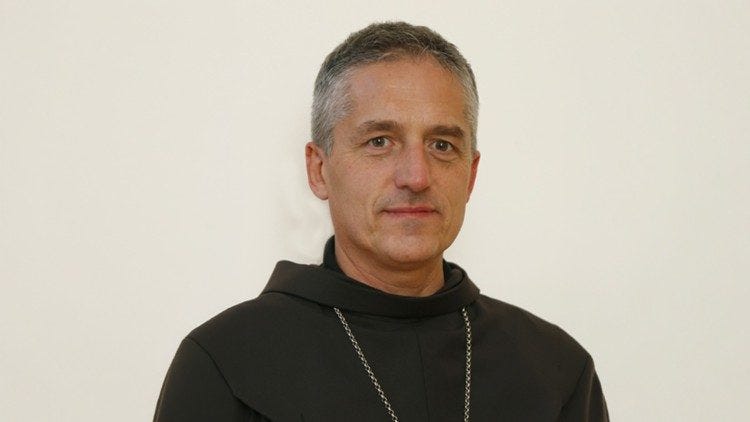
The appointment follows the pope’s recent decision to move Cardinal Mauro Gambetti out of St. Peter’s — and the Vatican — and to the Italian Archdiocese of Chieti Vasto.
Both moves have raised the usual questions about what Leo’s personnel choices say about his policies. And the manner and timing of the announcements suggest a few possible interpretations for a pontificate still waiting for its marquee Vatican reshuffle.
As was discussed at the time of Gambetti’s reassignment earlier this month, the cardinal’s departure from Rome was seen as a pointed decision by Leo. He was sent to a small archdiocese despite having no experience of diocesan ministry as a priest or bishop, and his tenure at St. Peter’s was marked by numerous criticisms of his leadership, both in the practical management of the basilica, its maintenance and security, as well as policies on sacramental celebrations in the world’s most visible church.
That Gambetti was sent into what was seen as a kind of early retirement from the Vatican at just 60 years old was widely interpreted in Rome as a singular mark of papal disfavor by Leo — compounded by the fact that the pope removed Gambetti without a successor to name in his place.
From all this, many expected that successor, whenever he was named, to single a clear breach with what came before, and stoked expectations that unpopular policies — like banning individual pilgrim Masses from the side altars of St. Peter’s in favor of concelebration — might be revisited.
The appointment last Saturday of Archbishop Viola as archpriest has tempered those expectations somewhat.
As secretary of the Dicastery for Divine Worship and the Discipline of the Sacraments, Viola enjoyed for years the reputation of being the driving force behind many of its policies, most notably on the implementation of Traditionis custodes.
Along with figures like Archbishop Ilson de Jesus Montenari at the Dicastery for Bishops, Viola was seen as part of the institutional civil servant class who many regard as the perennial power center in the curia, whoever the prefect might be. As such, the expectation around Rome regarding Viola was that he would either remain in post for the foreseeable future or, if he was someone Leo placed particular trust in, be promoted to lead a dicastery in due course.
Neither has happened. Instead, by giving him the job at St. Peter’s, Leo seems to have moved Viola out of a position of genuine power and influence in the curia and into one with decidedly less reach, globally and around Rome. Granted, it comes with the traditional expectation of being made a cardinal, but Leo hasn’t appeared to be in a hurry to create new members of the college, so there may not be any short-term guarantees there.
At the same time, Viola does carry the reputation of a competent administrator, he is a Franciscan — the order has a long history in the running of St. Peter’s — and he might be the answer to some of the practical problems of the Gambetti era. However, Viola also comes with a reputation for being even more liturgically opinionated, not to say intolerant of conservative sensibilities — than his predecessor at the basilica. It is, then, highly unlikely that some of the most unpopular policies of the Gambetti era will be rolled back, absent a direct papal order to that effect.
It is, in this sense, something of an odd move by Leo. Either, the thinking goes, Leo is sympathetic to Viola’s approach to the kinds of issues that will be front and center in his work at St. Peter’s, but in which case many would have expected him to be handed a higher profile role, given his effectiveness. Or Leo was looking to move on from the policies of the Gambetti era, in which case Viola seems to be an odd choice to turn the page.
But as outsiders looking in try to parse these seeming contradictions, around the Vatican, including those close to the Apostolic Palace and the CDW, another narrative is being considered. According to some curial officials, Leo originally had both Gambetti and Viola’s moves pencilled in as part of a longer chain of personnel moves.
Specifically, some suggest that the pope had intended to transfer Cardinal Rolandas Makrickas, currently archpriest of Santa Maria Maggiore, to succeed Gambetti, with Viola in turn moving to Makrickas’ former role. That chain of appointments, at least to some, would make more linear sense, as it would have placed a sitting cardinal in charge of St. Peter’s, one with a proven record in dealing with exactly the issues facing the basilica. Makrickas’ tenure at Mary Major has been widely praised for bringing the church’s finances and management into line.
At the same time, moving Viola to the place of Pope Francis’ burial, and placing him in charge of it, would have been widely interpreted as moving him out of an influential curial role at CDW and into a lower profile position, but one with emotional resonance for the archbishop.
Of course, as plausible as this alternate slate of appointments would seem to be, the question it raises is: If that was Leo’s, why didn’t it happen? To that, there are no good answers. Some dismiss the whole notion as mere speculation.
But others insist that Leo has had some difficulty in putting together a complete slate of top-tier Vatican appointments because some key figures asked to be excused when offered more senior roles. Whether M
akrickas was among those to turn down a new position — if indeed any have actually done so — is essentially unfalsifiable, unless he chose to say so himself publicly. Though it is the case that his name was widely discussed around Rome this summer as one pending promotion. But the persistence of that narrative, and the currency it has in some senior curial circles suggests one of two things.
Either it is true, or those working in Vatican City are searching hard for a way to rationalize what, for the moment, appears to many like a series of curial appointments both confusing and confusingly modest for a pope well into his second year.