
Meet the Muslim theologian who teaches Catholic missionaries
"My daily life is dialogue: continuous dialogue with my colleagues, with my students"
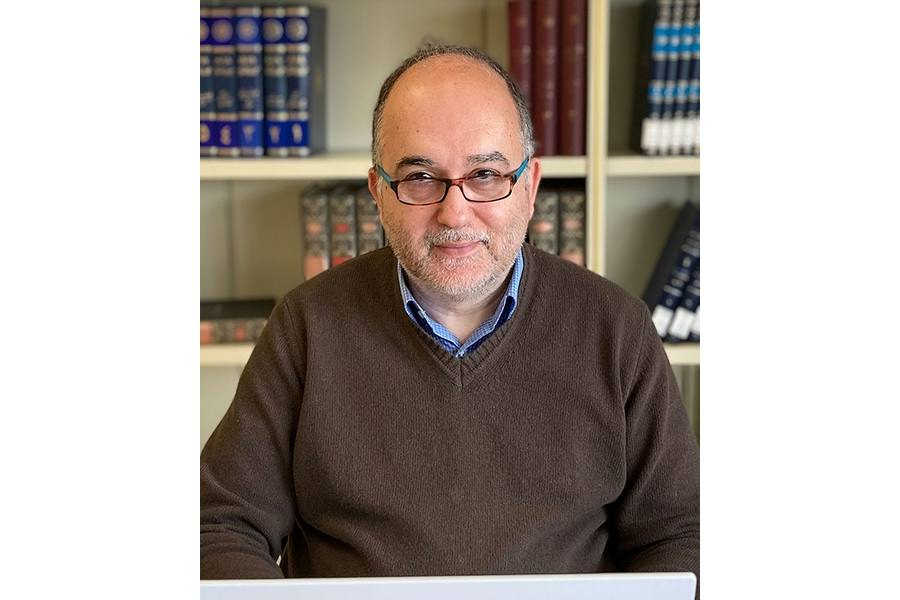
Adnane Mokrani is a Muslim and a professor of Islamic Theology at the Pontifical Gregorian University in Rome.
Born in Tunisia and raised in Algeria, he has been living and working in Rome for three decades. He has met with every pope during that time and is often called on to advise Vatican institutions, or to speak about Islam to Catholic movements, universities and events.
Last week, Mokrani was invited to speak at an event organised by the Portuguese bishops’ conference in Coimbra, Portugal, to mark the 10th anniversary of the Abu Dhabi “Document on Human Fraternity for World Peace and Living Together.” The document was signed by Pope Francis and the Imam of the University of Al-Azhar, in Egypt.
Professor Mokrani spoke with The Pillar about his experience teaching Catholic students – including clergy – about Islam, the relationship between the two religions, and his own theological work regarding non-violence in the Islamic tradition.
The interview has been edited for length and clarity.
How does a Muslim theologian end up teaching at one of the most prestigious Catholic universities in Rome?
It’s a rare experience, and I am very proud and happy about it. It’s a sign of openness from the Catholic Church to accept a Muslim professor, but I also have a Jewish colleague. Together we teach Catholic and non-Catholic students, providing an interior vision of our own religions, and that is a great occasion for dialogue.
My daily life is dialogue: continuous dialogue with my colleagues, with my students, in an atmosphere of peace and respect. And that has changed me from the inside, and affected my theology. Now I cannot ignore Christianity when I do theology, because it is part of my identity and of my experience.
What is your aim when you teach Christian students about Islam?
The first thing that I want to transmit to my students is the complexity of the phenomenon of Islam. We cannot generalize; we cannot just look at one country or one historical period. It’s very complex. We find many things in Islam. We find even contradictory theologies and ideologies, cultures. So, the key concept is diversity and pluralism.
I try to explain this complexity and to open their eyes and their curiosity to continue this journey, because many of them are living in, or have a mission in, a majority Islamic context, and they need to know basic information about history and theology of Islam.
Which means that you are helping to prepare Catholics to be missionaries and evangelists in Muslim lands. Isn’t this a problem for you?
It depends how we understand mission, and how we understand evangelization. I deeply believe that in Christianity there is great potential of humanity, of a positive presence in society, and shared values. I believe also in inter-religious mission, that we can work together for a shared mission of humanization and bringing people to God, to help people to be more human, more open, more theological, less prone to conflict, less violent.
You have dedicated the past 30 years to teaching Catholics about Islam. But living in Rome and dealing with Christians on a daily basis, you must also have learned very much about Christianity.
How has your idea of Christianity changed over these years?
Again, the idea of complexity. The Catholic world, the Christian world, is very complex.
I have found many friends, friendships, many teachers, many people who I learned from. They transformed my life because I saw in them a concrete model of being Christian. So Christianity is not a question of university, or library, or books, or reading, it is a question of life. This is the issue, to have living examples, models for the youth. This is better than 1,000 speeches.
For example, I have a very deep relationship with the Catholic Focolare movement, and with the Mar Moussa community in Syria. Fr. Paolo Dall’oglio was my friend, and I learned a lot from him. So, their mission is my mission, and I think we can work together. These people enriched my experience and I am grateful for them.
[Note: Paolo Dall’Oglio was an Italian Jesuit priest who served for many years in Syria. He founded the Syriac Catholic monastic community of Mar Moussa in the Syrian desert, which was very active in interreligious dialogue. He was kidnapped at the height of the Syrian civil war, in 2013, and has not been seen since.]
In a recent conference speech, you said that the Abu Dhabi “Document on Human Fraternity for World Peace and Living Together” is skeptical about theological dialogue, preferring to focus on relationships.
Do you agree with this approach?
I think it’s a way to avoid sensitive topics of polemics and apologetics. We have a long history and literature of polemics on issues like the Incarnation, the Trinity or other doctrines in Islam and Christianity. Not everyone is ready to do this kind of study.
Do you also think it’s easier to talk about these sensitive topics when there is already an established friendship?
Yes, it’s a question of trust and friendship. And to understand that one’s interlocutor is intelligent, not stupid…He or she is a respectful person with real choices and mature thinking. And we share the same humanity. And we can find a positive interpretation of the dogmas.
When I ask a person, a friend, to share their spiritual experience with me, in their own terms – not just to adapt himself to me, but from authentic experience – I can learn a new vision, a new interpretation, discover another dimension that did not make sense to me before. In this sense, dialogue is not a question of theory, but a question of life, even for theology. Because concrete theology, theology of life, applied theology, is better than just theory and discourse.
The current influx of Muslims in the West has been causing some tension. On one hand, we have seen a rise in neo-nationalism with people referring to immigrants as invaders, and on the other hand some immigrant communities tend to isolate themselves and in some cases embrace a fundamentalist view of Islam.
What can we do to try and defuse these situations?
In the case of Europe, the majority of immigrants are Muslims from Africa and Asia. But in the case of the U.S., the majority of immigrants are Catholics from Central and South America, and yet they deal with them in a very hostile way. This mentality of creating a deep fear that they are invading, that they want to dominate and destroy the local culture, is just propaganda, and very dangerous propaganda.
So we need to work for integration, but integration is not easy. It should be cultural integration through learning the language and learning the local culture, the collective memory, to feel themselves part of a shared destiny. And this is a question of education. It’s not a question of police, or violence or expulsion.
But regarding exclusion, they begin with the immigrants, but who will be next? This is the point. Because the same hostility will eventually be applied not only to immigrants, but to any opposition.
But we do have issues with Islamist extremism in many parts of the world. It is easy to simply dismiss them as not being true Muslims, but these are people who invoke Quranic texts to justify their methods, they are supported by Muslim scholars, and so on.
From your perspective, should they be challenged at the theological level, or is it dangerous to lend them that legitimacy of speaking to them in theological terms?
First of all, most of the members of these extremist and violent groups do not have religious education or leadership. The majority of them come from technical and scientific fields of education, and very rarely from the humanities – there are statistics about that – so they are largely ignorant about religion, but they self-declare themselves as authority. Of course, there are also some religious leaders, but they are not the majority.
At the same time, we know that a selective reading of the Quran, or of Islamic tradition, can be manipulated to justify violence.
What we need is a leadership of religious people with solid education and preparation to speak with young people. It’s a challenge of communication and education. But we can no more consider these groups as representative of Islam than we can the Ku Klux Klan as a legitimate representative of Christianity. They are a marginal group, although in some political cases, they can seize power.
As believers from different faiths, we should see violence as a common challenge. Because this challenge arises in many religions, especially in these post-modern times when we have this discontinuity of religious memory, and sometimes nationalism and identitarian religiosity try to use religion.
For example, you cannot convince someone to sacrifice himself with rationalist argumentation, but if you use religion, you can say that he will be a martyr, and go to paradise.
One of your areas of expertise is Islamic theology of non-violence. Could you briefly run us through the main ideas of this theory?
Non-violence is not a marginal topic for theology in Islam or any religion, especially for modern theologies, it’s central. For instance, theology of religious pluralism criticizes religious exclusivism, which poses a potential for violence in contexts of conflict; feminist theology is against violence applied against women; eco-theology is against violence applied to creation. The topic of violence and non-violence is present in different theories.
So, theology of non-violence is not just about resisting dictatorship or colonialism, though it is a very important aspect of political and social activism… It is an act of liberation, but which does not use the same tools as the oppressor. Because the real risk in violence is to be transformed in the image of the oppressor, to replicate that attitude. This is a spiritual risk, because we are created in the image of God, not in the image of the aggressor.
But theology of non-violence is not about political activism, it is a more inclusive idea, to purify theology from ambitions of power. To bring clarity to the relationship between religion and power, religion and politics, and to liberate religion from any manipulation or political abuse, as an ideology of dominion and manipulation. In this sense, theology of non-violence is a project of reforming religious thought.
When I speak about non-violence in an Islamic context, especially to young people, I find interest. If they hear new ideas presented in a good and convincing way, they accept them, and if they receive a positive message, perhaps we can change the mentality and offer them a new possibility.
In his apostolic exhortation Evangelii Gaudium, Pope Francis said that “authentic Islam and the proper reading of the Quran are opposed to every form of violence” (#243). Do you believe that the pope has the authority to judge what is or is not a correct reading of the Quran?
I have been asked many times if the pope has the authority to declare what is Islam and what is not Islam. But in this case, I accept, because it’s the summary of my belief.
If I were asked to present the clearest statement to describe what I deeply believe, I would choose this one by Pope Francis. Pope Francis had a very deep knowledge of Islam, and he had Muslim friends.
In his message for the World Day of Peace, in 2017, called “Nonviolence: a style of politics for peace” he mentions Khan Abdul Ghaffar Khan, who died in 1988, as an example of Muslim nonviolence. Khan was part of Mahatma Gandhi’s struggle against British colonialism in India.
A friend of mine was very close to Francis and he confirmed that the reference to Khan was the pope’s choice, and not the suggestion of his advisors, they did not know anything about Khan Abdul Ghaffar Khan.
And in Laudato Si’, in a footnote, the pope quoted a paragraph from a great Muslim Sufi mystic, Ali Al-Khawas, who is not even known to many Muslims. That means that the pope knew about Islam.
Secondly, he had in mind a definition of religion, what religion is and what it is not. In his mind, religion as vocation, mission, function and message should be a message of peace, of humanization. If we find violent religion, it is a deviation, it is not the authentic soul of religion.
But there are references to violence in the Quran…
Yes, in the Quran we can find some violent verses. But how can we understand them? Normally, in the Quran, we find the justification of defensive war, but not of preventive war, expansion, invasion, or imperialistic war. We don’t find any trace of that in the Quran.
Of course, Muslims later did create empires, they dominated a huge part of the world, even what is now Portugal, where we are today. So Muslims were like other human beings, they searched for power, dominion, conquest. But this is not the Quranic theory, in the Quran we find references to defensive war, with moral and ethical conditions. First of all, it must be defensive, then proportionate, and it must cease when we see the first sign of peace. It’s not war for war’s sake, but war to protect people and the weak.
But meanwhile the meaning of war changed completely. What we now call war is not the same meaning of even two centuries ago, or at the time of the Quran. Now, war is totally immoral, because we are using highly destructive weapons. With nuclear weapons, war became impossible, for the first time in history, human beings can destroy the planet. There is no winner in war, we are all losers.
This is pretty cool.