
This month will see the beatification of five Franciscan missionaries who were martyred in 1597 in the region known as La Florida, along the coast of modern-day Georgia.
The missionaries evangelized and ministered to the local Guale people, and had largely lived in peace with them for years until what came to be known as the 1597 Uprising, sparked by the insistence of a local chieftain’s heir on continuing to practice polgamy after entering the Catholic Church.
The cause for canonization for the five murdered missionaries was opened in 1981. In January 2025, Pope Francis approved the official promulgation of their martyrdom.
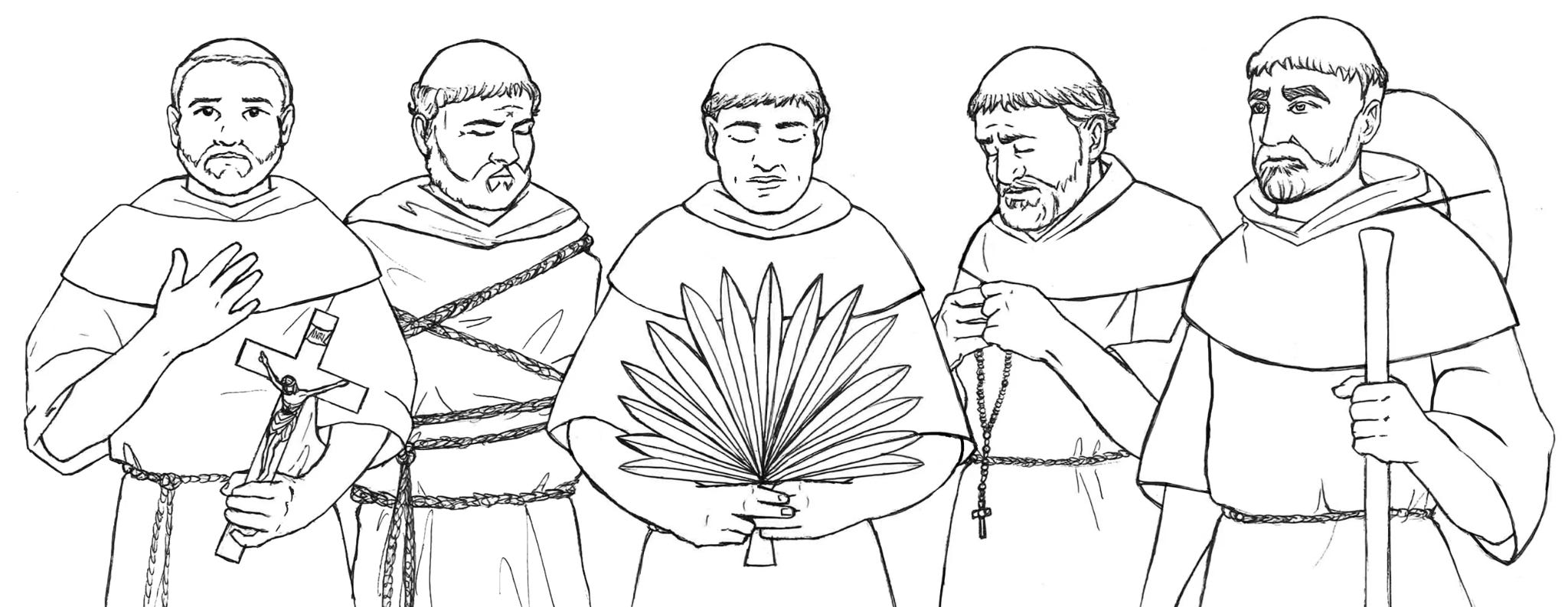
Friars Pedro de Corpa, Blas Rodríguez de Cuacos, Antonio de Badajoz, Miguel de Añón, and Francisco de Veráscola will be beatified October 31 in Savannah, Georgia.
Cardinal Frank Leo of Toronto will serve as papal representative, celebrating the beatification Mass at the Savannah Convention Center.
Who were the Georgia Martyrs? What are the events that led to their deaths? The Pillar explains:
Friar Pedro de Corpa
A native of central Spain, Pedro de Corpa was ordained a Franciscan priest in Castile. He arrived in present-day Georgia in 1587 and established a mission in the village of Tolomato, where for a few years he preached and administered the sacraments in peace. He became known for his obedience and love of poverty, and he was successful in winning many souls as converts.
Among the challenges in spreading the Catholic faith was the practice of polygamy among the native Guale people. The missionaries would only baptize those who agreed to a life of monogamy.
Eventually, an influential man named Juanillo, who was in line to become the tribal chief, decided to marry a second wife, despite his baptismal promise.
When de Corpa opposed this union, Juanillo plotted with local Guale warriors to murder him, attacking and beheading him in his hut on September 14, 1597.
The warriors then embarked on a wave of attacks against other Franciscan friars throughout the region in the days that followed.
Friar Blas Rodríguez de Cuacos
Born in the Spanish town of Cuacos in the 1550s, Blas Rodríguez de Cuacos joined the discalced Franciscans of San Gabriel. He came to La Florida in 1590, working in the village of Tupiqui.
He was killed on September 16, 1597.
When the band of warriors that had killed Pedro de Corpa arrived at his mission, the friar asked to celebrate a final Mass.
Afterwards, he was beaten to death with clubs and axes. His assailants left his body in the woods, to be torn apart by wild animals.
Friar Antonio de Badajoz
A lay Franciscan, Antonio de Badajoz joined Pedro de Corpa on his journey to present-day Georgia in 1587.
Renowned for both his simplicity and his mastery of the Guale language, he served as a catechist and interpreter on the island of Santa Catalina.
After prominent local warrior Juanillo killed de Corpa, he ordered his gang of men to kill de Badajoz as well.
Warned of the coming danger by a friendly tribal chief, de Badajoz refused to flee and instead remained at the mission praying. He was attacked and killed alongside Friar Miguel de Añón on September 17, 1597.
Friar Miguel de Añón
Miguel de Añón, a Franciscanan priest of Castile, traveled to modern-day Georgia in 1595, joining Antonio de Badajoz at the mission at Santa Catalina. He was known for his gentle nature.
He was martyred alongside Antonio de Badajoz on September 17, 1597 at the mission where he lived.
His reputation for sanctity was so great that the members of the war party sent to murder him refused to do so, and one of non-Christians in the group ended up stepping forward to kill him with a tomahawk. His mangled and decapitated body was buried in a nearby shallow grave.
Friar Francisco de Veráscola
Born to a prosperous family in Spain in 1564, Francisco de Veráscola joined the Franciscans in Cantabria and volunteered as a missionary in America in 1595.
He was known for both his athletic abilities and his acts of penance.
Known as “the Cantabrian giant” due to his large stature, the friar’s enormous size and strength offered protection in some hostile situations.
However, de Veráscola became a target following the martyrdom of Pedro de Corpa. A group of Guale men attacked him with an axe and killed him as he was traveling, unsuspecting, in his canoe in September 1597.
Amazing that de Cuacos was able to avoid martyrdom until the mid-20th Century. :p
Georgia martyrs, ora pro nobis!
Under Friar Blas Rodríguez de Cuacos
1557 not 1957