
At first, churchgoers celebrated when Fr. Clemente Morales returned to his parish alive, after he’d gone missing in the Mexican state of Sinaloa for three days at the end of October.
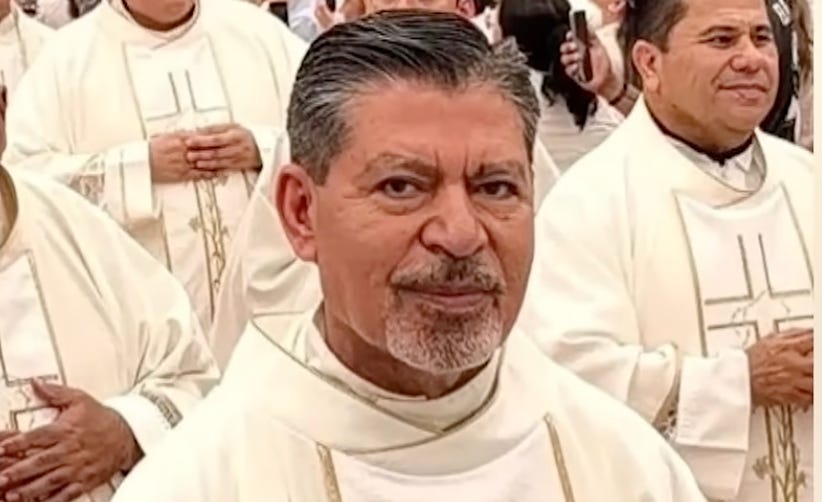
But the celebration turned to sorrow, when Church officials said the priest had been tortured by criminals while in captivity, shocking many across the country.
The 67-year-old Morales, parochial vicar of Resurrected Christ Parish in the La Campiña district of Culiacán, was last seen at 4 p.m. on Oct. 24, driving his silver Toyota Hilux pickup truck in the Fraccionamiento Montebello area.
When he failed to return that evening and could not be reached by phone, his disappearance was reported to local authorities, and alerts were issued.
Members of his parish organized vigils and gathered to pray for him. On Oct. 27, three days later, Morales returned to his parish. He arrived in his own vehicle and appeared to be in relatively good condition, despite visible bruises and marks on his skin. News of his return was widely celebrated across Sinaloa.
On Nov. 1, however, the Diocese of Culiacán released a statement revealing that Morales had been violently interrogated during the three days he was held captive, suffering beatings and even burns.
“We can confirm that the priest was abducted by a group of unidentified individuals and taken to an undisclosed location. He was beaten and even suffered severe burns to his body,” read the statement, signed by Bishop Jesús José Herrera and Father Ramón Ibarra, the diocesan chancellor.
His captors, the statement said, “demanded information that he did not possess and therefore could not provide.”
“He was held for three days, during which he was repeatedly threatened with death, until he was released last Tuesday,” it continued.
The diocese explained that Morales received assistance from members of his parish, local doctors, and local authorities before being taken to a clinic for specialized medical care.
“Although his injuries were not immediately life-threatening, they required medical attention and follow-up care. The ordeal has also had psychological and emotional repercussions, stemming from the threats against his life that the priest reportedly received,” the statement said.
Morales remains under medical observation, and “his condition is improving, although his recovery will require time, care, and comprehensive support.”
News of the priest’s torture surprised and shocked many in Sinaloa, according to Father Saul Norzagaray, a spokesman for the Diocese of Culiacán.
“It is an extraordinary event. We had never experienced a situation of this nature before. The figure of the priest is highly respected among our people,” he told The Pillar.
He said parishioners “have shown great solidarity and empathy in response to this situation,” but “uncertainty and fear continue to prevail among the population in general.”
“We have now endured two years of violence stemming from the dispute between the two factions involved,” Norzagaray said, referring to Los Chapitos and La Mayiza, the two factions fighting for control of the Sinaloa Cartel.
The priest said that, throughout several years of violence, priests have served as points of reference for their communities.
“We have stood by people, offered comfort, and consistently called for peace,” Norzagaray said.
But violence has eventually reached priests as well, Julieta Appendini, director of Aid to the Church in Need (ACN) in Mexico, told The Pillar.
“Sinaloa, where this happened, is the state where organized crime is most powerful. Apparently, they wanted to obtain information about the rival criminal group through the priest. Violence certainly finds its way to priests, one way or another,” she said.
ACN reports have shown that Mexico is becoming an increasingly dangerous country for priests. Growing numbers of clergy members have been threatened, beaten, or even killed over the past couple of decades.
One of the most prominent cases was that of Father Marcelo Pérez, who was killed in October 2024 in San Cristóbal de las Casas, Chiapas. A human rights and environmental activist, Pérez had been receiving threats for years. Those responsible for his murder have yet to be identified, but evidence points to criminal groups that have been taking control of the region, harassing communities, and fueling a serious social crisis.
According to Oscar Loza Ochoa, head of Sinaloa’s State Human Rights Commission, “when violence reaches a certain level in society, no segment is exempt from suffering its consequences,” including the Church.
“We have been facing a terrible social crisis over the past two years [amid the infighting within the Sinaloa Cartel], with more than 4,000 people missing,” he said.
The Mexican Church launched a peace campaign in 2022, following the killing of two priests in the state of Chihuahua. Known as the National Dialogue for Peace, the initiative brings together hundreds of academics, activists, government officials, and Church representatives in a multifaceted effort to promote peace at every level of Mexican society.
“Despite the hardships, the work of the Church and civil society has been very important. We could be in a worse situation if it weren’t for them,” Loza said.
Prayers for his rapid healing and recovery...
OLOG and Blsd Fr Peo pray for your people 🙏🏽