The Spanish bishops are sharply divided in their responses to the recent influx of undocumented migrants from Morocco into the autonomous Spanish city of Ceuta.
The president of the Spanish bishops’ conference called last week’s migrant surge “an invasion,” a striking contrast to the local diocese’s emphasis on a humanitarian response to the migrants.
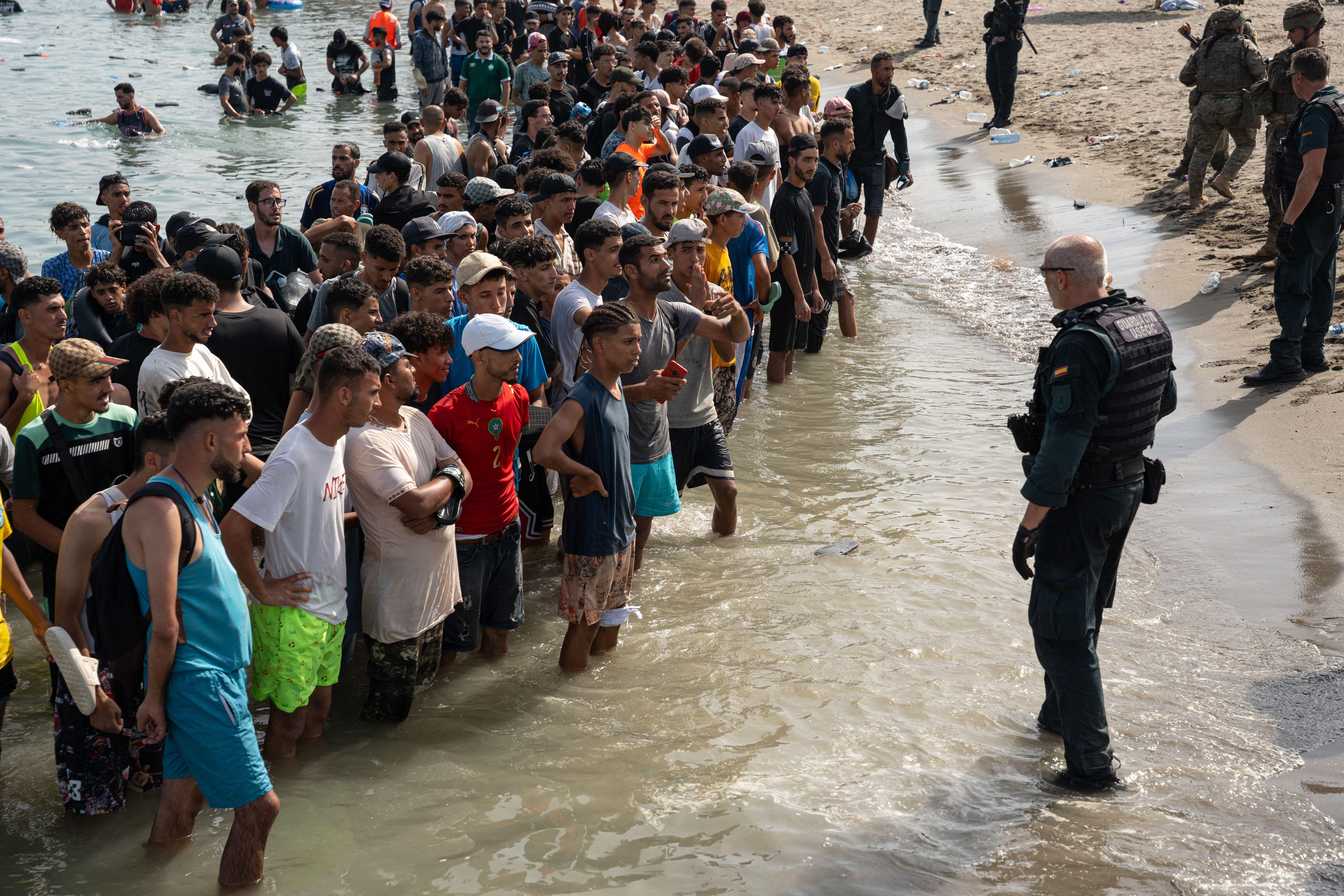
More than 80,000 people flooded across the border from Morocco to Ceuta in a matter of hours last week, according to Spanish authorities, overwhelming the city of just 83,000 inhabitants.
News reports suggested that the migrant rush was due in part to false news on social media suggesting that the border had been opened. It is not clear who was behind the social media posts.
The vast majority of the undocumented migrants returned to Morocco after Spanish authorities said they would not be permitted to stay. But around 7,000 have remained in Ceuta, including an estimated 1,000 minors.
Archbishop Luis Argüello of Valladolid, president of the Spanish bishops’ conference, said Aug. 2 on twitter.com that the influx of migrants was part of a broader political strategy.
“Games are being played with life and people are being used – their dreams, hunger, sexuality, and data – in favor of money and power. Migrations are part of this strategy. The Ceuta invasion is a test. Demographics are a weapon,” he said.
The scale of the most recent wave of migrants drew similar responses from other Church leaders, who warned of political motivations behind the migration surge, while also emphasizing the need to care for the migrants involved.
Archbishop José Rodríguez Carballo, OFM, of Mérida-Badajoz, blamed the crisis on local trafficking mafias and said that “it would be very sad to try and take political advantage of a grave humanitarian situation.”
He referenced an article by Archbishop Emeritus Santiago Agrelo of Tangier, which suggested the wave of migrants had been “provoked by political interests,” but added that “these thousands of people manipulated and used are again, for the believer, not a matter of political or ideological analysis, but a matter of compassion. This multitude can only receive our mercy.”
The Spanish bishops have been generally supportive of migrants.
The Diocese of Cádiz and Ceuta said in a July 31 statement that Sunday collections would be given completely to the diocesan migration delegation. The diocese added that it was in touch with civil institutions to contribute to alleviating the crisis.
The director of the bishops’ migration department, Fr. Fernando Redondo Pavón, maintained in an interview that the massive wave of migrants “didn’t have anything to do with the extraordinary regularization” of illegal immigrants passed by the Spanish government earlier this year.
That measure, which was supported by the Spanish bishops’ conference, has allowed for the regularization of over 600,000 migrants. Local critics had argued that it would attract more illegal immigration.
Other Catholic leaders, meanwhile, have taken a more outspoken approach in response to the recent wave of migrants.
Andrea Riccardi, founder of the Sant’Egidio community, said in an interview that “we need migrants, not closed borders.”
However, he also acknowledged suspicions of a possible political push behind the most recent migrant wave.
“This isn’t just another typical arrival. It’s truly an exodus of the wretched of the Earth, which raises suspicions that an organization is behind it. Prime Minister Sánchez has spoken of mafia organizations,” he said.
Meanwhile, Archbishop Emilio Rocha, OFM of Tangier rejected the idea, saying that “mafias are not acting here, because they act for money, and the young men crossing the border are not paying anyone [to do so].”
He also criticized the idea that people are fleeing desperate poverty, saying that “Morocco is not a poor country, it’s not a country in which young people are fleeing hunger.”
Fernando Sotomayor, the director of Caritas Ceuta, said in an Aug. 5 interview that “most of our resources are for 450 vulnerable Ceutan families, first [we attend to] the locals.”
“It’s been horrendous… The first two days were very complicated. We saw damages caused by migrants, all NGOs acted as they could and with the resources they had at hand.”
Sotomayor said that a significant number of the migrants still in Ceuta come from countries other than Morocco, which is why they can’t be returned to the country, and asked for more resources to take part in aid efforts.
The city of Ceuta has been under Spanish sovereignty since 1640, when it remained loyal to the Spanish Crown after Portugal’s restoration of independence. The city had already been under Portuguese rule since 1415, following its conquest from the Marinid Sultanate.
Its incorporation into Spain predates the rise of the Alaouite dynasty, which established the ruling house of present-day Morocco in the 17th century.
Despite this long history of Iberian rule, Morocco continues to claim sovereignty over Ceuta and Melilla, another Spanish enclave on the North African coast.
This has prompted many people in Spain, across the political spectrum, to suggest that the Moroccan government was behind the migrant wave.
A similar situation occurred, on a smaller scale, in 2021, when 8,000 migrants crossed the border, with local media pointing to “an evident relaxation of controls by Moroccan authorities” as a major factor in the migrant surge.

As someone who lives in a border diocese, I will say it’s become increasingly obvious that some bishops are out of touch with the concerns of many of the laypeople living in their diocese. I get it, they don’t have their own property or children to worry about (strong pros for missionary abilities); the reality is that unchecked immigration poses real dangers to women and children. As an example- our bishop called for churches to open their halls as shelters for undocumented immigrants. There was no concern shown for the safety of the women, children, and elderly of the parish (the same people who, if they are 18+, are required to become Virtus certified to teach Catechism to classes that include their own children).
"it would be very sad to try and take political advantage of a grave humanitarian situation."
I'll remember that, in case any other humanitarian situations start becoming politicized.