
The Archdiocese of Detroit announced this week a plan that would see the vast majority of its parish priests reassigned next summer, amid a restructuring process expected to dramatically shrink the number of parishes in the archdiocese.
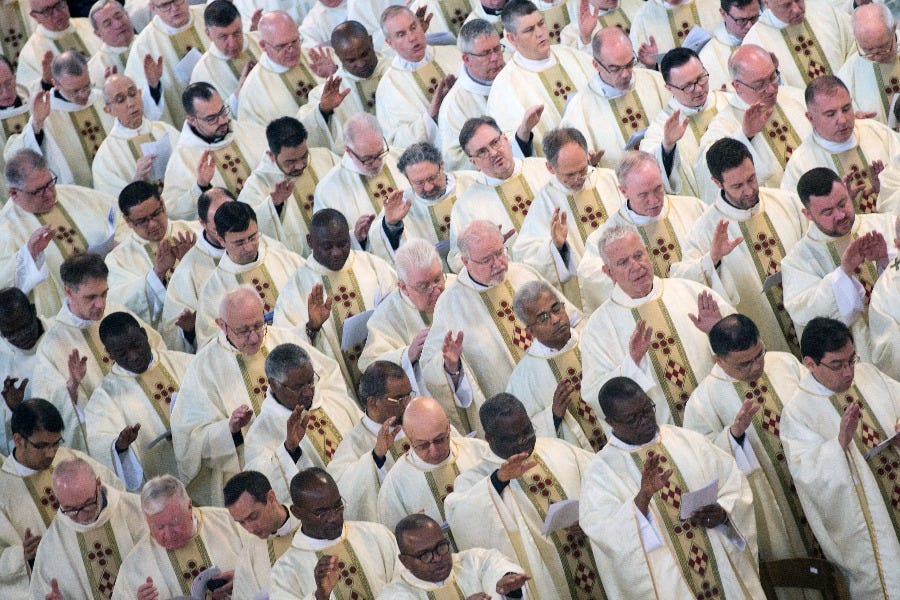
The plan, Detroit Archbishop Edward Weisenburger said this week, “asks much of our priests,” but is a “sacrifice they are making as brothers of one, unified presbyterate.”
But while the contours of the plan leave open many questions for the future in the Archdiocese of Detroit, they also raise broad questions about the protection of clergy rights, the Church’s canonical praxis of hierarchical intervention, and what could be done to better protect the canonically established rights of priests.
—
When the archdiocese announced a coming swath of clergy moves, it made clear that few priests would be left behind from the “fresh start” Weisenberger intends for the Detroit archdiocese.
An Oct. 17 report in the archdiocesan newspaper explained that only priests in the curia, faculty members at the seminary, and nine recently ordained or assigned priests would be exempted from a major slate of “priest transfers” Weisenburger intends to effect.
The rhetoric in the announcement seemed to emphasize that Detroit’s priests have consented to the plan en masse, and are broadly supportive of it. That emphasis may well be true. But careful observers of archdiocesan consultations in the United States might well suspect it is intended to convey a certain momentum, to remind reluctant priests that their archbishop expects to see his plan come to fruition, and to quell the possibility of any anticipated clerical pushback.
Of course, a good bishop always wants his priests to be consulted in major plans for the future of the diocese, and wants his priests to be supportive of those plans, and willing to do their part, whenever possible. But when the plan involves mass reassignments of parish pastors, the bishop needs buy-in for a practical reason, beyond the harmony and concord of the diocesan clergy.
Pastors have the right in canon law to stability in office. This means that they can not be easily removed from a parish to which they have been appointed, even if they are going to be transferred to a new parish. Both removal and transfer involve processes intended to ensure that a bishop is not being hasty in removing a pastor from the parish which has been entrusted to him. The reason for this is that pastoring a parish is difficult, it requires making difficult choices, and it inevitably involves making people unhappy — sometimes those people are parishioners, and sometimes they are the bishop and his curia “downtown.”
The parish pastor is not a “branch manager” of a large corporation with locations spread across town. He is instead the spiritual and practical shepherd of a real community, and the Church’s law has enshrined the hard-won lesson that to fulfill that task well, he needs protection from the prospects of being run out town on a rail, or from being ousted at the moment he’s displeased the local bishop.
A consequence of that lesson, and its place in the Church’s law, is that if a bishop intends to give his whole diocese the sort of “fresh start” that Weisenberger seems to have in mind, he’ll need each parish pastor to actually resign from his office — without that, he’d have to undertake a cumbersome process to effect a transfer for each one, and violating the procedural requirements of the Church’s law in that process could see the entire thing invalidated.
At the same time, it’s one thing to possess a right in the Church, and another to exercise it freely. Of course, the Church presumes that a bishop won’t pressure or coerce his priests into resigning their offices. And it provides a mechanism of canonical recourse for priests who believe their rights have been steamrolled in some way during situations like the mass resignation event presumably anticipated in Detroit.
Indeed, Detroit priests who made a recourse to the Dicastery for Clergy against the expectation of resigning their offices amid a restructuring would almost certainly get a sympathetic hearing, and depending on the particulars, probably a legal victory, or at least the opportunity to appeal to the Apostolic Signature, where violations of procedural law are not treated lightly.
But legal victories can be pyrrhic victories.
A Vatican decision that a priest’s rights were not respected amid a restructuring process would see his bishop go back to the drawing board, at least in part, and have to rework the process by which he’d plan for the future of the diocese.
But at the same time, the priest’s bishop would remain his bishop. And there are certainly a number of U.S. priests who can attest that winning a Vatican recourse against their bishop did not endear themselves to the man, or leave their relationship congenial in the years thereafter. There are many ways an aggrieved bishop can make his displeasure known to his priest. And that reality has the effect of deterring some plausible acts of recourse before they even get started.
While the possibility of recourse is meant to protect a priest’s rights, the broad-ranging power of the diocesan bishop over the rest of his life means that avenue of recourse seems often reckless to ordinary diocesan priests.
But as it happens, even when Vatican dicasteries are aware of situations that might violate the rights of an individual cleric or a presbyterate, their intervention into the internal affairs of particular churches is rare without an act of recourse to set them in motion. This is in part a consequence of the sheer number of dioceses in the world, in part a consequence of the tendency for bishops to defer to their brethren on internal matters, and part the consequence of the framework of the Church’s legal system. The Vatican tends to decide the cases put before it, not to seek them out.
In principle, there is another party who might put in a motion a legal process meant to adjudicate the legality of a bishop’s actions — the promoter of justice.
The office of promoter of justice is meant to exist in every diocese, according to the law, as an office “to provide for the public good,” in matters in which the “public good can be endangered.”
The promoter is, in short, the closest the Church’s canonical system has to a public prosecutor. But in most dioceses, either the office is unfilled, the promoter an employee of the diocese occupying several other roles at the same time, or the promoter is also in a long-term subordinate relationship to the diocesan bishop.
But increasingly, some canonists have asked whether the office might be expanded in the Church’s law and practice, established at a national level to give the promoter more independence from particular bishops, and with a special focus on intervening in cases where the relationship of a potentially harmed party to ecclesiastical authorities renders him especially vulnerable to retribution from those authorities.
In short, they’ve asked whether a truly functional legal system ought to ensure the presence of parties with enough independence to make use of that system for the sake of justice.
There are, to be sure, practical challenges which would have to be overcome to see the role fleshed out — how it would be funded, how it would be supervised, how it would triage the torrent of cases likely to come across its desk.
But priests are increasingly expressing dissatisfaction with a sense that the canonical legal system does not actually protect their rights, regardless of how much it takes care to enumerate them. And at the same time, the Church is increasingly aware of the need to provide justice to persons in positions which makes them “vulnerable” for speaking out against violations of their rights and dignity.
An expanded promoter of justice role might well prove an able answer to those emergent issues. And a canonist pope might be especially equipped to guide that vision to fruition.
This article is 100 percent right on how priests feel - which is totally helpless when our rights are violated with no one to turn to without risking retaliation. To be clear, where I am now I don’t feel that, thanks be to God, but I know many priests in many diocese who do, and even if your bishop is good, that is no guarantee his successor will be. Sometimes we have joked about forming a priest’s union and entering into collective bargaining. We never would, of course, but it points to a need for something. I have seen religious priests working in a diocese as more protected as they have a group they are part of that in theory can have their back if they are mistreated, and that is at least one interesting solution…
Don’t understand why they feel the need to reassign everyone along with a huge parish reduction. I’m very sympathetic to bishops wanting to reduce the number of parishes in a diocese because I most historic diocese, there are way too many. But coming from the diocese of Buffalo, the move is always unpopular and this seems to make it worse.