‘My diocese is the poor’: Archbishop Marín on his plans as papal almoner
The longtime collaborator of Leo talks about the 'quantitive and qualitative leaps' taken by his ancient office.
Pope Leo XIV appointed Archbishop Luis Marín de San Martín, OSA as papal almoner and prefect of the Dicastery for the Service of Charity on March 12.
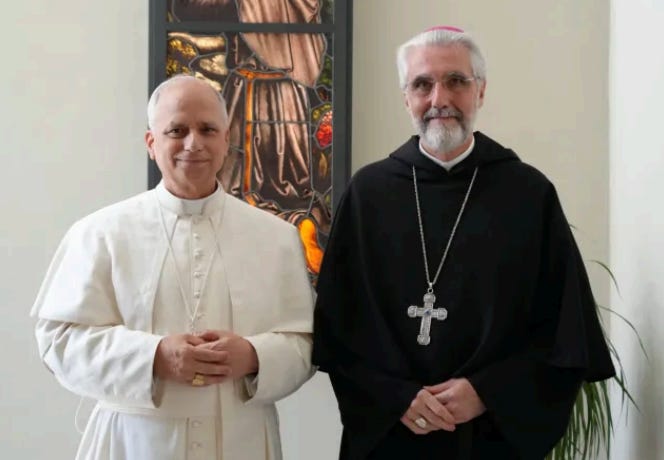
While the office of papal almoner is one of the oldest Vatican institutions, Pope Francis’ 2022 reform of the curia overhauled the position, expanding its mission and turning the office into a dicastery, on par with other senior curial departments with a global remit.
Given Marín’s three-decade relationship with Leo, and his reputation as one of the pope’s closest advisers, the archbishop’s appointment to the almoner role could suggest that Leo intends to give the dicastery — and the pope’s charitable mission more broadly — the same significance Francis did.
Archbishop Marín was born in Madrid in 1961. He made his first vows in the Augustinian order in 1982, his solemn vows in 1985, and was ordained a priest in 1988. Since then, he served as parish priest in several Augustinian parishes in Spain, seminary professor, novitiate formator, and prior of the monastery of Santa María de la Vid.
In 2008, then-Fr. Robert Prevost, OSA, prior general of the Augustinians, asked Marín to become the general archivist of the Order in Rome. In 2013 he became general assistant of the Augustinians and president of the Institutum Spiritualitatis Augustinianae. In 2021, Pope Francis appointed him undersecretary of the Synod of Bishops, a post he held until his appointment as papal almoner, and was consecrated a bishop in April the same year.
The Pillar spoke with Archbishop Marín about the Church’s service of charity, the challenges of his new role, and the pope’s social priorities.
This interview was conducted in Spanish and has been edited for clarity and length.
First, could you tell us about how your new role as head of the Dicastery for the Service of Charity works?
It’s a fascinating, beautiful task, but at the same time a very demanding one. We’re part of a large dicastery that carries out specific and wide-ranging social initiatives. The best-known aspect is papal blessings — the proceeds of which go to the pope’s charity.
Then we have two clinics next to the colonnade of St. Peter’s as a specific social initiative in the area of healthcare. The word “clinic” might sound like something small, but we have 120 volunteer doctors, several of whom are retired. And we offer services in the main medical specialties.
There are also showers for people who need hygiene services but cannot access them. And we are responsible for the Domus Mariae, run by the Missionaries of Charity, and the Palazzo Migliori [shelter], run by Sant’Egidio.
Twelve deacons from Rome come in shifts to assist the people who come every day for help and assess how to help them in coordination with the parish priests. It is a concrete service of charity through which we express the Lord’s mercy toward those most in need. We also assist various institutions, parishes, and social organizations, primarily in the outskirts of Rome, but also in other parts of Italy.
And we have our international outreach: we strive to be where there is need, where there are the poor, the excluded, and those in extreme need, especially victims of natural disasters or wars. This service is carried out in coordination with the nunciatures.
Although the papal almoner is one of the oldest Vatican institutions, Pope Francis transformed it with the 2022 reform of the curia.
How did the institution change?
The papal almoner has been part of the papal family since its origins, when it was responsible for the pope’s direct and personal acts of charity. Now, following Praedicate Evangelium, the document reforming the curia, I would say it has taken a leap forward. It is the third in the list of dicasteries, after the Dicastery for Evangelization and the Dicastery for the Doctrine of the Faith. And its scope of action has grown enormously.
There has been a quantitative leap in terms of the number of people working in our Dicastery and collaborating with it. The expansion of tasks leads to greater collaboration with other bodies, such as the Dicastery for Integral Human Development, the Secretariat of State, the Vicariate of Rome, Caritas, and many other institutions.
But the leap is also qualitative, because Pope Francis wanted it to grow and develop as a concrete expression of Christ’s love. We have before us a very broad and demanding task, which refers us back to the Gospel, to the presence of God’s love in the midst of the world, alongside the most vulnerable.
When your predecessor was elected, the pope told him to sell his desk because he wouldn’t be using it…
[Laughs] Pope Francis was referring to the fact that the priority in this role is concrete charity, not theoretical charitable action.
We are here to be the channel of the pope’s charity. For this, certainly, we need to reflect and assess the situation. Administrative development is also necessary. But essential reflection must not lead us to conceptualization, and the administrative structure must not lead us to bureaucratization.
I am not here to be an academic of theoretical charity, nor a bureaucrat or a manager. I am a witness, a channel of Christ’s charity. My job is to be on the ground and to be the Gospel alongside the needy and the excluded.
Therefore, I must bring charity to the poor, to the vulnerable, and walk with them. Everything else is secondary to fieldwork, to the concrete reality. When Pope Francis said that to Cardinal Krajewski, he wanted to make it clear that he should not hide behind a desk, becoming a bureaucrat. This position is about being with the poor. It is a matter of having clear mission objectives and priorities.
To paraphrase Spanish philosopher Manuel García Morente, one who walks through Paris for two hours knows the city better than one who has read about Paris for two years…
Exactly. We can know all the theories about love perfectly well and yet not love; we can know Christian doctrine very well and not be Christians.
We are here to be the Gospel, to listen to the poor, to be with them, and to walk with them. That is, to be an expression of true love. And this is not possible unless it becomes a way of life, unless it takes root in daily life.
You have known the pope for nearly three decades and worked together during his time as superior of the Augustinians.
Do you see your appointment as a statement of intent by the pope, in entrusting this specific position to someone he trusts completely?
Without a doubt, charity is the cornerstone. Pope Leo has said it time and again: charity is at the center because Christ is the center.
Saint Paul reminds us that, of the three cardinal virtues, the greatest is love. It is what gives meaning to everything, and without it, nothing is of value; everything is empty [1 Cor 13:1–13]. The first letter of Saint John teaches us that God is love in his very essence and that only those who love know God [1 Jn 4:7]. Let us always remember this: only those who love; not those who possess a great deal of cold, detached knowledge or those who perform countless acts without charity.
To fully understand the pope’s approach to this topic, we have two essential texts from the beginning of his pontificate. The first is his greeting on May 8, 2025, shortly after his election, when he says: “God loves us unconditionally, and in this love of God we have the assurance that evil will not prevail.”
Starting from the experience of God’s love, two developments emerge. On the one hand, unity, fraternity, walking together as true brothers and sisters in Christ, integrating differences through love. This leads us to the second development: always seeking to be close, especially to those who suffer.
The other document is his homily at the beginning of his Petrine ministry, on May 18. There, he points out that love and unity are the two dimensions of the mission that Jesus entrusted to Peter. This leads to unreserved self-giving. And we find the key in the centrality of love, which is also a legacy of the Augustinian tradition.
The expression of love as something concrete where the reality of the Gospel comes to life.
Amor ipse intellectus est: Love itself is understanding, as the Scholastics used to say.
Truth is not an idea, a concept, but a Person in whom God’s love is expressed and whom we can and must know through the experience of charity. Therefore, to know God as he wishes to be known, it is necessary to live mercy and open ourselves to compassion.
It is the way of Christ, of the Word made flesh, the way of love, which must also illuminate our relationships. In this regard, Saint Augustine pointed out that, if you want to know someone, you must know what they love. Love shapes our identity.
In his Treatise on the First Letter of Saint John, Saint Augustine says that “Each person is what their love is. Do you love the earth? You are earth. Do you love God? What can I say? That you will be God? I dare not say it on my own authority. Let us listen to Scripture: ‘I said, you are gods, and all of you are children of the Most High’ [Ps 81:6].”
That is to say, you will be Christ for others because you identify with Him: this is what it means to be a Christian. God’s love is made concrete in Jesus, God with us, and in him, each and every one of us brings him to the world. This is the key to the Christian life.
St. John of the Cross warned that “in the evening we will be examined on love” [Sayings of Light and Love, 60]. The judgment will not be about the success of our lives, the positions we have held, the diplomas we have accumulated, or the activism we have engaged in, but rather how much love there was in everything we did. And we have the Gospel: I was hungry, I was thirsty, I was a stranger, I was naked, and I was in prison—what did you do, and how did you respond? [Mt 25:31–46].
Moreover, did you see Christ, even in those who did not deserve it? Sometimes we look for Christ in the crucifix on the altar, but we do not see him in the poor person next to us, to paraphrase St. Augustine.
What do you think have been the main features of Pope Leo’s social teachings? Where do you see continuity with Pope Francis, and where do you see change?
As a preamble, I will say that both Jorge Bergoglio and Robert Prevost are children of the Second Vatican Council and have been formed in its ecclesiology. There is also an evident convergence regarding the development of the Church’s social doctrine. In this sense, the choice of the Pope’s name linked to Leo XIII — a key figure in the Church’s social doctrine, which continues to have enormous strength and relevance — is interesting. And even more so in these turbulent times.
Another theme, which I have already mentioned, is the importance of charity, which leads us to differentiated unity, not to homogeneity. Grounded in the depositum fidei, which does not change, we must consider its expression in the diversity of contexts, cultures, and sensibilities. Unity in love integrates differences and transforms them into richness.
In this changing era, to which both popes have referred, we must learn to read the signs of the times. The only way to do this is through prayer, listening, dialogue, and interaction. Only in this way can we know what answers today’s challenges demand of us and respond to them.
Another hallmark of continuity is found in the steadfast defense of life and its dignity — of all life, from conception to death. This includes the rejection of abortion and euthanasia, the promotion of human rights, the struggle for justice and dignity for every man and woman, the promotion of peace, and the condemnation of the immorality of those who harm the most vulnerable. The world finds in the pope a moral reference point.
We also see closeness to the most vulnerable. Both prioritize the option for the poor, which springs from the Gospel. Looking at the world through the eyes of the poor is necessary to look at the world through the eyes of God. There is, therefore, great continuity between Leo XIV and Pope Francis.
There are also differences, especially in character, formation, style, and, perhaps, emphases. No person is a carbon copy of another. Each pope has his own personality, way of expressing himself, and way of being. We can say that there is continuity in general terms. Both start from the same principles and prioritize similar issues, but with different styles and nuances.
Their personalities are different, and times also change.
Sometimes in the Church there is a temptation to reduce charity to something secondary or, on the other hand, to turn the Church into an NGO, where we focus on the social aspects and forget to evangelize or teach doctrine.
How can we find the balance?
We must insist that the Church’s charitable work is not mere welfare; we are not an NGO. It is about walking with the poor, but from Christ, with Him. That is why it is essential to experience Christ’s love, so that this love may be incarnated in one’s own heart. This leads us to see the face of the poor, to consider their story.
I think it’s very important not to speak of “the poor” as if they were numbers or a depersonalized mass. We must give them a face, welcome them, listen to them, value them, and open ourselves to their lives and experiences. It’s about being able to look them in the eye.
Sometimes it’s difficult, because we see a poor person as a nuisance and we tend to exclude them, to fail to regard them with dignity, or to look down on them. We may even come to view charity as a way to soothe our conscience. That is not what it is about. We serve the poor because it springs from our being Christians, not because they will thank us or because they will respond as we wish.
Charity and mercy cannot be exercised out of selfishness or pride. We are not the ones who should put ourselves at the center. What is perfect love? Unconditional love, the kind that expects nothing in return. God loves us even though we do not deserve it. Therefore, we must love with the same love as God.
We can draw some conclusions. First, we must see Christ in the suffering poor. The disfigured Christ is just as real as the transfigured Christ. And He awaits a loving response.
Second: the poor evangelize us, because they make us humble, reorder our priorities, make us generous, and help us grow in love—as an experience of God that transforms us from within.
Third: evangelization. If we encounter the living and risen Christ, we will necessarily step out of our comfort zones to bear witness to Him, to proclaim the Good News. Our challenge is to be the Gospel in the midst of the world as an expression of love, and thus become a channel of divine grace.
I would like to pause on an important theme. Pope Leo has told us that the greatest poverty is that of not knowing God. We cannot forget this. It is the most radical poverty because God gives meaning to everything. To live as if He did not exist means depriving ourselves of the only possibility of greatness, of hope, of full happiness. The task of evangelization, in all its reality, must draw us toward God.
What are the steps? How should we proceed?
First: live in humility. Pride makes us impervious to God’s grace, to his presence in our lives. We need humility to know who God is, who we are, and how to place ourselves in the proper perspective.
Second: nurture prayer. Nurture our relationship with God to avoid falling into passivity, activism, or the ideologization of charity; deepen our experience of the living Christ.
And third: cultivate compassion — from the Latin cumpassio or the Greek sympátheia, literally “to suffer together.” It means opening our hearts to the needs of others, allowing ourselves to be moved, without becoming immune.
It is shocking how desensitized we have become to the misfortune of others. That is why we must ask the Lord to transform our hearts of stone into hearts of flesh [Ezekiel 36:26]. In this way, we will be able to hear the cry of the poor.
Pope Leo seems concerned about the issue of technology and artificial intelligence; I think this plays a role in the desensitization you’re talking about.
We see so many news stories about so many tragedies that we hardly care anymore; we make an online donation to a foundation, and that’s enough to ease our conscience.
The risk we run of becoming immune to the suffering of others is that of failing to embody charity, which is not merely about giving alms, but about sharing our hearts. Otherwise, we distance ourselves from the source of life, which is Christ.
With the constant succession of terrible news, relegating previous events to oblivion, we run the risk of viewing these tragedies as if watching a movie or a show, causing us to forget the suffering of others that, deep down, unsettles us.
The need for conversion is crucial. The essence of charity is not giving, but giving of ourselves—personal self-surrender. We are in Easter. May the living Christ, the conqueror of sin and death, help us to break down barriers, overcome all that is death—for selfishness is the death of the soul—so that we may open ourselves to a joyful and fulfilling reality that gives meaning to life and, from within it, illuminate the shadows of the world.
Your predecessor was both applauded and criticized on occasions, such as when he connected electricity to an informally-occupied building or distributed tents to the poor sleeping around St. Peter’s Square.
Will you follow in your predecessor’s footsteps?
Beyond the anecdote, what matters is why things are done. It is not about seeking applause or holding back in the face of criticism, but about doing what is right. Cardinal Krajewski’s work has been extraordinary. I highlight his courage, generosity, and freedom. He let the poor into his heart and knew how to put them at the center.
Now, each of us serves the Church as ourselves. I have already said that no one is a carbon copy of anyone else. I am not Konrad Krajewski. I am Luis Marín, with my own personality, characteristics, and style. We both love the Church with passion; we want to serve her with dedication and generosity, to wear ourselves out in the process, to put the poor at the center, to listen to them, to walk with them.
But each of us does so from who we are, from our own way of being. There is continuity in what is essential, but perhaps discontinuity in the forms, because each person is different. I do not try to imitate anyone but to be myself.
Pope Leo XIV’s first major document was Dilexi te, dedicated to the poor. What is the main lesson you draw from it for your work as papal almoner?
I read Dilexi te when it was published, and I have now reread it following my appointment. It is a very thought-provoking, very beautiful apostolic exhortation. I highly recommend it. I believe it is worth reading meditatively, in a spirit of prayer. Regarding its teaching, I would like to highlight five aspects that summarize what we have been saying.
First: the call to encounter Christ in the poor. In the face of the poor, we find the very suffering face of Christ. We must move beyond mere charity, seeing the poor as an unpleasant reality that we must address in order to return to our comfort zone and peace of mind, and instead come to see Christ, who asks of me a response of love and mercy.
Second: Dilexit te shows us that walking with the poor is part of the Church’s tradition. The option for the poor is a Gospel choice; it is not ideology, demagoguery, or extravagance. If I am a Christian, if I follow Christ, I must support the preferential option for the poor.
Third: I must denounce the structures of sin that create poverty and extreme inequality. To fight against them, we must address the root causes.
Fourth: it is interesting that the document portrays the poor as subjects capable of creating culture, not as mere objects of charity. They are people who walk with me and have something to say to me. They are not on a lower plane; we are on the same level.
Fifth: the poor help me to convert to Christ, to listen to God’s voice, to purify my faith and simplify my life, and to be consistent. They help me not to set limits on love. That is why, as paragraph 121 states at the end of the document, whether through my work of charity, my commitment to changing unjust social structures, or simply through simple and personal gestures of help, may it be possible for that specific poor person to feel that Jesus’ words are meant for him: “I have loved you” [Rev 3:9].
My service as the Holy Father’s almoner and prefect of the Dicastery for Charity is, without a doubt, a demanding challenge. But it is also a great blessing, because it helps me to be a Christian, to be a religious, and to be a bishop.
I do not have a specific territorial diocese: my diocese is the poor. It is a truly beautiful task, and I am very grateful to the Holy Father for the trust he has placed in me to carry out my service alongside them.


Abp. Marín gives me the impression of being a really deep man of God! And very learned, too.
I'm encouraged by our Pope's appointments.
Very lovely. Thank you!