‘Never going out of style’ — How Catholic colleges aim to navigate the demographic cliff
“We would be foolish not to pay attention.”
Whatever else they’re thinking about, every college president in the U.S. has one common concern right now — the coming demographic cliff.
This year marks 18 years since the 2008 financial crisis — a watershed moment in American demographics.
Historically, financial crises have led to lower birth rates as parents have fewer children due to financial concerns. When the economy rebounded, birth rates would too.
In 2007, the number of births in the United States had reached an all time high — 4,316,233 babies born. According to a report published by the CDC, birth rates fell by 4% between 2007 and 2009, with 4,131,019 babies born in 2009.
Demographers attributed the decline to the Great Recession and the financial fears of would-be parents.
But when the economy recovered, demography didn’t. In 2011 birth rates continued to fall, and demographers began to worry that the U.S. might be facing a long-term problem.
And the trend has continued. In 2024, according to John Hopkins University, the U.S. recorded a birth rate of 1.6 births per woman, the lowest rate on record, well below the population replacement rate of 2.1 children per woman.
Last year, 3,606,400 babies were born, 710,000 fewer than in 2007 — a 23% decrease in babies.
“We would be foolish not to pay attention,” Father Dave Pivonka, president of Franscican University told The Pillar. “We talk about it, we strategize, and then we pray and fast.”
Children born in 2007 will head to college next fall. Then, fewer and fewer students will apply and attend college, simply because there are fewer and fewer students in high school.
According to data from the Western Interstate Commission for Higher Education, which has published an analysis of high school graduates since 1979, there will be a 7.7% decline in the number of high school graduates in the next 10 years.
“I worry about the demographic cliff all the time,” Stephen Minnis, President of Benedictine College, told The Pillar. “Every board meeting and every community meeting that we’ve had for the past several years have discussed how we’re preparing for it.”
Problems abound
For years, schools have been anticipating the demographic cliff, developing strategies to navigate the prospect of falling enrollment. Schools in the Midwest and Northeast specifically are bracing for the demographic cliff as those areas are projected to have the steepest decline in high school students.
In the Northeast, high school graduates are expected to fall by 10% over the next 10 years, in New York, home to around 20 Catholic colleges, by 15 percent.
The same phenomenon is playing out in the Midwest, which has roughly 85 Catholic universities. High school graduation rates are expected to decrease by 16% by 2041.
Administrators at some Catholic schools, like St. Bonaventure University in southern New York, have responded by changing their recruitment strategies, hoping to draw on a more diverse population.
“It’s tough because success depends on where that growth is or isn’t,” Bernie Valento, vice president of enrollment at St. Bonaventure’s, told The Pillar. “High schools across New York are shrinking, the growth is in a more diverse population too. So we need to be as diverse as possible.”
Facing financial pressures and declining enrollments, several Catholic universities across the Northeast and Midwest have either merged or closed their doors in recent years, foreshadowing looming woes for other universities.
Magdalene College in New Hampshire, Fontbonne University in St. Louis, Missouri, and Cabrini college in Philadelphia have all closed within the past two years. In Northern Iowa, St. Ambrose University and Mount Mercy University, two historic Catholic colleges, merged this past summer.
Leaders for those institutions declined or did not respond to The Pillar’s request for comment.
But while those colleges had historically low enrollments, small endowments, and other challenges, many college presidents have watched these closures with a keen eye, looking for lessons.
And while there are challenges, some college administrators told The Pillar they believe that small colleges can remain stable in the demographic cliff, or even thrive.
“Most of the schools that are doing really well are fairly small schools, but there are also a lot of small schools that are closing,” Pivonka said.
When it comes to viability, Pivonka added that, “it’s not merely being small, but it’s being intentional about reaching out and encountering the kids and then bringing them into relationships.”
Demographic woes are not the only problem administrators face. The increasing cost of college, fears of artificial intelligence replacing white collar jobs, and renewed interest in the trades are contributing to fewer students attending college.
For these small Catholic universities, that is concerning.
High school students are increasingly worried about job prospects with the advent of AI and whether the value of college is worth the high price tag. On the AI question, administrators offer differing strategies.
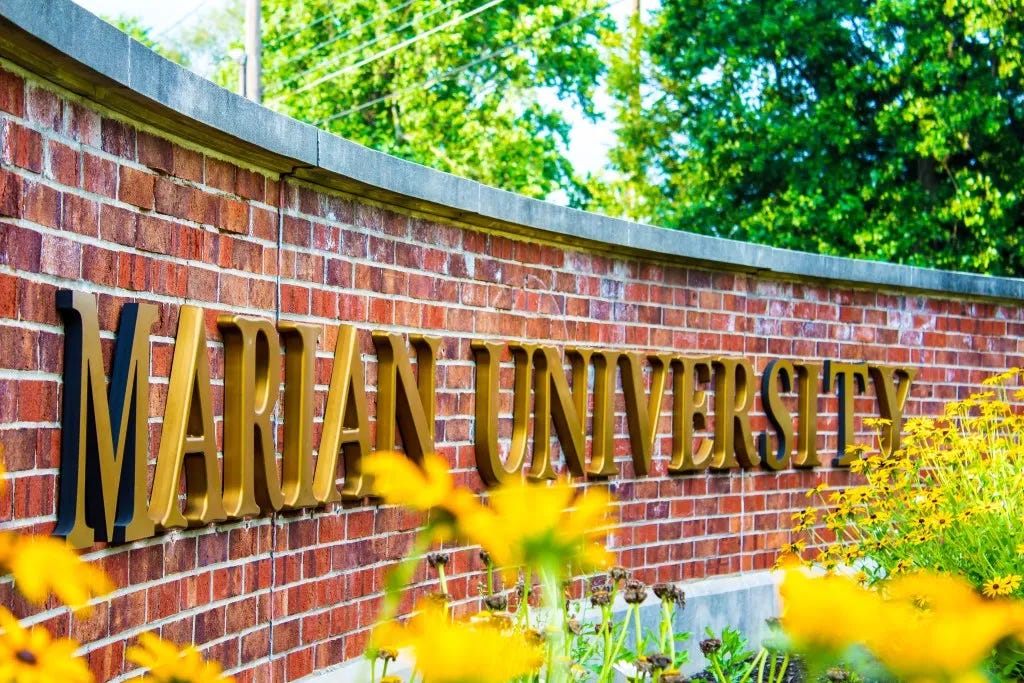
At some universities, like Marian University in Indianapolis, administrators have raced to adjust curriculum to better incorporate AI. Administrators are encouraging faculty to not be afraid of AI, rather to form students to use it in an ethical manner.
“There’s going to be a shortage of teachers and nurses in America. Can AI do either of those jobs? No.” Daniel Elsener, president of Marian University said. “A great educator is involved in an intimate communication between two souls and asks people to think. We are trying to shape our students to be those teachers.”
Other schools, like the University of Dallas, are doubling down on their liberal arts and humanities focus, in part with the expectation that a focused, liberal arts human formation will be more frequently sought after as AI shifts culture and economy.
“The liberal arts are an opportunity to cultivate clear thinking, good writing, creativity in how you approach problems,” Dr. Jonathan Sanford, president of the University of Dallas, told The Pillar. “With AI, I think the liberal arts are going to become more and more the hot commodity.”
The rising costs of college presents another challenge for smaller Catholic institutions.
“Our endowment is sitting at about $100 million, Notre Dame’s at like $25 billion,” Sanford said. “That’s an astonishing difference.”
Embracing mission
With a constellation of looming crises, colleges are looking both to communicate the value of an education and distinguish themselves amongst the competition. Embracing a college’s mission is the first step to revival, presidents said.
At least, administrators say, that’s what led to revival at both Benedictine College and Franciscan University of Steubenville, two schools once on the cusp of shutting their doors.
Curriculum and mission changes after the infamous 1967 Land O’ Lakes Conference, which critics said encouraged Catholic institutions to place academics outside the ambit of faith, contributed to Catholics colleges hemorrhaging money and experiencing declining enrollments.
In 1968, Benedictine College had 1,400 students, after St. Scholastica College — an all girls’college, merged with St. Benedict’s College, the male counterpart.
“From the moment that the Land O’ Lakes document was signed, and we embraced it,” Minnis said, “our enrollment began dropping very quickly, all the way down to 571 students in 1991, which is the lowest enrollment in modern Benedictine college history.”
Eight hundred and fifty miles away, a similar story played out in Ohio where Franciscan also saw enrollment drop in the 1960’s.
When Father Michael Scanlan became president of the university in 1974, he was initially tasked with closing the university. But, Pivoka said that Scanlan saw a path to viability if the college could embrace its Catholic identity, especially as other institutions seemed to downplay theirs.
“Father Michael said … that the university was going to take a different path and look different than other Catholic colleges,” Pivonka told The Pillar.
In 1990, Pope John Paul II published Ex Corde Ecclesiae, an apostolic constitution on Catholic Universities. Leaders at several institutions told The Pillar that embracing that document distinguished from other regional Catholic institutions.
On an enrollment front, that seems to have made a difference.
In the past 20 years, Benedictine College has doubled its undergraduate enrollment from 1086 in 2004 to 2247 in 2025. In the past six years, Benedictine has grown by almost 300 students.
“We embraced our mother, by consecrating the school through Mary, and we embraced our mission,” Minnis said. “We have to continue on that path, if we ever walk away from our mission, if we ever walk away from our love for our lady, we are done.”
For the past 11 years, enrollment has grown year over year at Franciscan. This year, the school welcomed 1,227 new students, enrolling 4,250 across its undergraduate and graduate programs. Average undergraduate enrollment has grown by more than 1,000 students in the past 10 years. Both schools project enrollment to continue growing in the next few years.
As those institutions look to the demographic cliff, both say they have made efforts to double down on mission, believing that if they are upfront about the mission and stay close to the Church, it will be an attractive offering to high school students and families.
“We’re fully embracing the Catholic identity,” Tim Reardon, vice president for enrollment management at Franciscan. “[Some] other schools are trying to figure out how they can maybe hide their Catholicism a little bit to attract other students. You want to be who you are and do it well.”
Loras College in Dubuque Iowa, has take up a similar strategy. Loras has struggled in recent years with declining enrollment — enrolling only 1,300 students in 2023, a 15% decline from a decade prior.
But for the past two years, enrollment has grown, after the college aimed to change its marketing strategies and assess its brand.
Maria Gentile, vice president of marketing and enrollment, said that the boost came after the college changed its marketing strategy and brand to better reflect the institution and make the college more appealing to students.
“We really worked to get our admission reps back out on the road and build relationships on the road with high school students,” Gentile told The Pillar. “We reworked our enrollment and marketing strategies to make sure that it was relevant for who we are as an institution.”
Loras has doubled down on its Catholic identity in recent years, seeking to market it more explicitly and expand faith opportunities on campus. This embrace, Gentile said, has been “very impactful for the community.”
“We have done a lot to share our Catholic mission and vision with our campus community,” Gentile said. “By staying very true to who we are as an institution and as a diocesan Catholic college, we are seeing an increase in students who are identifying as Catholic and we are seeing more students interested in the Catholic programming that we offer on campus.”
Other colleges, like St. Bonaventure’s, are being advised to lean into their Catholic identity as they look to the future.
“We have made the determination and have been advised that the best thing that we can do is to lean into that Catholic Franciscan identity,” Gingerich said. “ It says who we are. It plants the flag in the ground, the values that you’ll receive when you come here.”
A three-pronged strategy
Campus administrators told The Pillar they have identified three areas to mitigate the demographic cliff — embracing mission, offering distinctive programs, and remaining affordable.
In recent years, Catholic colleges have looked at expanding graduate programs and offering degrees that other universities do not offer. Benedictine College has added an architecture and engineering program, the only Newman guide school to offer either, while Franciscan has emphasized expanding graduate programs.
St. Bonaventure has expanded its healthcare school, adding both undergraduate and graduate programs to meet the growing demand for healthcare professionals, specifically in rural America, president Jeff Gingerich told The Pillar.
“We are investing heavily in expanding our work around rural healthcare so that we can meet those needs in society that are getting more and more desperate, and that our students are ready to go out and take on those jobs in those areas,” Gingerich said.
Benedictine College too is planning on expanding into the healthcare market, building off of its existing nursing school. Four years ago, the college announced plans to build a Catholic school of Osteopathic Medicine, for a price tag of an estimated $120 million.
“We’re running out of doctors, there’s going to be this huge crisis in health care,” Minnis said. “There’s a dramatic need for doctors that are going to practice Christ-like medical care and no one is doing this, combining academic excellence while being faithfully Catholic.”
Affordability is another factor on many school’s minds. The University of Dallas has one of the highest sticker prices for private Catholic schools, with annual tuition and housing costing $68,940. The school has made an effort to offer generous scholarships to bring the cost closer, and even lower, than other Catholic schools, Sanford told The Pillar.
“We’ve got a challenge when it comes to why there is this high sticker price while the actual cost is so much less,” Sanford said. “We’re taking a look at how best to address that, so that it more closely represents the reality of what you pay.”
While there are challenges facing administrators, several told The Pillar that small Catholic universities will remain in demand as college demographics shift.
Many small Catholic colleges offer a liberal arts education and humanities courses that administrators believe will be particularly appealing as AI becomes more prevalent.
“We are able to talk to students and their families about the value of a liberal arts education, where we’re not teaching them what to think, we’re teaching you how to think and how to ask critical questions,” Reardon said. “That’s a skill that’s going to be needed regardless.”
The size of the schools also offers a competitive edge for these colleges. Administrators believe that the small size will offer a compelling reason for students to attend as the schools provide a smaller community to navigate and a more personalized academic experience.
“The large classes at public universities is just a model that has been built up to save costs and not to deliver an excellent education,” Sanford said. “We are trying to make the case for why having small classes is better even if you have to pay a little bit more to receive an excellent education.”
As for recruitment, some colleges are looking to large homeschool families. Benedictine College and Franciscan have both been targeting families in recent years. Twenty years ago, 1% of Benedictine’s student body was homeschooled, now it’s 25%.
As part of these changing demographics, the Benedictine College has implemented a great books program, the Sheridan Center for Classical studies, and a classically-based architecture program.
“We believe that the works of the past can inform us about the needs for the future that’s why we offer this to our students who are very interested in that,” Minnis said.
As those schools look to the future, they remain optimistic that high school students and their families will continue to see the value of a college education. Yet, each school has a different growth projection and strategy.
The University of Dallas is projecting enrollment to remain stable, which administrators say is a strategic move to ensure a personalized education for students.
“If our goal were to increase headcount and we’re not achieving it, that’s one thing. If our goal is to continue to maintain our size and do what we do even more excellently, that’s different,” Sanford said.
St. Bonaventure’s administrators, while not projecting enrollment declines, expect undergraduate enrollment growth to slow, which they say fits with their plan.
“Undergraduate is probably going to slow down and that actually fits well for us, we don’t want to become too big,” Gingerich said. “On the graduate side, we could see growth because the demographics are not going to affect that as much.”
While expanding its academic offerings, Benedictine College and other institutions are looking to communicate the value of learning within a Catholic community and demonstrate to students the benefits of attending college.
“You have to demonstrate the value of a Benedictine College education,” Minnis said. “We talk about educating within a community of faith and scholarship so understanding how to build community is going to be one of the most important things.”
That value, administrators know, will always be present as Catholic colleges have a unique, proven education model that is now, perhaps, more important than ever.
“When will the value of an education guided by faith, transcendent values, and larger purpose ever go out of style? Especially in a world where the secular world’s grown mammothly and has shoved religion to the corner,” Elsener said. “What we’re doing now is more important than it’s ever been.”


