The new patriarch of the Chaldean Catholic Church reflected last week on the power of faith amid fear during the homily at his installation Mass last week, and outlined several “principal features” for the future the Baghdad-based Eastern Catholic Chaldean Church.
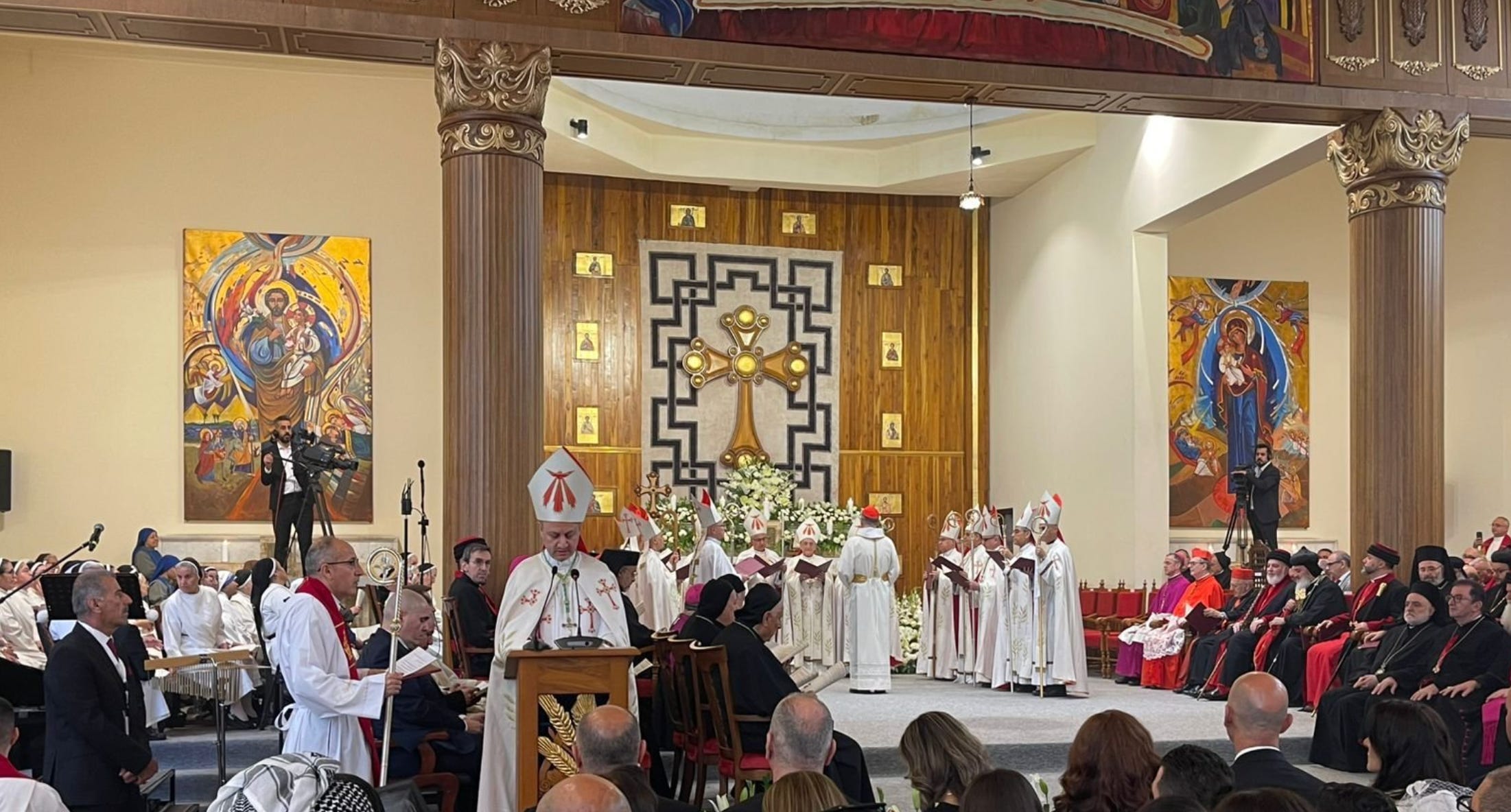
Addressing the congregation gathered at St. Joseph Cathedral in Baghdad, Iraq on May 29 for his installation Mass, Patriarch Paul III Nona aimed to offer an encouraging homily, after months of difficulty for the Chaldean Catholic Church, including the unexpected March 10 resignation of his predecessor, Cardinal Louis Raphael Sako.
“‘Do not be afraid; only believe,’ these words spoken by the Lord, were not merely a word of emotional comfort,” Paul III began his homily, “it was a radical call to an inner transformation: from the logic of fear to the logic of faith.”
—
Nona was elected in April to lead more than 600,000 Catholics belonging to the Eastern Catholic Chaldean Church.
He had served previously as Archbishop of Mosul, Iraq, from which he was forced in 2014 into exile as ISIS took control of the area and Christians fled or were killed, leaving no flock in his archdiocese. He was soon after appointed to lead the Chaldean Catholic diaspora in Australia and New Zealand, serving in that post until his April election as patriarch.
The election came after Sako’s controversial resignation, which concluded a 13-year run as patriarch for the 76-year-old Iraqi prelate. Sako resigned amid controversy over his handling of the resignation of San Diego-based Chalden Bishop Emanuel Shaleta, who stepped down while facing criminal charges of embezzlement from his diocese.
After Shaleta submitted a letter of resignation from his diocesan post in late January, Cardinal Sako consulted with Chaldean bishops about his hope to see the bishop transferred to an administrative post in Baghdad, as a high-ranking official of the Chaldean patriarchate, The Pillar has previously reported.
But despite the firestorm, Sako said in March that his resignation had come freely — rebutting reports that Pope Leo had insisted upon it —“so that I could devote myself quietly to prayer, writing, and simple service.”
“To dispel any misinterpretation,” the cardinal said, “I want to emphasize that no one asked me to do so; I submitted my resignation of my own volition.”
Just a month later, the synod of Chaldean bishops met in Rome to elect Nona, who took the regnal name Paul III.
The bishop was widely considered a front-runner for the post, and a significant break from Sako’s leadership tenure in the life of the Chaldean Church.
Faith over fear
At the beginning of his homily, the patriarch stressed the importance of maintaining faith in the midst of fear. Reflecting on Mark 5:36 ”Do not be afraid, only believe”, Nona noted that the move from living in fear to faith is one marked by inner transformation.
“Faith, in this context, means seeing what cannot be seen and trusting what goes beyond human logic. It means remaining firm when all guarantees are shaken. It means accepting that God is at work, even in the silence of death,” the patriarch said.
Faith, he continued, provides the foundation to realize that trust does not come because “I understand everything, but because I know the One in whom I believe.”
He emphasized that two virtues — faith and trust — would form the foundation for his new mission as patriarch of the Chaldean Church.
“With trust despite the presence of fear; with faith despite our knowledge of the challenges, and with openness to all despite the temptations of withdrawal and closure,” Paul III said. “Today, I receive this mission and this great task with deep humility and great gratitude.”
Six ‘principal features’
After expressing words of gratitude, Nona outlined “some of the principal features of the new stage into which, with the help of the Lord and under the guidance of His grace, (the Chaldean Church) is about to enter.”
The elements were unity, spiritual life, clergy formation, involved laity, maintaining Chaldean culture, and fraternity with other Churches in the Catholic communion.
And amid long-standing concern that the Chaldean Church would increasingly adopt Latin Catholic culture and practice, Nona emphasized the uniquely Eastern elements of the Church’s identity.
“Our Church in the lands of the diaspora must be regarded as a grace, not as a misfortune. It is a true mission and not merely a draining of the nation from within. The presence of our Chaldean faithful in the countries of the diaspora is a new apostolic hope entrusted to those lands,” he said.
“The existence and continuity of our Chaldean Church in the East, and most especially in Iraq, are essential and foundational for our perseverance as a church and as an ancient people with a deep-rooted history and civilization. We shall do all that lies within our power to strengthen this presence in our homeland of Iraq and throughout the countries of the East,” Nona added.
As part of that preservation, he noted that the Chaldean Church must “must see the Church as sent forth for evangelization, or for a renewed evangelization, of societies that need to hear once again the message of faith, with all the reverence, spiritual strength, and fidelity that distinguish our Chaldean and Eastern Christian witness.”
Clerics, especially, should “live as members of one great body rooted in the East, with a historical and living presence there, and not as isolated entities enclosed within themselves.”
Addressing identity directly, Nona emphasized that “we live in a period and within a global culture that seeks to erase identities, merge cultures, and dilute traditions and inheritances, leaving no firm foundation for any value, principle, or moral and spiritual conduct.”
As a solution, Paul III emphasized the need to ensure that the Chaldean eastern tradition might “be the foundation of our entire journey.”
Maintaining this identity is critical today, Paul III shared, as “it grants us a distinct identity in a time of dissolving identities, with all the dissolution of values and principles that follows.”
He continued: “to preserve one’s tradition is not, as some may claim, a refusal to engage with the modern world. Rather, it is the neglect of tradition, heritage, and language that leads the sons and daughters of that tradition to lose their very identity, through which they are able, in a unique and authentic manner, to express their shared faith, thoughts, and beliefs alongside others who belong to different traditions.”
“We are communities united by one faith in God the Father, in His Only Begotten Son, Jesus Christ, and in the Holy Spirit, though adorned with diverse and beautiful traditions, rites, and cultures,” Paul III continued.
He compared the common Catholic faith to a garden, “filled with flowers of many colors and fragrances.” This fraternity, he said, is crucial to the strength and survival of the Chaldean Church.
At the heart of the Christian message, he said, “all that has been said will bear no fruit unless we work together, pray together, and stand together in the one service of the Gospel, faithful to the inheritance that has been entrusted to us.”
Amid his homily, Nona offered a brief acknowledgement of his predecessor.
“I offer deep thanks to His Beatitude Patriarch Cardinal Mar Louis Sako, venerable and blessed, for his long service in our Church, to which he gave most of the years of his life with zeal and passion. We pray that he may enjoy years of rest, stability, and prayer after the weariness of a long journey.”

