New nuncio to US bishops: Let Sacred Heart be source of communion, mission
“Peace, communion, and mission: These are themes for the Church’s public witness."
The new apostolic nuncio to the United States called on bishops Wednesday to look to the Sacred Heart of Jesus as they build communion and proclaim the truth of Christ. The bishop also emphasized his desire to be available as a brother to American prelates, and encouraged them to a relationship of mutual trust during his tenure in the United States.
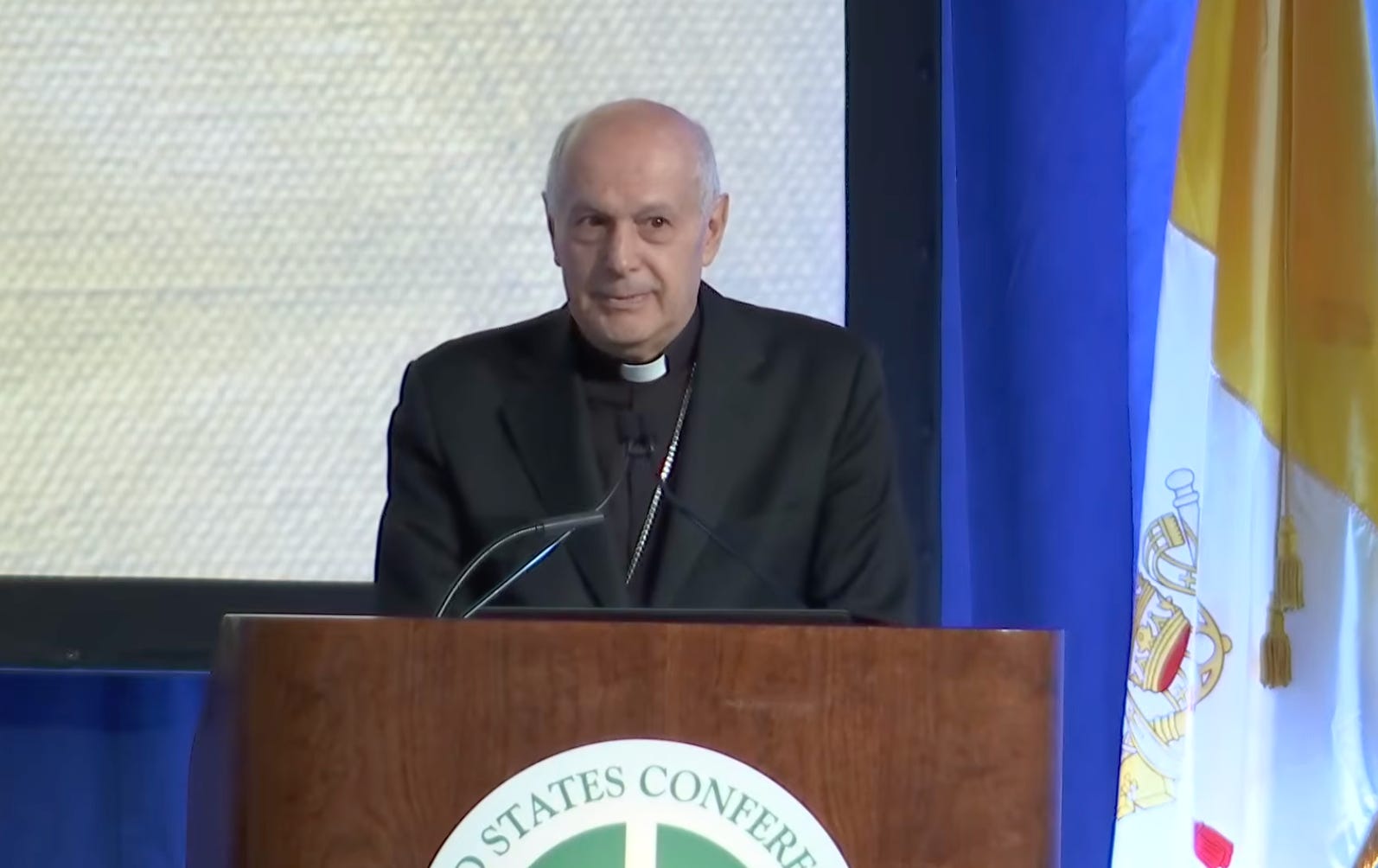
“Peace, communion, and mission: These are themes for the Church’s public witness, but they begin in the way we live our own ministry,” Archbishop Gabriele Caccia said Wednesday in his first address to the U.S. bishops.
Speaking in Orlando at the annual summer gathering of the U.S. Conference of Catholic Bishops, Caccia emphasized the importance of offering a credible witness in order to renew and purify the Church.
“In a world that sees more and more conflict arising at all levels— within the family, the workplace, and even in national and international relations—as followers of Jesus we are called to witness to another way,” he said.
“This way is the peace of the risen Christ. A peace that, as the pope said, ‘is unarmed and disarming, humble and persevering. A peace that comes from God, the God who loves us all, unconditionally’.”
Caccia pointed to the upcoming consecration of the country to the Sacred Heart of Jesus on Friday. He encouraged the bishops to turn to the Sacred Heart as the anchor of unity for their own ministry as they work to build peace and communion with those around them.
He also voiced his desire to build communion in his own role as nuncio, through his work with the bishops of the United States.
“I know that the ministry of a bishop carries many responsibilities, some of which can feel isolating,” he said. “I hope you will feel free to speak with me in open conversation and dialogue, being assured that my service here is one of listening, trust, and shared discernment within the Church that we are all serving together.”
The call for mutual trust as the new nuncio kicks off his tenure in the United States comes after the retirement of the previous nuncio, Christophe Pierre, who at times had a rocky relationship with the U.S. bishops. Pierre openly criticized the bishops in a 2023 interview and delivered remarks to the conference that were viewed as negative, prompting what was widely perceived as a thinly veiled response to the nuncio from then-conference president Timothy Broglio.
From communion flows the call to mission, Caccia said. He again pointed to the Sacred Heart of Jesus as a model for this work, saying that at its core, missionary work is not offering a program, but the love of Jesus.
Missionary work does not only involve traveling to foreign lands, he continued, but can also be an attitude toward every person one encounters.
“To meet them with the charity of Christ, to recognize their dignity, and to help them find a place in the life of the community is also part of a missionary Church,” he said.
A missionary approach is also necessary to encounter the new realities of the modern world, the nuncio said, in particular noting the questions posed by artificial intelligence.
“Pope Francis reminded us that no algorithm can capture the depth of the human heart. Pope Leo now asks how the Church can help safeguard the human person on this new frontier,” Caccia said.
“The answer cannot come only from techniques or policies, necessary as these are. It must come from a renewed Christian humanism, rooted in Christ who reveals the human person to himself and teaches us the path of love.”
This understanding of the human person is what “allows the Church to meet new realities without naïve enthusiasm or anxious fear,” the nuncio said. “It also reminds us that the Church’s response is built in communion, not in isolation.”
Caccia offered each of the bishops a booklet containing the Vatican II dogmatic constitutions, Lumen gentium and Dei verbum.
These texts, he said, “remind us who the Church is, and how the Church listens to the Word of God. They bring us back to the sources of our communion and mission.”
“This continuity is important,” he said. “We are not beginning again from zero. We receive a living tradition; and above all, we receive the love of Christ, poured out from his heart for the life of the world.”
Archbishop Paul Coakley of Oklahoma City also spoke to the conference on Wednesday.
In his inaugural address as conference president, Coakley encouraged the bishops to move boldly beyond their comfort zones in order to proclaim a message of hope to a world that desperately needs it.
“The Church’s witness to Christ, to the Good News of the knowledge of Jesus, is needed in every generation, but today, in an age of constant flux, of forced migration, polarization, disruptions, climatic and economic upheavals, artificial intelligence, and wars, in a time when so many are wondering what it even means to be a human person, to restore hope, in such a time as this, the truth of Christ must be proclaimed all the more confidently,” he said.
Coakley stressed the country today faces many challenges to hope.
The bishops should work to help restore hope where it has been lost, he said. This is done in large part by defending human dignity wherever it is being attacked – through threats to the unborn, elderly, and sick, as well as through acts of racism, abuse, or mistreatment of the poor.
“Society tends to disregard and cast aside what it deems useless,” Coakley said. “But life, human life, can never be adequately valued based on it being useful or useless. Or a burden or unworthy of protection.”
“To restore hope necessitates preaching exactly that – that life is a gift from God. Every life has value and dignity, and we cannot forfeit that dignity, even when it is besmirched by sin and wickedness. It comes from God.”
The bishops can also promote hope through efforts to reduce polarization, Coakley continued.
“Polarization within our country, and even within our Church, is a scandal that can only be overcome through encounter, through the cultivation of interpersonal relationships and conversations between those who may disagree,” he said. “We must never give up on those who are different or see things differently. We must continue to proclaim the truth of Christ, and the dignity given to each person by the Lord.”
The archbishop said the conference is “working on ways to promote faithful citizenship – through dialogue, deeper realization of who is our neighbor, and by placing faith before politics – a faith that inspires hope, respect, and the pursuit of the common good.”
Coakley said he is grateful for his “cordial visit” to the White House last January, while also acknowledging the need for further progress.
“[W]e must stay in the conversation,” he said, citing a theme often emphasized by the pope: “Now is the time for dialogue and building bridges.”
The conference president also encouraged the bishops to reach out with a message of hope to the unaffiliated and disaffiliated, and to consider concrete acts of witness – such as 250 works of mercy and 250 hours of adoration in recognition of the country’s 250 anniversary this year.
“I know that we have much work to do before we rest, but we are comforted by two things – we are in this vineyard working together, and, in the end, it is the Lord who will accomplish it all,” he said.


Archbishop Coakley only used the word "synodal" once. Archbishop Caccia, from what I could tell, did not use it at all.