
Nicaraguan bishop appears in regime interview six weeks after disappearance
Bishop Mata had not been seen since being taken into custody June 29.
Nicaraguan Bishop Abelardo Mata, SDB, emeritus Bishop of Estelí, appeared this week in an interview with a regime-controlled TV station, his first appearance since being taken into police custody six weeks ago.
In the interview, Mata claims to be well taken care of and said he has received visits from a brother and a niece at his residence. However, local observers have raised alarm at what appears to be an unofficial house arrest, as the bishop has not been publicly accused of any crimes.
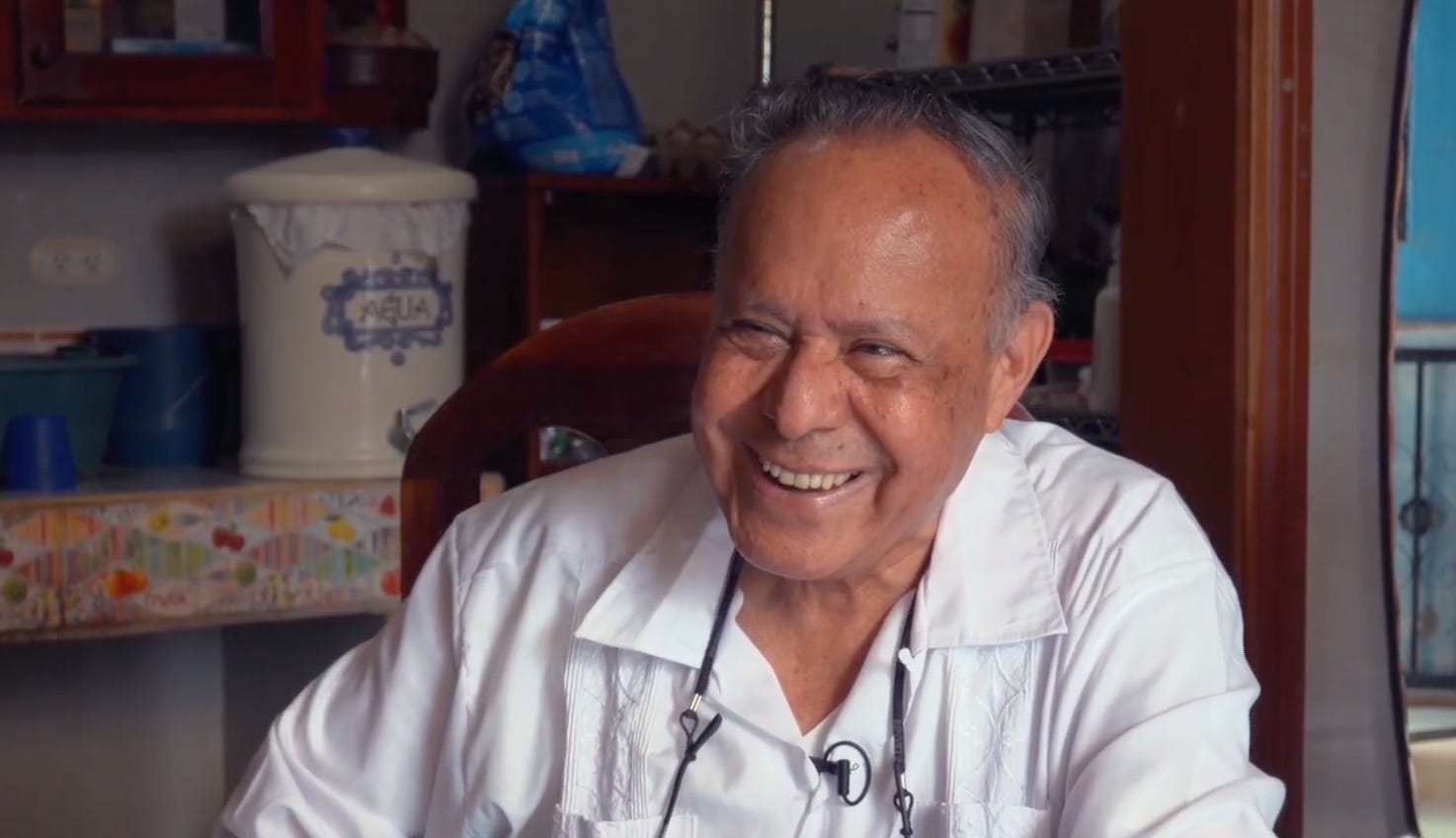
Mata, who is 80 years old, was taken into police custody on June 29, following a homily mentioning the persecution of the Church in the country.
The bishop was taken from a local hospital, where he was undergoing a checkup related to his pacemaker, and was brought to a regime prison, where he was held for several hours, according to local media.
On July 4, the Nicaraguan regime published a statement claiming that Mata had returned to his home “in perfect condition,” after “a necessary inquiry on the origin of properties and family links that are incoherent with the priestly condition” of the bishop.
“Mata has provided [authorities] with statements on different events that violate national laws… After returning with his residence, Bishop Mata acknowledged that he was treated in every moment with the due respect and consideration that characterizes Nicaraguan law enforcement.”
Following international pressure, Canal 4, a regime-controlled publication, released an interview with Mata on August 13.
The video depicts Adolfo Pastrán, an MP of the Nicaraguan regime, visiting Mata at his home. Pastrán described Mata as “an old friend.”
The video depicts the pair walking around Mata’s farm. The bishop mostly talks about his crops and horses. Pastrán asks him if he’s being taken care of, and Mata says, “Yes, that’s not an issue.”
Afterward, Pastrán asks if he has received visits from his family. Mata says that he’s received visits from his brother and niece, but that he is not a very social man.
“I like silence, study, and prayer. I’m in my corner, leading a monk’s life… prayer, intellectual work.”
The interview comes less than 24 hours after the Inter-American Commission of Human Rights called for “urgent measures” to guarantee Mata’s wellbeing.
Human rights activists had demanded a proof-of-life, voicing doubts that the bishop was actually at his residence.
A source close to the Nicaraguan bishops’ conference told The Pillar in July that “the police returned hours after they had taken Bishop Mata home, and his family lost contact with him. Some outlets have said he’s under house arrest, but no one really knows where he is, his family has no access to the house, which is surrounded by police.”
“He could be there, but it also may be the case that they’re just surrounding the house to make people believe he’s there, while he’s actually in El Chipote,” the source said. El Chipote is a Nicaraguan regime prison, which human right activists have described as a torture center for political opponents and priests.
On the same day that it released the interview, Canal 4 also published an unnamed op-ed, criticizing that the “coup-promoters and propagandists of the right said that [Mata] was disappeared, ‘kidnapped,’ ‘tortured,’ or ‘in danger of death… the Inter-American Commission of Human Rights, a discredited organization that is in favor of coup-plotters… joined this media war.”
“But once again, truth prevailed over lies… because Bishop Abelardo Mata himself voluntarily and calmly gave an interview to Adolfo Pastrán. Mata looked serene, joyful, vigorous, and agile, he spoke with naturality and walked without difficulties in his property,” the article added.
In 2024, the same outlet had published an article calling Mata “the emeritus devil.”
Mata served as the bishop of Estelí between 1988 and 2021. He is well known for his opposition to the Nicaraguan regime, especially during the 2018 protests in the country. In July 2018, the bishop’s car was hit by gunfire from members of a paramilitary group connected to the Nicaraguan regime as he was travelling to Managua, the country’s capital.
The Nicaraguan regime had previously barred Mata from returning to his diocese and celebrating Mass there, but the retired bishop defied the ban, arriving in Estelí on Thursday, June 25, and celebrating Mass publicly on Sunday, June 28. It was during that Mass that he asked for prayers for the “persecuted Church in Nicaragua” and for exiled Bishop Rolando Álvarez, according to La Prensa.
A local source told La Prensa that several other people had been arrested and interrogated alongside Mata on June 29.
Nicaragua, a country of around 7 million people bordering Honduras and Costa Rica, is led by an authoritarian regime that dates back to 2007, when Sandinista Front leader Daniel Ortega, who served as president from 1979 to 1990, returned to power. The regime launched a crackdown on the Church following mass protests in 2018.
Since the start of the persecution against the Catholic Church, the Nicaraguan regime has forced the closure of dozens of Catholic TV and radio stations, the dissolution of the legal structures of religious congregations, Catholic universities, and Catholic foundations, and the seizure of their properties.
Several religious orders have been forced to leave the country, including the Jesuits, the Franciscans, the Missionaries of Charity, the Poor Clares, the Discalced Carmelites, and the Missionaries of the Sacred Heart.
More than 250 clergy and religious have been forced into exile, including four bishops and almost one-fifth of the country’s priests.
The Diocese of Matagalpa has been hit particularly hard, losing over 60% of its clergy, including its bishop and most of its diocesan curia. The regime also seized the local seminary in 2025.
Matagalpa was home to Bishop Rolando Álvarez, widely seen as one of the most stringent critics of Ortega. His criticism of the regime led to his arrest in August 2022, and his subsequent 25-year prison sentence on charges of conspiracy.
After beginning his prison sentence, Álvarez was exiled to Rome in January 2024 and has lived there ever since.
Bishop Isidoro Mora of the Diocese of Siuna, who was detained after he mentioned Álvarez in a homily in December 2023, has also been in exile since January 2024.
Bishop Carlos Herrera, OFM, president of the Nicaraguan bishops’ conference, was forced into exile in 2024 after criticizing a pro-regime mayor during Sunday Mass in the Jinotega cathedral.
Bishop Silvio Báez, OCD, auxiliary bishop of Managua, has been in exile since 2019, first in Rome and then in the United States, after receiving death threats from the Nicaraguan regime.
"he was treated in every moment with the due respect and consideration that characterizes Nicaraguan law enforcement.”
Lord have mercy.
I am curious how someone can write something like that. Do they find it humourous? Is it like a knowing wink that they don't believe what they are writing?