
A bishop ordered Monday the closure of Catholic institutions and the withdrawal of pastoral workers from a town in Nigeria’s Middle Belt, following a wave of arson attacks on Church properties.
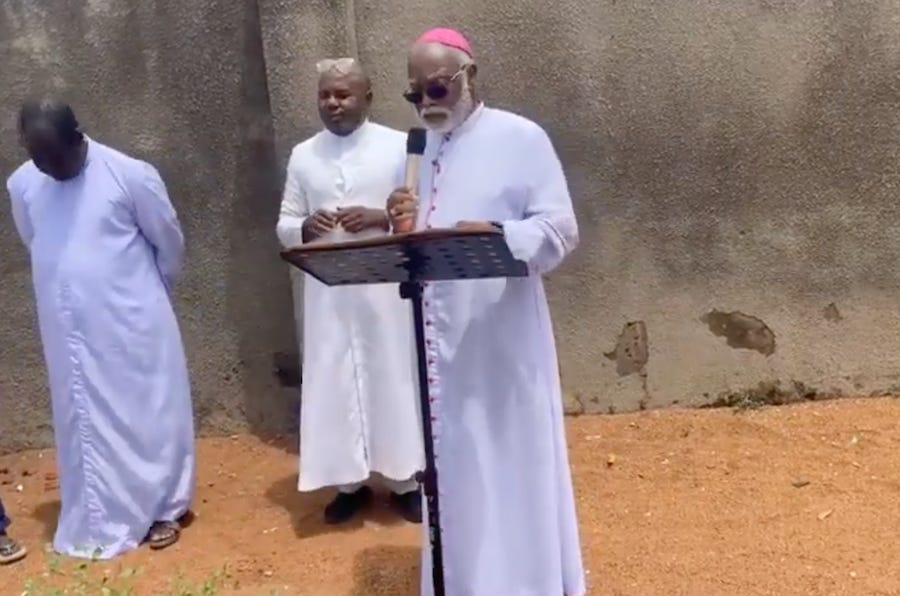
Bishop William Avenya of Gboko said in an Oct. 12 pastoral letter that he was taking the step in response to “a systemic pattern of hostility and destruction directed at Church-owned properties” in Ihugh, Benue state. The letter did not identify those responsible for the attacks.
Ihugh is the hometown of Fr. Hyacinth Alia, a priest of the Diocese of Gboko who was suspended by Avenya before running successfully for governor of Benue State in 2023.
In the pastoral letter, Avenya wrote: “The Church cannot, in conscience, continue to expose her priests, consecrated persons, teachers, medical personnel, students, and patients to danger, nor continue to invest the resources of God’s people where they are not safe and are not valued.”
The bishop said perpetrators had targeted Catholic institutions in Ihugh, which is located in Vandeikya Local Government Area, “over a considerable period.”
The earliest incident he cited took place on June 21, 2024, at the reopening of St. Thomas Hospital, Ihugh, which has been run under the leadership of religious sisters. Avenya said that local residents held placards and chanted slogans indicating that “they no longer want the Reverend Sisters to work in Ihugh.”
The bishop also cited four separate arson attacks on student hostels belonging to St. Winifred Girls Secondary School, Ihugh. He said the arson attacks took place on Oct. 28, 2025, and May 10, May 15, and Oct. 11, 2026.
He said the incidents had “destroyed the shelter of young people entrusted to our care, wiped out the labor and sacrifices of many years, and placed the lives and safety of students, teachers, and staff in grave danger.”
Avenya also cited “consistent burglary issues” at St. Winifred Parish, Ihugh, the sole Catholic parish in the town.
The bishop stressed that before making the decision to withdraw from the town, the diocese had sought dialogue with local leaders. Ihugh is located in an area associated with the Tiv people, an ethnic group that accounts for around 3.5% of Nigeria’s population.
Avenya wrote: “The diocese has met with the host community, engaged the traditional rulers and elders of the land, and brought these grievances before the relevant civil and security authorities, all in the hope of finding a just and lasting peace.”
“We have listened, we have appealed, and we have waited patiently. Sadly, these sincere efforts have not yielded the peace, security, and guarantees that the continued presence of our institutions requires.”
“We have done all that depends on us. The attacks have continued, and no assurance of lasting safety has been secured.”
The bishop said that, following consultations in the diocese, he decreed the closure of St. Thomas Hospital, St. Winifred Secondary School, St. Winifred Nursery and Primary School, and St. Winifred Parish, effective Oct. 12.
Avenya said the closure was “temporary in intent, though indefinite in duration.” He added that it would remain in force until he decided “the conditions for a safe and peaceful return have been truly and lastingly met” and issued a further decree reopening the institutions.
He also ordered the withdrawal of all pastoral agents linked to the closed institutions. This covered all priests, including the chaplain of St. Thomas Hospital, all religious serving in the parish, schools, and hospital, and all catechists deployed by the diocese.
He said that all teaching and non-teaching staff, as well as medical and administrative personnel, serving under diocesan authority would be “redeployed, reassigned, or otherwise provided for.”
Avenya decreed that no one should resume their duties at the closed institutions or exercise ministry on behalf of the Diocese of Gboko in the town without his written authorization.
He also ordered the transfer of parish registers and archives to the diocesan archives, and the removal of the Blessed Sacrament, sacred vessels, and sacred objects.
The bishop said the diocese would help students to continue their education at other diocesan schools, while patients at St. Thomas Hospital would be transferred to other health facilities.
”Staff affected by this decision will be treated with justice and charity, in accordance with Church teaching on the dignity of labor,” he wrote.
Avenya, 71, has led the Diocese of Gboko since its creation by Pope Benedict XVI in 2012. According to its website, the diocese serves 1.6 million Catholics out of a total population of 2.4 million, with 270 incardinated priests.
Addressing the population of Ihugh, including its leaders and young people, the bishop wrote: “We bear no ill will toward our brothers and sisters, many of whom have known only the good that these institutions brought. But we say plainly that violence, arson and destruction are contrary to the Gospel, contrary to the dignity of the human person, and contrary to the good of the community itself.”
“They impoverish the very people they claim to defend, depriving children of education, the sick of healing, and the faithful of worship.”
“We call upon those who have the power to restore peace, whether elders, traditional rulers, youth leaders, or public officials, to do so in justice and truth.”
He added: “We also call on the law enforcement agencies and the government at all levels to do their duty to protect lives and property, and to bring to justice those responsible for these acts.”
Avenya asked members of the Gboko diocese to offer prayers and do penance for a resolution. He declared that Oct. 23 would be a day of prayer and fasting for reconciliation.
”May Our Lady, Queen of Peace, St. Winifred, St. Thomas the Apostle, and all the saints intercede for us and for the people of Ihugh,” he wrote.