‘No invite,’ or ‘no fly’? Nicaraguan cardinal absent from Rome consistory
Cardinal Leopoldo Brenes has said he was 'not invited' to the consistory, but sources in Nicaragua say he may be afraid to leave the country.
Nicaraguan Cardinal Leopoldo Brenes has said he did not attend the Rome consistory because he “was not invited” — but local observers believe the cardinal was likely prevented from leaving the country by the Ortega regime and has chosen not to state that publicly.
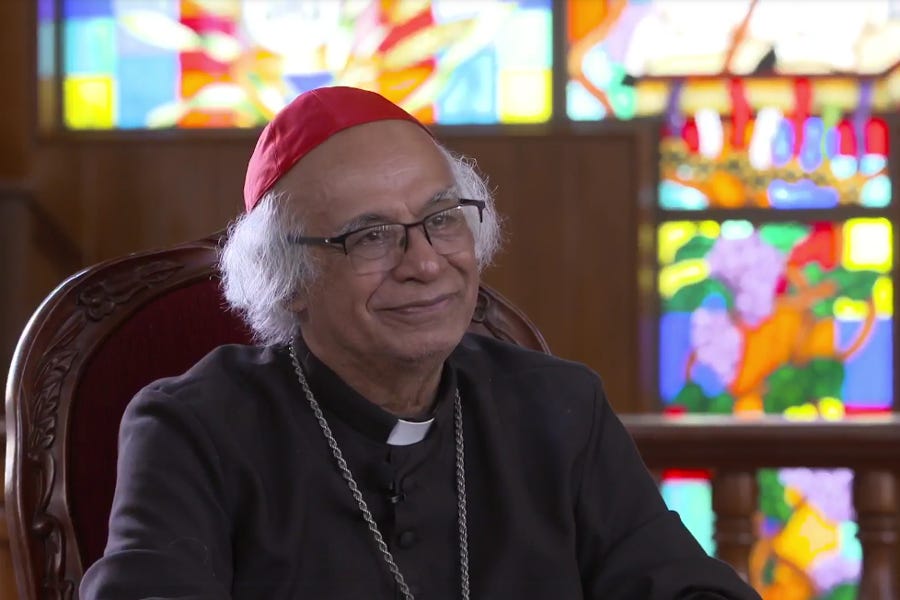
Brenes, Archbishop of Managua, said in a television interview after a Mass in the Nicaraguan capital, that he would not attend the Jan. 7-8 consistory in Rome because he had not “received an invitation.”
“I’ve been checking my email, my WhatsApp, and the communications of the College of Cardinals,” he commented.
Brenes instead stayed in Managua, where he celebrated Mass in the cathedral as cardinals from around the world began their meeting in Rome.
However, despite the cardinal’s public statement, sources close to the Nicaraguan bishops’ conference told The Pillar it’s unlikely Brenes was not invited to the consistory.
“It’s more likely that he was invited but was not allowed to leave the country by the regime, but he won’t say so in government-controlled national media, knowing that other bishops would also see the news,” one Nicaraguan priest said.
Another source close to the bishops’ conference said Brenes was constrained by fear of the regime, particularly after four other Nicaraguan bishops — including his auxiliary, Bishop Silvio Báez — were forced into exile.
Nicaragua, a country of around 7 million people bordering Honduras and Costa Rica, is led by an authoritarian regime that dates back to 2007, when Sandinista Front leader Daniel Ortega, who served as president from 1985 to 1990, returned to power. The regime launched a crackdown on the Church following mass protests in 2018.
The source said: “Brenes doesn’t like going to Rome. Brenes doesn’t like leaving Nicaragua. And with what’s going on in Venezuela, repression in Nicaragua has worsened. Brenes’ great fear is that he will not be allowed to return if he leaves the country, which is why he skipped meetings of the Central American and Latin American bishops’ conference.”
The source added: “It’s a weak excuse because in this time and age, everything is known. All cardinals were invited. Brenes doesn’t like to travel because he doesn’t know if he’d be allowed to return. He lives in constant fear. He went to the conclave because it was an obligation tied to his position. But he’s afraid and tired. He has said more than once [in meetings] that he wants to retire.”
Brenes, who has led the Archdiocese of Managua since 2005, will turn 77 in March.
Senior Church sources told the Nicaraguan outlet La Prensa that Brenes received an invitation to participate in the consistory, but refused to go for undisclosed reasons.
According to La Prensa, it is likely that Brenes is in the middle of negotiating an agreement with the regime regarding the current situation of the Church in the country. But the details of such an agreement are unknown.
In the past, the Ortega regime has used the exile of priests and seizure of Church property to try to force the Church to appoint a regime-friendly successor to Brenes in Managua and pressure the resignation of the bishops in exile to the same end.
That tactic hasn’t been fruitful for the regime, though it has forced more than 20% of Nicaraguan clergy into exile.
Brenes himself has frequently been accused of silence in the face of persecution, and at times accused of collaboration with the Nicaraguan dictatorship. The cardinal’s supporters, on the other hand, say that he has aimed to defuse tension when possible and to preserve whatever freedom is left for the Church.
In March 2023, three current and former seminarians of Managua published a letter criticizing Brenes for allegedly allowing the regime to infiltrate the seminary and the diocese to report the most politically active priests and seminarians to the government.
The letter provoked uproar against Brenes among clerics — especially after the Managua auxiliary Bishop Silvio Báez, now exiled in Miami, shared it on social media.
“The seminary is currently the most disappointing and mediocre place to be in Managua,” the letter’s authors wrote. “We have been forced for some time now to absolute silence: talking about the reality of the country in class, at meals, in our social media, and in prayer is forbidden.”
“When Msgr. Silvio Báez was exiled [in 2018], we were not allowed to say anything. When they began to take civil society leaders prisoner, we were not allowed to say a single prayer.”
“When they took Matagalpa, and [local] Bishop Rolando Álvarez was imprisoned, he was mentioned very few times in the Eucharist,” the letter added.
The authors charged that, despite a culture of silence in the seminary, there were “seminarians sympathetic to the Sandinista Front who report our activities” to political authorities — seeming to allege that seminary administrators had failed to address the presence of government informants.
“His Eminence, as so many sweet-talking seminarians love to call him, has never once expressed himself about the reality of the country and the Church, or about Bishop Rolando,” the letter said of Brenes.
“The Church has two faces in Nicaragua: that of Bishop Álvarez, capable of convoking Catholics around a prophetic dimension, and that of the Nicaraguan bishops’ conference, and especially the Cardinal [Brenes],” a foreign priest and long-time missionary in Nicaragua, told The Pillar when the letter was published.
“I shared a parish with Brenes before he became a bishop. I’ve been in many meetings with him and I know him very well. I know he is too timid, too shy to denounce persecution,” the priest said.
“He also has a lot to be grateful for from the government. He has received favors from them, and they want to use him — and he allows them to. That’s why he doesn’t say anything, he doesn’t denounce anything.” the priest added.
Questions about the cardinal’s independence are not new.
In 2017, he was criticized for blessing a pro-government candidate running to become mayor of Managua, doing so after the legal window for campaigning had ended.
He has also been criticized for choosing public supporters of the Nicaraguan dictatorship in his inner circle, even while the bishops mediated a standoff between Ortega and his political opponents in 2018.
The head of Brenes’ security detail was, until 2020, also an outspoken supporter of the Ortega regime. Local activists said the security official was with Brenes constantly while the Church mediated the national dialogue in Nicaragua, serving as both his secretary and driver.
During the 2018 mediation, local media reported that an official photographer of Ortega’s — with close and regular access to the Nicaraguan president — had been hired by the Archdiocese of Managua to photograph the cardinal.
The move drew criticism in some Church circles, especially when it became clear that government officials knew the cardinal’s schedule in detail, usually days before it was made public or other Church officials knew it.
The relationship between Brenes and Bishop Álvarez, who was exiled in Rome after a year and a half in a Nicaraguan prison, soured after Álvarez was jailed.
Brenes was the only non-family member allowed to visit Álvarez once in the first months of his imprisonment. Sources close to the Nicaraguan bishops told The Pillar that Brenes tried to convince Álvarez to immediately accept going into exile, and Álvarez felt Brenes was allowing himself to be manipulated by the regime.
Various sources told The Pillar that Álvarez and Brenes have not spoken since Álvarez was exiled to Rome in January 2024.
In February 2023, Brenes directed Managua’s priests to obey police orders prohibiting Lenten and Holy Week processions, even though clerics in other parts of the country had defied prohibition orders.
When the Nicaraguan dictatorship announced in March 2022 that it had formally suspended diplomatic relations with the Vatican, Brenes again refused to condemn or criticize the move.
“These are terms I don’t know about; some say breaking of relations, others say suspension. These are matters of law and of state, so I don’t want to get in any trouble,” the cardinal said.
At the same time, some Nicaraguan activists have claimed that Brenes has directed exiled priests not to speak with the media, even while they are abroad, lest they lose their faculties for ministry.
“I can confirm that priests who have been critical of Ortega, and gone into exile, have been told by Brenes not to talk to the media or they won’t be given the letter that accredits them as priests ordained in Nicaragua,” a source close to the bishops’ conference told The Pillar.
One exiled priest from the Archdiocese of Managua confirmed in 2023 that he had been directed not to speak with the media.

So, reading between the lines, at best we can believe that Cardinal Brenes somewhat spinelessly tries to appease the Ortega regime out of some sense of self-preservation and protection of his priests - which I can moderately understand, even if I don't really like it.
But at worst, we could draw the conclusion that he's quietly supportive of the left-wing dictatorship under which he serves and is willing to act as a toady or lackey, even if it means throwing his own priests and brother bishops under the bus.
This is a pretty pathetic lie, unless he's just trying to talk in code (e.g., blink twice if you need help). Could have at least have made up something that would not be obviously false, or something that would technically be true, like a scheduling conflict.