An organization overseeing almost 600 Catholic schools in the Australian state of New South Wales announced Friday that it had fired its chief executive, days after he appeared before a state corruption watchdog inquiry, and erased his phone and iPhone hard drives amid the corruption probe.
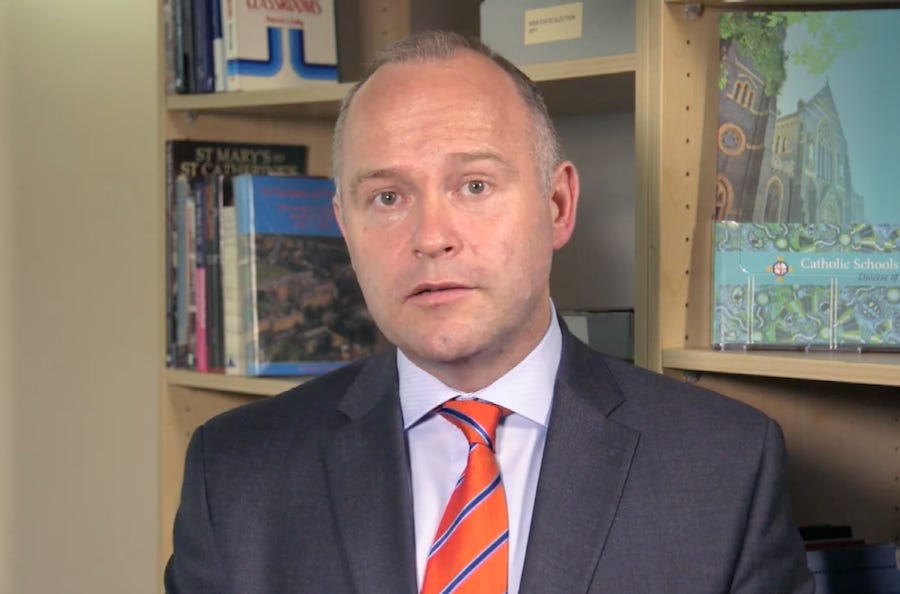
Catholic Schools NSW said Aug. 21 that its board had “unanimously determined” that CEO Dallas McInerney no longer enjoyed the confidence required to lead the body into the future.
Catholic Schools NSW added that the board had terminated its employment agreement with McInerney, who had served as chief executive since 2017, with immediate effect.
The move came after McInerney’s appearance before an inquiry by the NSW Independent Commission Against Corruption known as Operation Rosny.
The commission is investigating allegations that McInerney channeled political donations via Catholic Schools NSW to the Reformers, a Christian conservative faction of the New South Wales division of the Liberal Party of Australia, without properly disclosing the transfers and potentially in breach of donation limits.
The inquiry is particularly sensitive because Catholic Schools NSW — an organization whose members are the 11 diocesan bishops of New South Wales — is responsible for distributing more than A$3 billion (about US$2.15 billion) of public funding each year to the state’s Catholic schools.
Public financial support for schools with a religious ethos is a controversial issue in the state, which has a population of 8.6 million and covers part of Australia’s eastern coast, including Sydney, the country’s most populous city.
McInerney, who stood aside as CEO in July after being named in the inquiry, insisted during a three-day appearance before the commission that the payments amounting to around A$265,900 (US$188,000) over four years were for legitimate consulting work.
McInerney also told the inquiry that he had performed a factory reset on his work phone and iPad at the weekend after giving evidence to the commission on Aug. 13 and 14.
McInerney, who appeared again before the inquiry Aug. 19, explained that he had reset the phone after his bank informed him that his account had been compromised via his Apple ID and Apple Pay. He said he had reset the iPad ahead of returning it to Catholic Schools NSW, “in the realization I’m not likely returning to the company.”
He denied the suggestion that he had sought to wipe evidence of critical importance to the commission, noting that he had known about the inquiry for weeks before resetting the devices.
“Had I wanted to do any malfeasance of that nature, I would have had quite a runway to do that,” he said.
In its July 27 opening statement, the counsel assisting the commission said the inquiry was focused on possible unlawful political donations by individuals and entities made through companies for the benefit of the Reformers.
It said the Reformers sought to recruit or renew the memberships of Christian conservative members in branches of the NSW Liberal Party, a practice known as branch stacking, which is not considered corrupt conduct in itself.
The opening statement said the evidence would show that McInerney was “an influential factional heavyweight and powerbroker within the NSW Liberal Party” who was “aligned with the party’s Right faction, and shared the values and political objectives of key Reformers he had come to know.”
Catholic Schools NSW, known by its acronym CSNSW, said Aug. 21 that it did not intend to make any statement “regarding the inquiry or key witnesses” until the initial examination had been completed. But it expressed support for an independent review of its own operations.
The body noted that in its opening statement the counsel assisting the commission said there was no suggestion that Catholic Schools NSW was responsible for the alleged conduct under investigation, nor that any board members or members of the executive were aware of McInerney’s purported actions.
“The matters that are the subject of the inquiry are, though, of deep concern to CSNSW and to its key stakeholders,” the organization said.
“The board will work constructively with them to ensure there is an externally conducted review of CSNSW’s operations.”
Interim chief executive Peter Yates will continue to lead CSNSW — which oversees 594 Catholic schools, comprising around 274,000 students — until a permanent replacement for McInerney is found.
McInerney was a risk and compliance officer with the regulator Australian Securities and Investments Commission from 1999 to 2001, when he became a senior adviser on economic and regulatory affairs at the Insurance Australia Group.
From 2005 to 2009, he was a manager responsible for regulatory affairs at the MLC, an Australian financial services and wealth management company.
He served as general manager of government and public policy at National Australia Bank from 2009 to 2017, when he was appointed chief executive of CSNSW.
