The Holy See published on Monday the topics and preparatory document for an October meeting of presidents of bishops’ conferences and heads of Eastern Churches, who will gather at the pope’s request to discuss Amoris Laetitia.
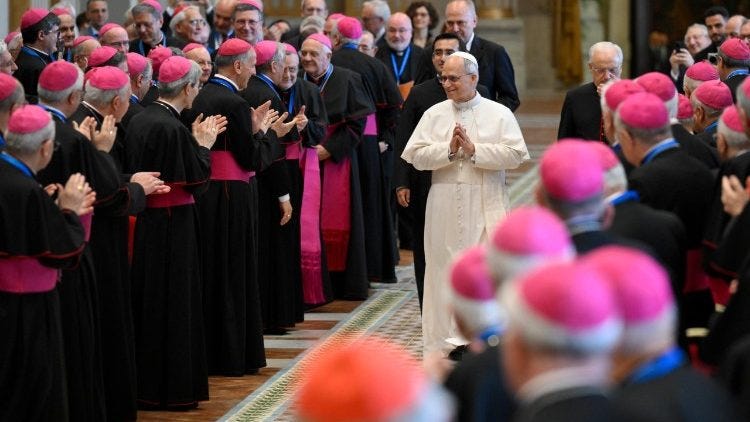
The meeting — which will also involve several families sharing their experiences — has been widely taken as a sign of Pope Leo’s ongoing intention to consult broadly among bishops on topics that have been in recent years controversial in the Church.
Between October 7-14, the participants will discuss five thematic areas, including the Church’s pastoral commitment with families, marriage and young people, the first years of marriage, marriage as mission, and walking with families in complex situations.
—
Pope Leo announced the meeting in a March 19 letter marking the tenth anniversary of Amoris Laetitia, Pope Francis’ apostolic exhortation after the 2014-2015 synod on the family.
Last month, the pope announced that several families would participate in the meeting to share their life experiences.
“Their presence is essential. At the same time, I hope that all those who come will prepare by listening closely to, and bringing with them, the experience of the families in their own Churches,” the pope in June.
Although the meeting is not a Synod of Bishops, the Holy See announced it will be conducted following a synodal style, which most likely means it will mostly consist of small group discussions instead of plenary sessions.
The Dicastery for the Laity, Family, and Life said in a statement announcing the topics that the meeting was intended “to provide a genuine space for encounter, listening, and discernment: welcoming the lived experience of families, sharing concrete stories of life, reflecting on the pastoral initiatives through which the ecclesial community accompanies families, and engaging in dialogue with experts.”
The dicastery also added that bishops’ conferences and Eastern Catholic Churches should begin reflecting on the topics, “placing particular emphasis on listening to the families of their local Churches.”
“This is, therefore, an eminently pastoral journey, one that places families at its centre not merely as recipients of the Church’s pastoral care, but as active subjects of her mission, through whom the Gospel takes flesh in everyday relationships, choices, struggles, and hope,” the statement adds.
The dicastery also announced a thematic framework with topics to be discussed during the meeting, and urges bishops to listen to the experiences of families themselves ahead of the meeting, “recognizing together both the beauty of love as it takes shape in daily life and the fragilities that often affect it, including precarious employment and housing, illness, the challenges of raising children, emotional loneliness, and the care of family members with disabilities, the elderly, or those who are not self-sufficient.”
The discussion topics will include the issue of pastoral care for Catholics who have been divorced — who are statistically more likely to discontinue religious practice. While that topic has been in the past fraught with controversy over questions surrounding sacramental ministry.
In October, discussion will center around a different approach to the issues, with the question: “How can Christian communities be built in which those who have experienced suffering, abandonment, separation and divorce may truly feel listened to, involved and co-responsible?”
Further, the discussion will take up the question of how families can be understood and commissioned as missionaries, drawing on the experiences of learning the “languages of love, day after day,” in family life.
—
Pope Leo XIV invited the presidents of the world’s episcopal conferences to meet in Rome in October 2026 “to proceed, in mutual listening, to a synodal discernment on the steps to be taken in order to proclaim the Gospel to families today” on March 19, saying that the meeting should take place “in light of Amoris laetitia and taking into account what is currently being done in the local Churches.”
Amoris laetitia was the result of the two-year Synod on the Family, celebrated between 2014 and 2015. While it deals with a range of issues on spiritual accompaniment and evangelization of families, it sparked significant controversy for its discussion of the possible reception of communion by divorced and civilly remarried Catholics in irregular situations.
The apostolic exhortation says in paragraph 305 that “a pastor cannot feel that it is enough simply to apply moral laws to those living in ‘irregular’ situations, as if they were stones to throw at people’s lives.”
The paragraph adds that “because of forms of conditioning and mitigating factors, it is possible that in an objective situation of sin – which may not be subjectively culpable, or fully such – a person can be living in God’s grace, can love and can also grow in the life of grace and charity, while receiving the Church’s help to this end.”
A footnote to the paragraph says that such help “can include the help of the sacraments” and adds that the Eucharist “is not a prize for the perfect, but a powerful medicine and nourishment for the weak.”
Later, the bishops of the Buenos Aires region in Argentina published an instruction for their priests in which they called for mutual discernment of a couple in an irregular union on whether they can receive communion and go to confession if “it is acknowledged, in a concrete case, that there are limitations that diminish responsibility and culpability.”
“Amoris laetitia opens the door to access to the sacraments of reconciliation and the Eucharist,” the bishops of Buenos Aires said.
Pope Francis later said that there was no alternative interpretation of the document, and the Dicastery for the Doctrine of the Faith said in 2023 that the pope had included the Buenos Aires bishops’ instruction in the Acta Apostolicae Sedis and it therefore was considered “authentic magisterium.”
But while most of the discussion surrounding Amoris laetitia focused on reception of communion by people in irregular unions, Pope Leo’s letter didn’t mention the subject at all. Moreover, the topic framework only makes a short mention of divorce,without mentioning the sacraments at all.
The pope called Amoris laetitia “a luminous message of hope regarding conjugal love and family life, which was the fruit of three years of synodal discernment enriched by the Jubilee Year of Mercy,” and said that both Saint John Paul II’s 1981 apostolic exhortation Familiaris consortio and Amoris laetitia had “strengthened the Church’s doctrinal and pastoral commitment to the service of young people, married couples and families.”
The letter mentions a number of “valuable teachings that we must continue to examine today” in Amoris laetitia:
“The biblical hope of God’s loving and merciful presence, which allows us to live ‘love stories’ even when navigating ‘family crises’ (AL 8); the invitation to adopt ‘the gaze of Jesus’ (AL 60) and tirelessly to encourage ‘the growth, strengthening and deepening of conjugal and family love’ (AL 89); the call to appreciate that love in marriage ‘always gives life’ (AL 165).”
“Pope Francis affirmed the need ‘for new pastoral methods’ (AL 199) and for a better education of children (cf. AL chap. VII), while inviting the Church to accompany, discern and integrate fragility (cf. AL chap. VIII), overcoming a reductive conception of the norm, and to promote ‘the spirituality that unfolds in family life’ (AL 313),” it adds.
The pope says that pastoral attention to families is even more important now than when Amoris laetitia was written because the current era is one “marked by rapid changes.”
“There are, in fact, places and circumstances in which the Church ‘can become the salt of the earth’ only through the lay faithful and, in particular, through families. For this reason, the Church’s commitment in this area must be renewed and deepened, so that those whom the Lord calls to marriage and family life can, in Christ, fully live out their conjugal love, and that young people may feel attracted, within the Church, to the beauty of the vocation to marriage,” the letter concludes.

