
‘Our dignity is never lost’ - Ministering to an inmate on death row
"God is bigger than our sins."
Fr. Estevan Wetzel is the director of prison ministry and restorative justice in the diocese of Phoenix, Arizona.
He recently ministered to Catholic death row inmate Leroy McGill and celebrated Mass for him on the morning of his execution. McGill was executed by lethal injection May 20 at the Arizona State Prison Complex in Florence, Arizona, after being convicted of first-degree murder, for a brutal crime, reportedly committed under the influence of methamphetamines. When he died, after more than 20 years in prison, McGill was reported in the local press as “by all accounts, a changed man.”
Wetzel spoke with The Pillar about what it’s like to accompany an inmate who is about to die, how he prepared for the experience, and his spiritual reflections in the days since then.
The interview is below. It has been edited for length and clarity.
How is the experience of ministering to someone on death row different from accompanying someone dying in a hospital?
When my dad was dying, or when grandma’s dying, you’re kind of guessing, you’re like, “Okay. They could pass tonight, tomorrow.” But, with an execution, you know it’s going to be 10:00 on a Wednesday.
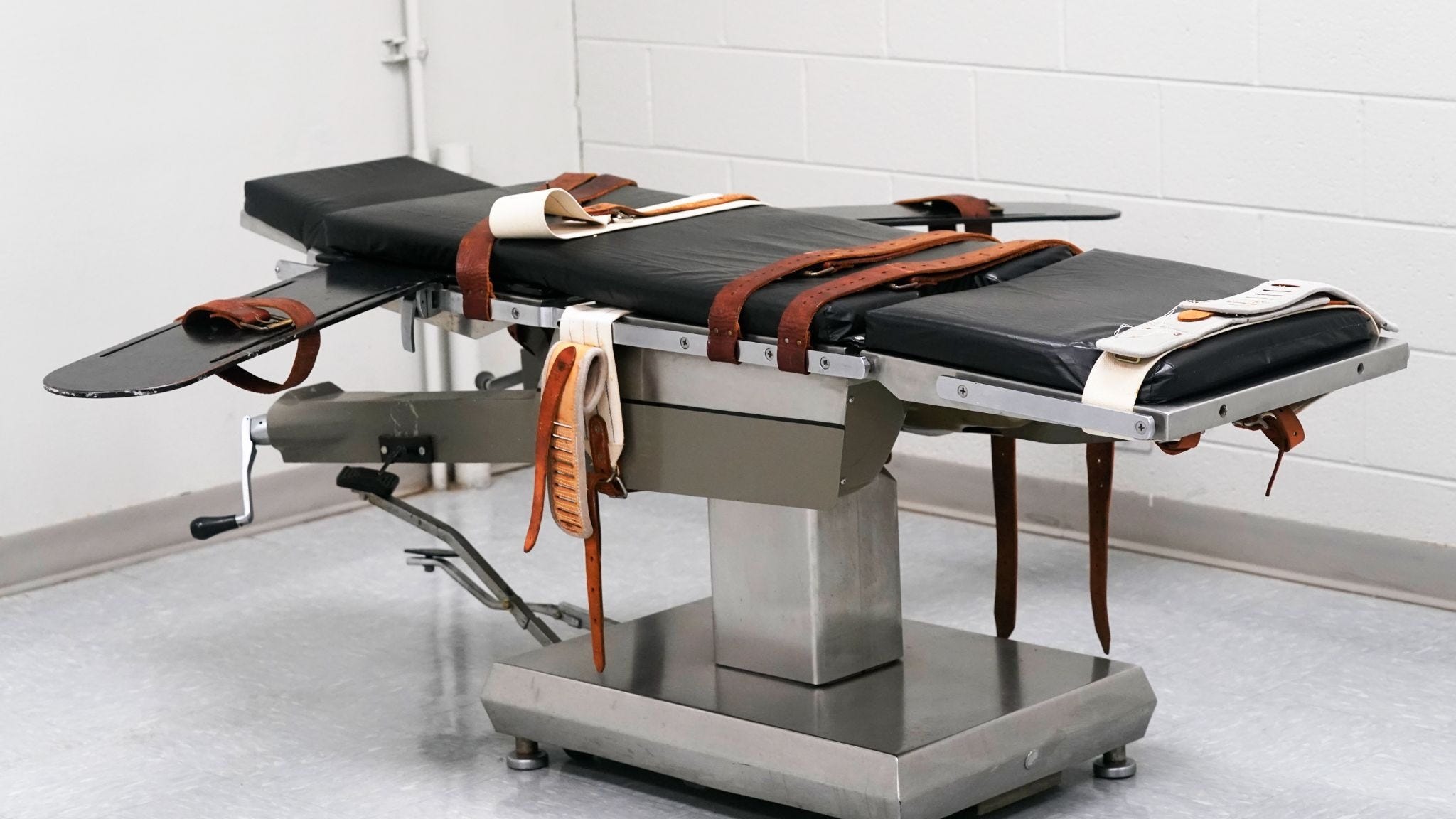
When I enter a hospital, I’m kind of confident that the space is already claimed by the Lord, or maybe there’s family surrounding, already praying a rosary. But since this was the execution chamber of Arizona, I just got a sense that I should just say some extra prayers, because I don’t know how many people have ever prayed in this building.
In other ways, it’s not so different. What sticks out to me is “the wages of sin is death,” which means that all of us come to the table with brokenness, with the reality that my sin personally has brought condemnation and death, eternal death, that I can’t save myself from my sin.
So then when I’m approaching someone in the prison — and now in particular this person to be executed — my heart is filled with a kind of hope, and with solidarity, knowing that I need a savior just as much as this person. They’re not some sort of second-class Christian. [Before conversion], St. Paul approved of the death of St. Stephen, Moses killed someone, David was complicit in the death of Bathsheba’s husband.
But God is bigger than our sins. I’m bringing that hope to the table in my prison ministry, just as fully as I would if I were to accompany someone in hospice.
How do you minister to someone who is about to be executed?
I didn’t know how the day would turn out. I’m just kind of being present with the Lord. I’m bringing to the table the Holy Sacrifice of the Mass. The day-of [execution] reading had to do with not belonging to the world, and the passage where Jesus says, “Now I am coming to you. I speak this in the world so that they may share in my joy completely. I gave them your word. Keep them from the evil one.”
After having celebrated Mass, I’m in a different room, just until it’s time.
And I’m just quiet, a little conversation here and there with those that are around me, but really just kind of praying the rosary, the divine mercy chaplet, and sitting and particularly praying just deliverance prayers. I brought my deliverance prayer book.
It’s weird to be participatory in an evil. Someone is going to be killed, and that’s a crazy thought. I’m not praying for the event to go smoothly. I’m not blessing the event. I’m just saying, “Lord, this is the last moments of someone’s life, so I need you to drive out any evil spirit that would try to interfere with the possible salvation of someone at the last moments of their life.”
And so when it came to the moment [of execution], there was no dread. The Lord was with me, and I did what I needed to do. I prayed Psalm 23, the apostolic pardon, and then the “Go forth Christian soul” prayer from the Anointing of the Sick book. And then just pure attentiveness: “Oh, Lord, I’m going to keep praying under my breath.” And I just sensed the Lord’s presence through it all.
How did you prepare spiritually for the experience?
I made sure to turn off my phone -- Instagram, the social media stuff, checking the news -- and I was just trying to pay attention to life. I think what the Lord helped me understand then is this: you already pray your holy hours, you pray your rosary on the way to work. So, then maybe just to be a little more silent, a little more reflective and almost reverential for the Spirit to do something, to make sure that those last conversations are guided by Him, that they’re sensitive to whatever the Lord wants.
The readings in the days leading up to the execution were beautiful. What I noticed the Lord was doing was giving readings that were very pregnant with meaning. In Acts of the Apostles 20, Paul says, “The Holy Spirit has been warning me that imprisonment and hardships await me, yet I consider life of no importance to me if I only finish my course and the ministry I received from the Lord Jesus.” So as I’m thinking of preparing this person, I’m looking at these readings, and it’s like the Lord is already showing his grace to let the scripture, the lectionary speak for that moment.
The night before, I wondered, is this a day to fast in preparation? But I knew, because it’s online, what Leroy’s last meal was: some Irish food, cottage pie, onion rings, chocolate cake. And I realized, Oh, you know what? Before I drive out to the prison, let me just be in solidarity with him, by having a favorite food of mine: tripas tacos.
I turned off my phone and I was just enjoying a meal at around the same time that I know he was having his last meal, just as some sort of spiritual lifting up of the heart and an appreciation of life and preparation for the next day.
What else stands out to you about that day?
In our last interaction [before the day of execution], I had written a list of prayer requests and passed it to Leroy – “for this person in my family, for prison ministry in general, for a place of healing and reconciliation for the diocese of Phoenix’s incarcerated population,” that sort of thing.
It was right there in his Bible, and he just showed it to me, and it just kind of moved my heart.
When you’re dealing with a hospice patient, they’re not always conscious or they may be in pain and distracted. To ask for someone to pray for you when they’re in purgatory and in heaven is just a really different conversation.
There was this inner peace within my soul and then almost a confidence that like, “Hey, whenever you get to heaven, make sure to pray for these things.”
What has your experience been in the days since the execution? Do you have any spiritual reflections or insights?
What first comes to mind is the word gratitude. All of us have charisms and gifts, and to be in this job, this job that I love so much, I was grateful to be in a spot that I needed to be as a priest.
My priesthood has been unfolding to be in this moment, having come from an incarcerated-affected background, having come from the police raiding my house as a kid, that now I’m on the other side and it’s just a joy to be there.
That week was a hard week…But with that theme of gratitude, [I was able] to have a prayer day at our retreat center, to have my priestly support group, to have continued to pray my holy hour and celebrate Mass.
I’m open to understanding that this will affect me deeper, or it might come in waves. I recognize that people process at different times in different ways.
But also there’s that deeper sense that this is a continuation of abiding in the ocean of God’s mercy. When life gets harder or it’s more difficult, or it’s more traumatic, to whom shall we go, Lord? You have the words of eternal life. And so with the proper prayer and supports, it continues to be something to be with the Lord in, a space of intimacy and vulnerability, that the Lord is who he says he is and he’s going to provide for us, as life still has the struggles -- and sometimes in the priestly ministry, very deep and difficult circumstances, as you accompany the people of God.
You are the head of prison ministry and restorative justice in your diocese. In your view, how does the idea of restorative justice fit into the Catholic understanding of justice?
While justice requires that we take responsibility for our sins, our dignity is never lost. And so this idea of restorative justice is the idea that those who are incarcerated, and also family members of the incarcerated, and also victims, at times have been so wounded that they forget or they seemingly lose the dignity of how precious they are in the eyes of the Lord.
So I find my restorative justice ministry as a part of setting captives free, to be able to bring healing and reconciliation to those who have been deeply affected by crime – both the incarcerated and the victims. When our blessed Lord wants to set captives free, he wants to save us from our sins and envelop us in his mercy, then he is elevating us and restoring us to the preciousness that we have in his eyes by his grace and healing.
Again, that 100% includes not only victims, but also the incarcerated. Mother Teresa talks about loving the poorest of the poor, that if indeed the wages of sin is death, then these individuals absolutely just as much are in need of and are entitled to the saving grace of our Lord Jesus Christ, because he has willed it. He has chosen to set captives free, to save us from our sins. No one is a second-class Christian, if we choose to repent and return to the Lord, who saved every single one of us from eternal death.
Many times in prison, once things have settled down and you’re outside of the world, you come to a freedom that you could never have on the outside. I’ve seen this multiple times in prison ministry. Many come to this falling in love with the Lord, this repentance, and that there’s this deeper meaning, there’s this deeper intercession that transforms the incarcerated heart, that they know they’re not second-class Christians, that an incarcerated individual comes to this understanding.
There’s a permission to fall completely in love with Jesus and to be redeemed by him. And I’ve seen it in multiple situations.