Papal rhetoric: ‘War,’ war, and Leo’s call for peace
Is Vatican terminology adding to growing tensions?
As the White House continues its criticism of the vicar of Christ, Pope Leo XIV, Vice President JD Vance said Tuesday that the pontiff should be more careful when talking about theology — a surprising admonition from the U.S. vice president.
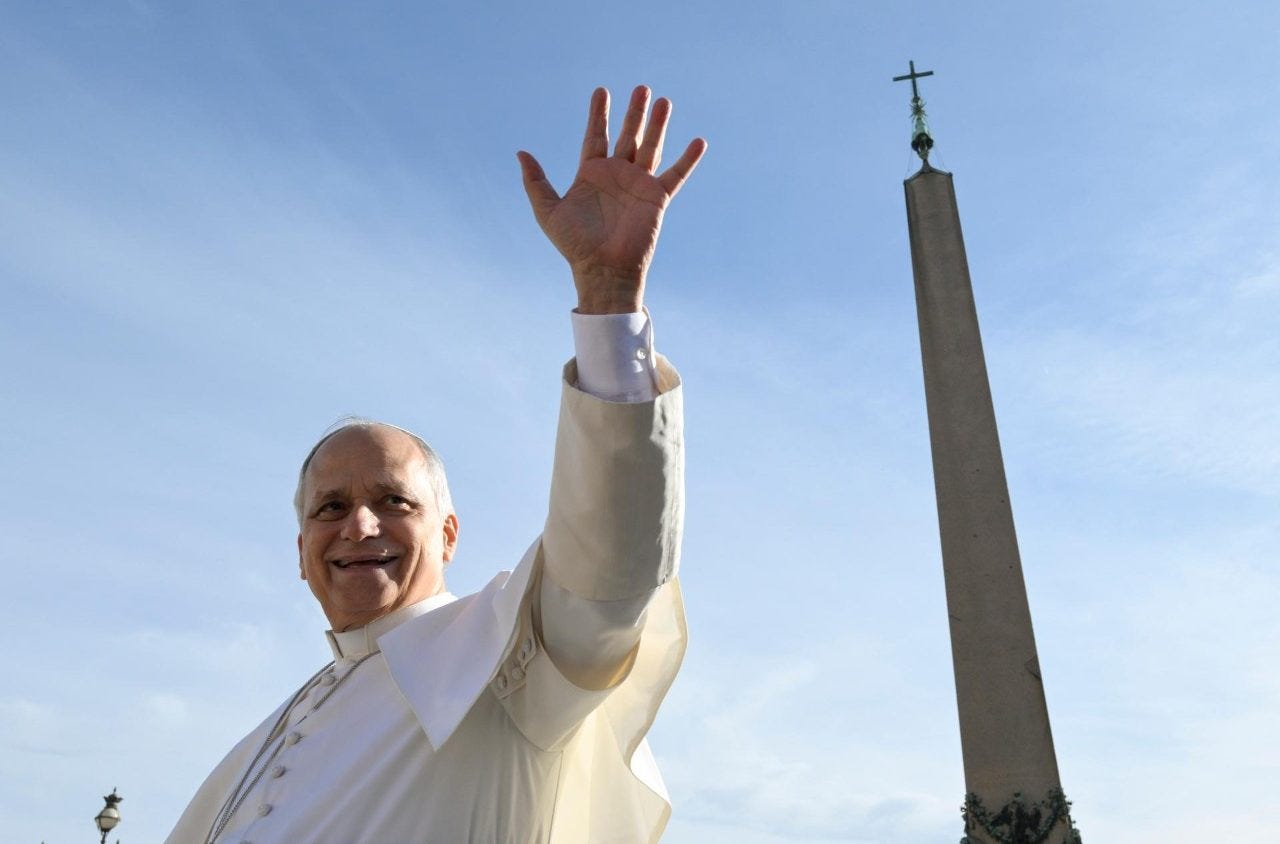
While Vance’s remarks have been widely panned, and seen pushback from the U.S. bishops’ conference and a wide swath of Catholics — they also point to the challenges for Catholics and for the pope incumbent in working through a rhetorical shift in the Vatican’s approach to talking about warfare.
—
Since the Iran War began, the Trump White House has taken considerable time to push back on Pope Leo’s frequent criticisms of the war and the way it’s being executed.
Leo has pushed back on Trump’s threat last week that “a civilization will die tonight” if a proposed cease fire deal on the Strait of Hormuz wasn’t reached, and, for weeks before that, was unequivocal in his warnings that military action in Iran could not be morally justified.
In fact, since March the pope has urged the world back from the prospect of military action in Iran, pleading that another way be found to address the region’s complex conflicts, and their implications for global security.
Trump has responded in his characteristically bombastic style, telling the press that he’s “not a fan” of Leo, and that the pontiff is too liberal on any number of issues. Trump has also seen fit to take credit for Leo’s 2025 election, postulating that the cardinals saw electing an American pope as “the best way to deal with Donald J. Trump.”
The president insists to reporters that he is “not fighting” with the pontiff, and that he “has to do what’s right,” even if the Roman pontiff disagrees with his assessment.
There has been speculation that Trump has centered in on Leo because he does best as a politician when he has a political nemesis, and that he is aiming by conflict to drum up support for an unpopular Iranian war.
And some people say that the pope has been unfairly centered on Donald Trump — with even Trump’s supporters arguing that when Pope Leo condemned “delusions of omnipotence… becoming increasingly unpredictable and aggressive,” he could have only been referring to Donald Trump.
But whatever the reason for the administration’s focus on the pontiff, the tensions have been escalating. And Vice President JD Vance has been pulled into the fray. While once he promised an open door of dialogue between the Church and his administration’s White House, Vance said last week that the Vatican should “stick to matters of morality” — apparently excluding the matter of the Iran conflict’s morality.
This week, at a university event in Georgia, the vice president said that if Leo was “going to opine on matters of theology,” his comments needed to be “anchored in the truth.”
“In the same way that it’s important for the vice president of the United States to be careful when I talk about matters of public policy, I think it’s very, very important for the pope to be careful when he talks about matters of theology,” Vance said Tuesday.
Vance’s remarks were meant to criticize a tweet from Pope Leo, published April 10, which said that “God does not bless any conflict. Anyone who is a disciple of Christ, the Prince of Peace, is never on the side of those who once wielded the sword and today drop bombs. Military action will not create space for freedom or times of #Peace, which comes only from the patient promotion of coexistence and dialogue among peoples.”
This, the vice president said, was not a careful or rigorous theological assertion.
The comment prompted immediate pushback from those who recalled Vance’s admitted willingness to “create stories” in order to advance his administration’s agenda.
But beyond that, it has also sparked debate among Catholics, some of whom have asked whether Leo’s rhetoric on war actually has become imprecise: Whether it endorses a kind of total pacifism that seems at odds with the Church’s “just war” tradition, and requires Catholics to renounce any kind of participation in any kind of armed conflict.
On Palm Sunday, some Catholics say, Pope Leo created confusion, again with remarks that gave the appearance of pacifism — namely, that the Lord “does not listen to the prayers of those who wage war, but rejects them.”
Some Catholics, including Vance, have asked whether God heard the prayers of the Americans who waged war against the Nazis to liberate Jews in concentration camps, or whether the Almighty rejected the prayers of the Union soldiers who fought to free slaves.
In short, while Vance’s remarks about theological precision seem especially provocative coming from a vice president, Vance is not the only Catholic to ask, in one way or another, whether Pope Leo is advancing a kind of development of doctrine, which would eschew the Church’s conventional just war doctrine, itself worked on by the pope’s own spiritual mentor, St. Augustine of Hippo.
In fact, even among Catholics who believe that America’s Iranian incursion is clearly unjust, there have been questions in many corners about the absolutist way that the pontiff seems to speak about warfare.
The question has been raised so prominently that USCCB doctrinal chair Bishop James Massa issued a statement Wednesday, aiming to clarify that the pope’s recent remarks are meant to evoke and apply just war theory, not ignore it.
But to some Catholics, that seems a bit counterintuitive — when the pope says God doesn’t listen to those waging war, is it ignoring those waging war justly?
Theologian Matthew Shadle has done recently some interesting thinking on this question.
Shadle points out that in recent decades, papal and Vatican rhetoric has made a kind of linguistic distinction — using the term “war” to “describe aggressive or offensive war” and the term “legitimate self defense” to mean just acts of combat, measures of last resort by which nations and their peoples defend themselves against aggressors.
In this schema, “war” is de facto unjustified, and “legitimate self-defense” is always just.
“So, when Paul VI says, ‘Never again war,’ he is not prohibiting nations from defending themselves from military attack, he is condemning those who resort to war to settle disputes, making that legitimate self-defense necessary,” Shadle explains.
If Leo is using the same linguistic framework when he talks about God not listening to war-wagers, the pontiff “is not referring to those who are legitimately using military force to defend themselves, but those who initiate war, or ‘wage war,’ which in the contemporary world is always unjust.
“God does not listen to the prayers of those who act unjustly,” Shadle elaborates. “That is why Leo immediately after cites Isaiah 1:15: ‘Even though you make many prayers, I will not listen: your hands are full of blood.’ In this passage, Isaiah is warning the people of the southern kingdom of Judah regarding their oppression of the poor, and Leo uses it to support the idea that God does not support those who act unjustly.”
Shadle’s argument is seemingly historically grounded, and would seem to square the circle in a certain sense — making clear that when Leo says “war,” he does not mean all theoretical armed combat, but something which is already circumscribed to injustice.
—
The situation explains that at least part of the confusion about what the pope is saying comes from a kind of terminology gap — two different groups of people using the same words in different ways.
Shadle argues that Leo, and all the popes before him, have been using the term “war” to mean a very specific thing. When the terms is understood as the Vatican uses it, Leo’s potentially confusing statements are immediately clear.
But the vernacular usage of “war” and even “waging war” is more broad than the Vatican’s limited intention.
That creates a communications problem for the Church — people who don’t understand the particular terminology of Vaticanese are apt to believe something he’s not. It is not a sign of effective teaching for the pope to make a dramatic statement — intended to call the world to peace — and then see Catholics shuffle in to explain that what the pope really meant was something a bit different from what many listeners heard.
At the same time, the Vatican’s specialized use of the term “war” leaves it open to a certain kind of exploitation — when the pope speaks to mean something specific, he bears the risk that global leaders who oppose will exploit the linguistic gap to suggest he means something far more controversial.
That seems to be exactly the challenge which the pope’s message now faces in much of the U.S.: An opportunity for his political opponents to suggest that a pope calling for an end to unjust aggression is just an unqualified pacifist.
In short, whatever else the Vatican takes away from the Trump affair, it’s worth asking whether the past few weeks might prompt some reflection on the challenges of using commonly used terms in specific ways, beyond their vernacular usage.
Pope Leo has demonstrated in the year of his papacy a desire for clear and transparent communication from the Vatican — and his plan to be a peacemaker, a prophet of the Gospel’s preference for authentic peace in the world.
It is not yet clear whether the Church’s recent developments in theological language on war and peace actually serve that goal. But as the pontiff continues to call for an end to unjust aggression and warfare, he is likely to consider carefully how best to get the message out.

