
The patriarch of the Syriac Catholic Church told The Pillar Tuesday that a Vatican cardinal is behind a recent papal law allowing Eastern Catholic Church leaders to be deposed, and behind the efforts in his own Church to see him dismissed from his position.
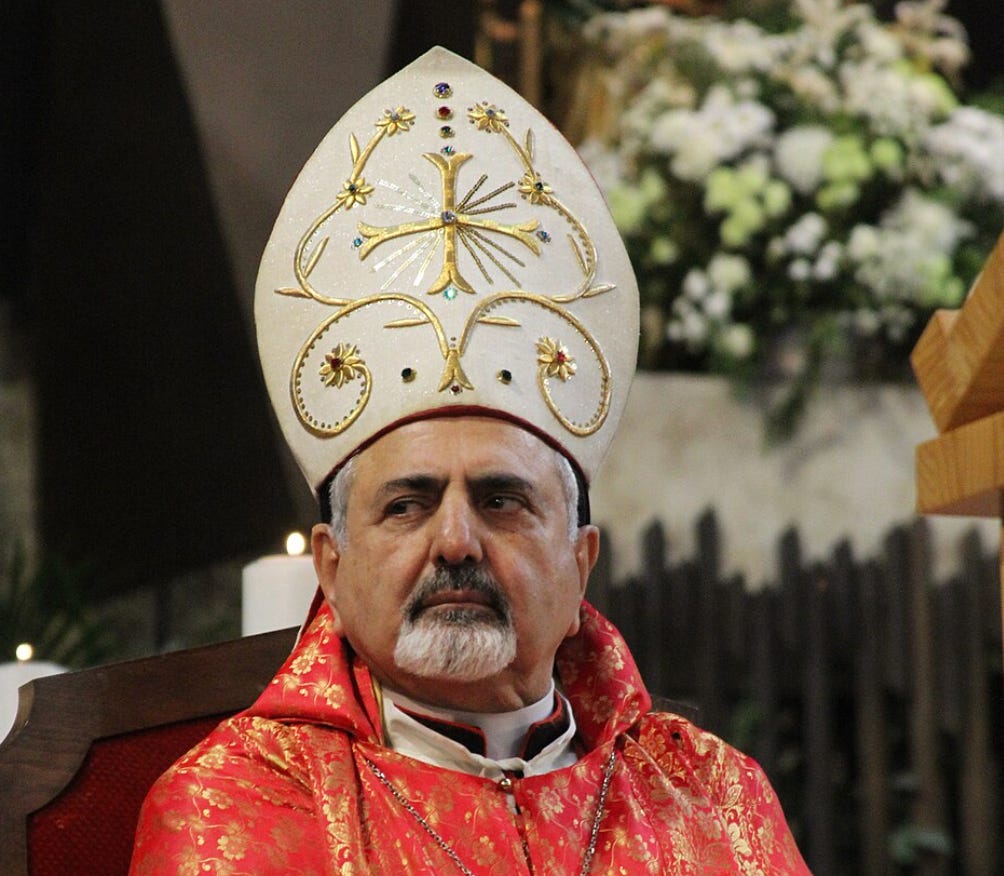
Patriarch Ignatius Youssef III Younan is the first leader of an Eastern Catholic Church to face the prospect of dismissal from office under new norms promulgated by Pope Leo. But the patriarch told The Pillar that both a Syriac Catholic bishop and the prefect of the Dicastery for Eastern Catholic Churches have “mobilized” to challenge his position, even while Youssef claims widespread global support among Syriac Catholics.
“I know my Church,” Youssef told The Pillar. “I have visited all the [Syriac Catholic] dioceses, either in the Middle East or in the diaspora, the Church of the extension. And I know that most of the people love their patriarch and respect him and want him to stay ministering and serving his Church.”
—
The Pillar was among the first to report earlier this month that bishops of the Lebanon-based Syriac Catholic Church had moved to call for a meeting at which bishops would vote on removing Patriarch Youssef from office, making use of the recently promulgated Mutua concordia, which allows Eastern Catholic bishops to remove their patriarch by majority vote, with subsequent papal confirmation.
Youssef said the call among Syriac bishops to remove him stems from a dispute with Bishop Flaviano Rami Al-Kabalan, who had served as the Syriac Catholic Church’s procurator in Rome and remains resident in the city. The patriarch told The Pillar that a dispute simmering over several years stemmed from his efforts to call Al-Kabalan back to episcopal ministry in the Middle East, and the bishop’s insistence on remaining in residence in Rome.
“I wanted him to return to Lebanon to find a place for his ministry. He didn’t accept and he mobilized his friends in the Roman curia,” the patriarch told The Pillar.
Despite a call to return to Beirut, the bishop — Youssef said — is “still staying in Rome, presenting himself as the procurator,” and insisting that Youssef would require the consent of the Church’s governing synod of bishops to return Al-Kabalan back to Lebanon.
Youseeff said he has asked for Vatican assistance on the subject in recent years, explaining in Rome “that this bishop is rebellious. How come that nobody interferes to correct the situation?”
But with the dispute escalating, Youssef said that Al-Kabalan has instigated among bishops the recent move to see the patriarch ousted.
“He is making promises to his brothers the bishops, or even threatening them,” the patriarch charged. “He knows people in the Curia, and if they have problems in their dioceses, he has promised to help them, or to defend their cause — or he threatens them. It’s very sad.”
Al-Kabalan did not respond to requests from The Pillar for comment.
But the patriarch also said that Cardinal Claudio Gugerotti — prefect of the Vatican Dicastery for Eastern Catholic Churches — had been instrumental in pushing for his ouster, and has pushed for changes the patriarch regards as theologically problematic.
Yousseff told The Pillar that the heads of several Eastern Catholic Churches have written a formal letter to Pope Leo raising complaints about Cardinal Gugerotti’s leadership.
“Most of the patriarchs are not so happy with the prefect’s behavior,” Youssef said. “He has spread the news for the past two years that he is trying to get several patriarchs dismissed, and he says that openly.”
The patriarch suggested that Gugerotti has adopted an authoritarian stance — and remained aloof from the heads of Eastern Catholic Churches — rather than find ways to work with them for the welfare of Eastern Catholic Churches.
And Youssef charged that Gugerotti developed the August papal motu proprio Mutua concordia — which allows an Eastern Catholic synod of bishops to remove a patriarch for serious reasons, with papal approval — and that the cardinal was involved directly in urging Syriac Catholic bishops to move for his own removal.
Gugerotti, he alleged, has prevented patriarchs and other Eastern Catholic leaders from bringing clear and accurate information to both Pope Leo and to Pope Francis, and used his position to shape Eastern Catholic Churches according to his own preferences.
The cardinal, Youssef said, “is trying to encourage, to instigate, bishops to just have their patriarch get out. And it is not the way in the east, especially for a patriarch.”
Youssef added that, in his view, Mutua concordia does not adequately respect both the theological and historical role of an Eastern Catholic patriarch; the cardinal urged that the motu proprio be reconsidered.
Youssef told The Pillar he hoped Pope Leo would “remember that the patriarch of an Eastern Church is a father and a head of his Church. We can’t ask him or oblige him to resign. This is not acceptable — neither with the Catholics or Orthodox. The patriarch is a father and the bishops — like the children of the father — can’t say, just, ‘we don’t have any trust in our father.’ This is not the way.“
In both a telephone conversation and emails to The Pillar, Youssef pushed back on the reasons apparently given for his dismissal proceedings.
While some Syriac bishops have said their Church lacks “fraternal harmony” under Youssef’s leadership, the patriarch said that his office requires him to make hard decisions, and that the Vatican should support that, rather than “encouraging the bishops to be divided against their patriarch.”
“In this misunderstanding,” he said, “the role of the Dicastery for Eastern Churches is to intervene, to find some kind of mutual reconciliation and to find the truth. But this didn’t happen, and it hasn’t happened.”
Further, he insisted, claims that he had refused to call for a governing synod in recent years are “entirely untrue.”
Youssef said that after a 2023 synod meeting, holding one the next year was impossible because of war in Lebanon. But the patriarch said he called Syriac bishops to consult on moving the synod, and was advised to hold the meeting in June 2025.
“It was then that [Gugerotti] began pressing Pope Francis to summon the bishops to Rome and threatening the patriarch in the name of the ‘Supreme Authority,’ even though the patriarch had repeatedly informed him that a synod had already been convened for Lebanon in June 2025, in accordance with the bishops’ wishes,” the patriarch said.
Amid disagreement in the Syriac Church, Pope Leo called for a July 2025 meeting of the Syriac bishops in Rome — with Youssef alleging that Gugerotti urged the pope to convene the session.
Gugerotti insisted on presiding over the assembly, Youssef said, even while the patriarch said he had both the canonical and customary right to do so.
At that meeting, he said, with “rebellion” already present among some bishops, Gugerotti “asked the bishops to say their accusations against their patriarch.”
Those accusations amounted to a “lack of harmony” among the bishops, he said — a charge which in his view should not warrant removal under the terms of Mutua concordia.
But Gugerotti did not, he said, “rebuild reconciliation and harmony in our synod,” he lamented. Instead, Youseff claimed that Gugerotti urged the bishops to make a vote of no confidence in the patriarch’s leadership, “and he took the result of the votes all the way to the pope.”
“Even those bishops who were hesitating, they did [in their votes] a lie, because they thought that the Holy Father, because of this prefect, had made already the decision to dismiss their patriarch.”
But Youssef called the July 2025 meeting a “farcical-synod, a sort of tribunal condemning the patriarch in the absence of any ‘grave reason,’ [which] was orchestrated by the bishops with the complicity of the Dicastery for Eastern Churches.”
“The patriarch did not refuse to hold a synod during these years,” Youssef emphasized.
The patriarch said that while it is possible he could be dismissed by the voting members of his synod, he hopes bishops will consider seriously the “rebellion” against his leadership.
“It is truly distressing to see that this entire distortion of the truth is the work of the patriarch’s former procurator … his representative to the Holy See,” Youssef said by email.
“Yet, he persists in his rebellion, backed by his friends in the Roman Curia!.”
Gugerotti could not be reached for comment.
There are some 160,000 members of the Syriac Catholic Church, with the majority living in Syria, Iraq, and Lebanon. Roughly 16,000 Syriac Catholics live in the United States, worshipping in the 11 parishes of the Eparchy of Our Lady of Deliverance.
Youssef, 81, was elected patriarch of the Syriac Catholic Church in January 2009. He was ordained a priest in 1971, and spent much of his career as a priest and bishop in North America, overseeing Syriac Catholics in the United States and Canada.
According to Mutua concordia, a synodal meeting to remove an Eastern Catholic patriarch should be called by the senior bishop of the synod who is in favor of removal. A two-thirds majority of the voting members of the synod, usually the diocesan bishops of the Eastern Catholic Church, is required to effect the removal, and the pope must confirm a removal decision.
While the law does not define legal criteria for defining or establishing the alleged irreparable damage to internal communion, it does require that the patriarch be allowed to defend himself before the synod.
In the case of the Syriac Catholic Church, Youssef said the apparently irreparable harm in question has been cited as a lack of “fraternal harmony.” But the patriarch said that in his view, that does not constitute a sufficiently “grave cause” to warrant his removal.
The Syriac bishops, he said, “didn’t have any serious reason, any grave cause, to ask [for] the patriarch to resign, just saying that we don’t have fraternal harmony.”
For his part, Youssef said he is trying to entrust his situation to Providence.
“Of course, I am praying. I am asking the Lord’s grace and the gifts of the Holy Spirit. And of course, it’s not so easy,” the patriarch told The Pillar.
“We pray to the Lord Jesus. And remember what Jesus said in the gospel: ‘No prophet is honored in his hometown or country.’ It’s very sad.”