Peña Parra appointed Italian nuncio
Archbishop Paolo Rudelli will become papal chief of staff
In the most senior Vatican curial appointment of his pontificate, Pope Leo XIV on Monday named Archbishop Paolo Rudelli, apostolic nuncio to Colombia, to replace Archbishop Edgar Peña Parra as papal chief of staff.
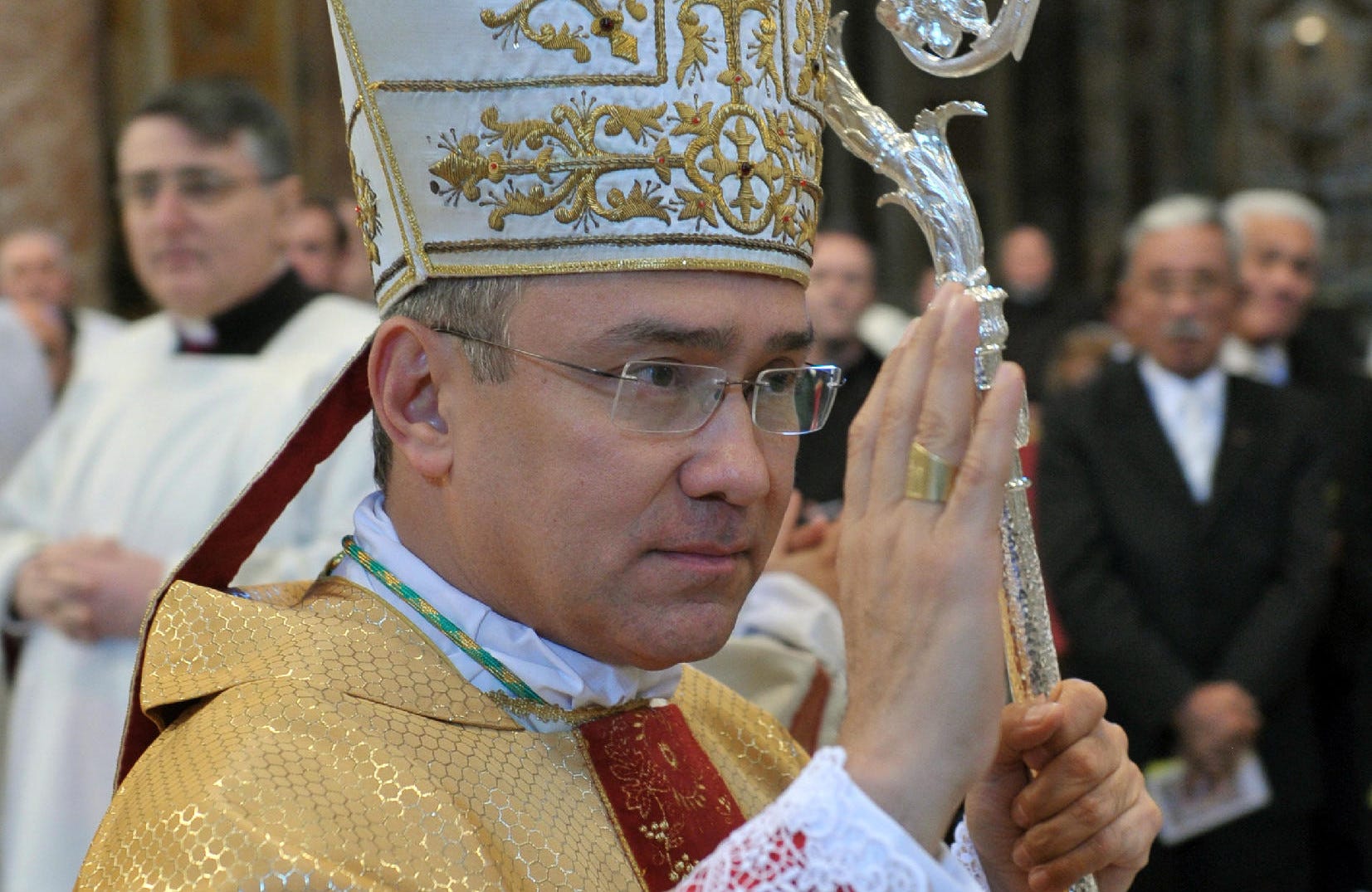
The pope also appointed Peña Parra, who was embroiled in several financial and transparency scandals during his tenure as sostituto, as nuncio to Italy and San Marino, while appointing Archbishop Peter Rajic, who formerly held that position, as prefect of the papal household, a position that had been vacant since 2023.
Rudelli had served as nuncio to Colombia since 2023, and before that was nuncio to Zimbabwe between 2019 and 2023, and permanent observer to the Council of Europe between 2014 and 2019.
After entering the Vatican’s diplomatic service in 2001, he served in the nunciatures to Ecuador and Poland, and in the Section for General Affairs of the Secretariat of State.
Sources within the Secretariat of State told The Pillar Monday that Rudelli was well-liked in his service as nuncio and during his time in the Secretariat of State, and was largely perceived as methodical, non-ideological, and profoundly intellectual.
Rajic, a Canadian-Croatian prelate, will move from the nunciature to Italy and San Marino to the prefecture of the papal household, a position that had been vacant since Archbishop Georg Ganswein left the post in 2023.
The prefect of the papal household is in charge of organizing papal audiences, both the weekly general audiences and private audiences, especially those granted to heads of state and government, and ambassadors coming to the Vatican to present their credential letters.
The prefect is also responsible for all non-liturgical papal ceremonies and the spiritual exercises of the Roman curia. It also oversees the arrangements for papal pastoral visits within Rome or trips within Italy.
Mons. Leonardo Sapienza had been serving as the de facto leader of the papal household for the past three years, in the post of regent. But Pope Leo XIV had in November signaled a desire to normalize the papal household when he appointed Fr. Edward Daniang Daleng, OSA, as vice-regent of the papal household.
Peña Parra was rumored to move to a major nunciature such as Washington or Paris for months, but he had reportedly expressed a desire to stay in Rome when his stint at the Secretariat of State came to a close.
He took the position of sostituto of the Secretariat of State – effectively, the pope’s chief of staff – in 2018, when scandal-riddled Cardinal Angelo Becciu left the position to become prefect of the Dicastery for the Causes of Saints.
But Peña Parra’s tenure as sostituto was no less controversial than his predecessor’s, mostly because of his role in the London property scandal.
Peña Parra appeared before the High Court of England and Wales on July 2024 to answer questions about his role in separating the secretariat’s investment from Raffaele Mincione, who managed some 200 million euros of borrowed money for the Vatican from 2013 until 2018, when Peña Parra replaced Cardinal Angelo Becciu as sostituto. His predecessor went on to be convicted of financial crimes by a Vatican City court, alongside Mincione.
During his testimony Peña Parra admitted to signing off on a five million euro invoice he knew to be “completely fictitious.”
“You said that was a problem, but for us it was a solution,” the archbishop told the High Court, when he was asked about why he agreed to sign off on millions of euros in alleged extortion payments, as part of the now-infamous London property deal.
The archbishop also acknowledged that he had passed the itemized invoice on to the Secretariat of State’s bank, Credit Suisse, for payment — despite knowing the invoice was for work that was never done on projects that never existed.
“The invoice was false,” the archbishop told the court, “but I insisted, in the object [description] of the transaction... is for final — full and final — settlement of all our contractual obligations [with broker Gianluigi Torzi].”
“I’m just a priest,” Peña Parra said. “I am not a specialist in banking. The important thing for the bank is the object [of] the one who is ordering — sending the money… And [in] my mind [it] was for full and final settlement [with Torzi]. ”
Asked if he was “not being honest with Credit Suisse” by knowingly presenting to the bank for payment an invoice he knew to be false, Peña Parra responded that “You said that I was not honest. I accept that.”
In March 2023 testimony during the Vatican financial trial, Peña Parra admitted to “informally” asking the head of the Vatican gendarmerie in 2019 to put the IOR director general Gianfranco Mammì under electronic “monitoring” — despite having no legal authority to do so, and without a warrant.
The archbishop explained he was surprised by the bank rejecting his demand for a loan of 150 million euros and so concluded its director might be secretly colluding with Gianluigi Torzi, the man accused of extorting the secretariat for millions. Peña Parra also said he would do the same again if he thought it was necessary.
2022 court filings showed that Peña Parra wrote to Pope Francis on May 2, 2019, saying that he had decided to “enter into negotiations” with the businessman Gianluigi Torzi, who had allegedly attempted to extort the Vatican for control of a London building, which the Secretariat of State had purchased for some 350 million euros.
Peña Parra wrote that he did not want to risk “unpredictable reputational damage” by reporting the alleged extortion to financial authorities.
During the trial, Msgr. Alberto Perlasca, the former head of the secretariat’s administrative office, told prosecutors that he repeatedly flagged Torzi’s actions to Peña Parra and recommended reporting the situation to financial authorities.
Perlasca claims the archbishop sidelined him from the project, and blamed Perlasca for arranging the terms of the deal in the first place.
Peña Parra wrote the letter to the pope to inform him of the “success” of those negotiations, which required the secretariat to pay Torzi an additional 15 million euros for control of a building the Vatican had already bought for 350 million.
The letter from Peña Parra was not the only piece of evidence from the sostituto to be presented in the trial. In a 20-page memo to prosecutors, sent in April 2021, the archbishop offered a withering account of his department’s business office.
“The overall management [of departmental assets] was aimed at financial speculation and not at the conservative and safe preservation of the assets of the Secretariat of State,” he told prosecutors, with officials stone-walling financial oversight, blind-siding superiors with last minute decisions, and deploying accounting sleight-of-hand to cover the true state of the department’s financial affairs.
Pointing to “serious errors” in the secretariat’s administrative office, overseen by Perlasca until early 2019, Peña Parra described accounting measures which “unjustifiably inflated the value of the assets managed by the Secretariat of State” by nearly a third, and showed a clear pattern of contracts unreasonably favoring the secretariat’s outside partners over Vatican interests.
Despite this assessment, Peña Parra opposed any move to alert the Vatican’s Financial Information Authority.
The head of that agency, The Pillar first reported, was on the Secretariat of State’s payroll, making hundreds of thousands of euros a year for part-time “consultancy” work alongside his full time job overseeing Vatican financial affairs, an arrangement which Vatican officials previously told The Pillar appeared to be a clear conflict of interest.
More recently, Peña Parra was implicated in an unexplained effort to reverse the laicization of an Argentine priest convicted of abuse.
In 2021, Fr. Ariel Alberto Príncipi became the subject of several complaints of sexual abuse against minors in the Argentine Diocese of Río Cuarto, centered around the abuse of so-called healing prayers, in the context of charismatic prayer circles.
Príncipi was convicted of multiple counts of sexual abuse of minors on June 2023 by the Interdiocesan Court of Cordoba, which ordered his laicization. In April 2024, the Buenos Aires interdiocesan court upheld his conviction and confirmed the sentence of laicization. The results were then sent back to the DDF for final approval.
In June and July 2024, according to the Vatican Secretariat of State in a letter signed by Peña Parra, some bishops from Argentina presented some kind of “evidence” to Rome arguing for Príncipi not to be laicized — though the Secretariat of State never clarified who those bishops were, or how many, or what the supposed evidence was, or to whom they presented their appeals.
Again according to the Secretariat of State, on July 5, 2024, “an extraordinary procedure was initiated” to reexamine Príncipi’s case. Neither the DDF nor the local diocese in Argentina were informed of this decision at the time. The secretariat has not said who carried out this procedure, or according to what legal process they did so.
In September 2024, Peña Parra signed an order for Príncipi’s reinstatement in priestly ministry, under some restrictions, following the “extraordinary procedure” which, according to Peña Parra, vacated his double conviction for child sexual abuse and instead found him guilty only of “recklessness.”
But on Oct. 7, the head of the DDF’s disciplinary section, Archbishop John Kennedy, issued a new decision to the diocese, which stated that the sostituto’s order had been canonically annulled, that Príncipi’s case “is again subject to the ordinary process in this Dicastery, according to the rules provided for by the Law of the Church,” and his laicization remained in effect.
Kennedy also noted that no appeal had been presented through the necessary legal channels, so the case was closed.


Lest the coverage of Abp. Pena Perra seem too one-sidedly negative, Pillar readers should also recall that he was quite solicitous of Edgar's well-being after the latter was roughed up by some Maduro-regime thug mid-interview. I don't think this in any way excuses all of his corrupt actions as sostituto, but it's good to remember that even curial bureaucrats have multiple sides to them. One hopes that simple human concern like he showed for Edgar will guide more of his actions in the future.