Poland sees rise in Sunday Mass attendance
The year-on-year rises indicated Mass attendance is stabilizing after the COVID-19 pandemic.
The percentage of Catholics attending Sunday Mass in Poland rose in 2024.
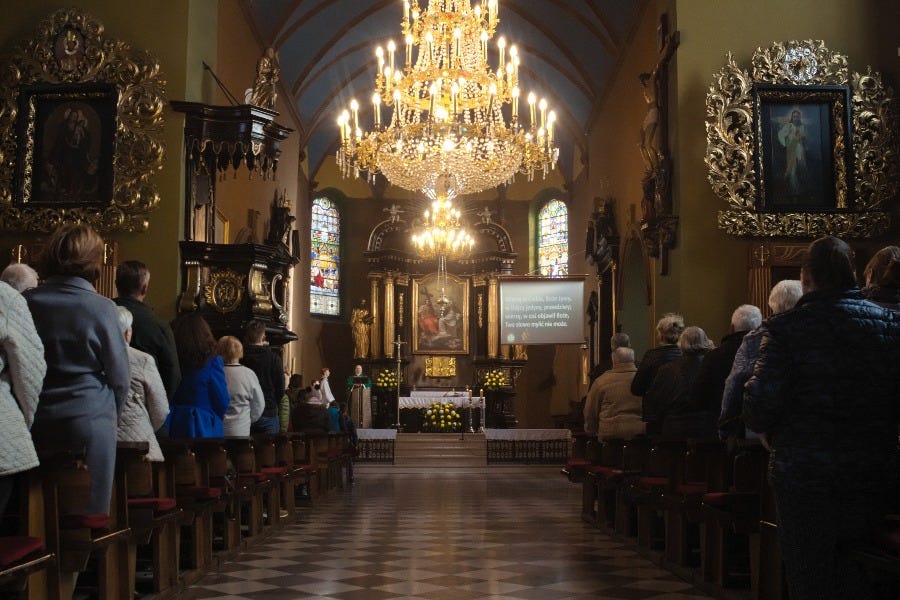
Poland’s Institute for Catholic Church Statistics announced Dec. 16 that the proportion of Sunday Massgoers increased to 29.6% in 2024, a 0.57% gain compared to the previous year.
The new figure is included in the 2024 edition of the Annuarium Statisticum Ecclesiae in Polonia, a yearly numerical overview of Poland’s Catholic Church published by the institute.
Each year since 1980, the institute has reported the percentage of dominicantes (Sunday Massgoers) and communicantes (recipients of Holy Communion) out of the total number of baptized Catholics who can fulfill the obligation to attend weekly Mass on a given Sunday each year.
The proportion of communicantes also rose in 2024, to 14.6%, an increase of 0.64% from the previous year.
The institute’s director Marcin Jewdokimow said at a Dec. 16 press conference in Warsaw that the year-on-year rises indicated Mass attendance and reception of Holy Communion were stabilizing following the COVID-19 pandemic, when Masses were tightly restricted.
But he noted that the 2024 percentages remained well below the figures before the pandemic, when the dominicantes rate was 36.9% and the communicantes rate 16.7%.
As in previous years, there were sharp regional variations in practice, with lower rates in western Poland, which is considered to be more secularized due to its proximity to Western Europe.
According to the institute, 59% of Polish Massgoers were women and 41% were men in 2024.
The institute also published a figure showing the proportion of people receiving Communion relative to the number attending Sunday Mass, rather than the overall figure of Catholics eligible for Communion.
This “relative communicantes” rate was 49.5%, up from 43% in 2015. This means that slightly less than half of those present at Sunday Mass in Poland received Communion.
“In recent years, it has been clear that the number of Catholics in Poland who receive Holy Communion during Sunday Masses has been growing,” Jewdokimow commented.
But other sacraments fared less well in Poland in 2024.
A total of 247,200 people were baptized last year, a 7.5% decline from 2023. The number of first Communions fell to 320,000, a 1.5% year-on-year drop. Only 213,000 people received the sacrament of Confirmation, a 27.6% fall from the previous year. There were 68,300 church weddings, down 11.6%.
Jewdokimow said: “The numbers concerning sacraments illustrate the demographic trend and cultural changes in Polish society — changes in values. Demographic and cultural changes are noticeable at the level of sacraments.”
“The decline in the number of baptisms and weddings is related to demographic changes — a decline in the number of births, while the decline in the number of sacramental marriages is the result of cultural changes.”
In common with many European countries, Poland’s birth rate has fallen to a record low. Statisticians forecast that, if trends continue, the population could drop from the current 37.4 million to 29.4 million by 2060.
Another source of concern for the Polish Church is the decline in the number of priests and religious.
The number of priests incardinated in the country’s dioceses fell from 24,876 in 2018 to 23,274 in 2024, a drop of 6.4%. Priests serving in parishes declined in the same period from 20,577 to 18,170, down 11.7%.
In 2024, there were 984 diocesan seminarians, a decline of 5.3% from 2023.
The number of women belonging to active religious congregations — as opposed to contemplative orders — was 15,400 in 2024, a decrease of 1.3% from 2023. The number of male religious in Poland was 7,123, down 2.9% from the year before.
But the number of permanent deacons grew to 109 in 2024, an increase of seven from 2023.
There are 10,352 parishes in Poland, 9,664 of which are administered by dioceses and 688 by religious orders.
The Annuarium Statisticum Ecclesiae in Polonia also records the percentage of students attending religion classes in public schools. The voluntary classes are largely, but not exclusively, Catholic catechism classes.
Catholic catechism classes in schools are governed by the 1993 concordat between Poland and the Holy See. Catholic teachers of religion, most of whom are lay people, need authorization (a missio canonica) from their bishop.
In the 2024-2025 school year, 75.6% of students attended religion classes, an annual decrease of 3.8%, continuing a steady decline. There were also significant regional variations, with the lowest percentages in urban areas such as Warsaw, Szczecin, and Wrocław, and the highest in more rural eastern dioceses.
The Polish bishops strongly criticized the government’s decision in January 2025 to reduce state-funded religion classes from two hours a week to one, describing it as an “unlawful act.”

