
A Polish bishop called for the firm defense of unborn children as well as compassion for their mothers Tuesday, as the lower house of Poland’s parliament passed two bills seeking to liberalize the country’s abortion laws.
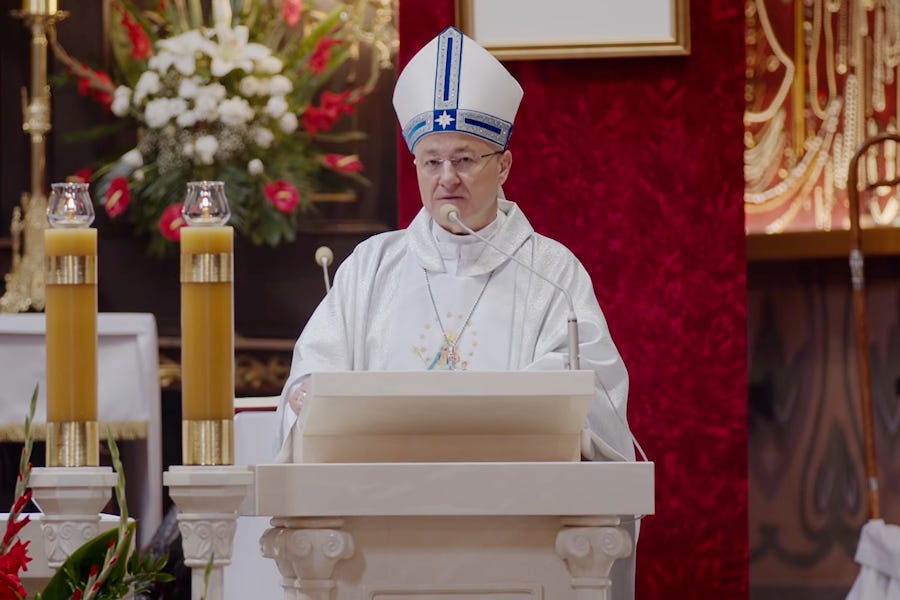
Bishop Artur Ważny of Sosnowiec issued the appeal Oct. 20 as members of the Sejm voted on a bill that would decriminalize assistance with abortion and a bill permitting abortion in cases of fetal abnormality.
The bill on decriminalizing assistance passed by 217 votes to 213, while the fetal abnormality bill passed by 233 to 203, thanks to the government’s majority in the lower house.
Both bills will now move to the Polish Senate, the upper house of parliament, where the ruling coalition has a larger majority. The Senate can approve the bills or suggest amendments. If the Senate rejects the bills, the Sejm could potentially override its decision by an absolute majority vote.
If the bills pass the Senate stage, they will be submitted to Poland’s President Karol Nawrocki, who can sign them into law, refer them to the country’s Constitutional Tribunal, or veto them. Observers believe a veto is likely as Nawrocki has previously indicated that he would not sign a bill liberalizing abortion.
The Sejm can only override a presidential veto with a three-fifths majority, which is unlikely given this week’s narrow votes.
Poland’s current government — an ideologically diverse coalition led by Prime Minister Donald Tusk’s Civic Coalition party — came to power in 2023 promising to relax the country’s abortion laws, which are among the most pro-life in Europe.
Nearly three years after taking power, with abortion supporters expressing impatience and new parliamentary elections looming in 2027, the government opted to advance the two bills, rather than pushing for abortion on demand, as sought by some members of the governing coalition.
The fetal abnormality bill is symbolically significant because if it became law, it would effectively overturn a 2020 ruling by Poland’s Constitutional Tribunal that a 1993 law permitting abortion for a severe and irreversible disability or a life-threatening incurable disease was unconstitutional.
After the ruling went into effect in 2021, abortion remained legal in Poland only when there is deemed to be a risk to the mother’s life or health and in cases of rape or incest.
The ruling prompted mass protests in cities across Poland, despite COVID-19 restrictions in force at the time. Protesters disrupted Masses, left graffiti on Church properties, chanted slogans at priests, and vandalized statues of St. John Paul II.
The ruling led to a sustained backlash against the Law and Justice party, which lost power after the 2023 election.
Poland’s Center for Public Opinion Research found that support for abortion “when a woman simply does not want to have a child” rose from 18% in 2023 to 29% in 2024 — a jump of 11 percentage points. It also found increased support for abortion in difficult financial or personal circumstances.
“Opposition to the current abortion law is most common among young people, people who do not practice religion, and those declaring left-wing political views,” it said in a 2024 report.
But while opposition to the status quo has grown, there is no consensus among abortion supporters on what should replace it. These disagreements have been evident within the governing coalition, which includes both members of The Left party and the center-right Polish People’s Party.
Following the Constitutional Tribunal’s ruling, the number of abortions performed in Poland’s hospitals initially fell sharply, from 1,363 in 2020 to 475 in 2021 and 452 in 2022. But the figures began to rise again, with 509 in 2023, 793 in 2024, and 851 in 2025.
According to the National Health Fund, Poland’s publicly funded healthcare system, there were 573 abortions in the first half of 2026, suggesting this year’s total could surpass 1,000 if they continue at the same rate.
In a social media post, Bishop Ważny wrote: “I am fully aware that these words will not meet with the approval of many groups, especially those who are determinedly demanding a change in the law by taking to the streets of our cities.”
“Nevertheless, as a human being and a bishop of the Church, I will not change my position. Defending the defenseless, especially the unborn human being, is an absolute cornerstone for me, one that I cannot and do not wish to abandon.”
“At the same time, I approach every woman experiencing the overwhelming fear of giving birth to a sick or unwanted child with deep concern, respect, and empathy. Firmly defending the lives of the smallest among us does not mean being insensitive to your pain.”
Ważny said he had listened to the testimonies of more than 200 women who had undergone abortions.
“The tragedy of this irreversible step is painfully familiar to me. It is precisely out of genuine concern for women’s welfare and safety that I will always oppose this tragedy. To speak of an alleged ‘post-abortion relief’ is to profoundly distort reality — the wound in the soul takes a very long time to heal,” he said.
“I therefore make an earnest appeal: instead of escalating tensions in the streets, let us direct our collective energy towards practical, rational assistance for women and men who are confronted with a devastating diagnosis and face it with dread.”
He added: “We must offer real help to frightened mothers, placing our deep trust in the fact that anyone may one day change their mind about abortion. Today, I pray for everyone on all sides of this difficult dispute to be granted the wisdom to see every life in the right light.”
“I also offer my heartfelt blessing to those groups campaigning for the protection of life. At the same time, I ask you to show one another mutual respect and unity, and to use language filled with love when expressing our noble aims. Only truth proclaimed with love has the power to persuade.”
God bless this bishop and may his brothers also bear witness to the defense of life.