Polish diocese defends bishop on eve of landmark trial
Bishop Jeż will stand trial Feb. 18 on charges of failing to notify law enforcement promptly about allegations against two priests.
A Polish Catholic diocese has defended its bishop’s handling of clerical abuse cases on the eve of a landmark trial.
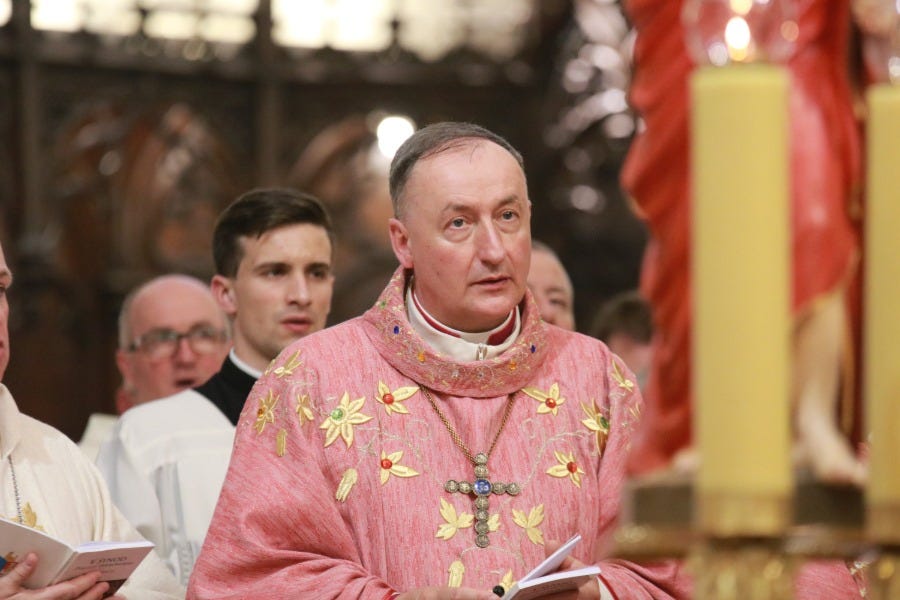
Bishop Andrzej Jeż, who has led the southeastern Diocese of Tarnów since 2012, is scheduled to stand trial in a district court Feb. 18 on charges of failing to notify law enforcement promptly about allegations against two priests accused of abusing minors under the age of 15, which he denies.
Polish media say the trial of a diocesan bishop on these charges is unprecedented and will be followed closely across the country.
In a Feb. 16 statement, the Tarnów diocese insisted that the 62-year-old bishop had correctly observed both civil and Church law.
The district prosecutor’s office in Tarnów filed an indictment against Jeż in April 2024, accusing him of violating Article 240 of the Polish Penal Code, which imposes an obligation to report sexual offenses against minors, which came into force in 2017.
Polish criminal law treats sexual offenses against under 15s with particular severity, while Church law defines sexual abuse of a minor as involving a person under 18.
The indictment referred to the cases of two priests of the Tarnów diocese, identified only as Fr. Stanisław P. and Fr. Tomasz K. Media report that Fr. Stanisław P. allegedly abused at least 95 boys in Poland and Ukraine between 1987 and 2008. Fr. Tomasz K. is accused of abusing three minors between 2008 and 2010.
The Tarnów diocese said that Jeż only became aware of specific cases of abuse of minors by Fr. Stanisław P. in 2019, when documents concerning the priest’s time in Ukraine were sent to the Tarnów curia.
It said: “The documentation raised many questions and doubts regarding, among other things, jurisdiction (the testimony transcripts and further information provided to the Polish side indicated that the case had been reported to the relevant Ukrainian authorities) and the reliability of the information.”
The diocese said it immediately opened procedures against the priest, informing the Vatican’s Dicastery for the Doctrine of the Faith, which launched an administrative and criminal investigation that ultimately resulted in his dismissal from the clerical state.
“After appropriate verification within the framework of Church procedures, at a time when the information could be deemed credible both objectively and subjectively, the [bishop’s] delegate reported the matter to state law enforcement authorities in August 2020,” the diocese noted.
“Furthermore, information obtained by Bishop Andrzej Jeż indicated that one of Stanisław P.’s victims had informed the district prosecutor’s office in Opole [Poland] about abuse by Fr. Stanisław P. as early as 2010, meaning that law enforcement authorities already had information on this matter in 2010.”
The prosecutor’s office reportedly discontinued the case against Fr. Stanisław P. in 2022 due to the statute of limitations.
In the second case, the diocese said that Jeż only became aware of the possibility of Fr. Tomasz K. committing a crime against a person under the age of 15 at the end of 2021.
“Immediately after discovering this information, Bishop Jeż instructed that a report be made to law enforcement authorities, which the bishop’s delegate did on Dec. 16, 2021,” the diocese noted.
“In the course of the earlier ecclesiastical criminal and administrative proceedings, witness testimony contradicted the claim that the victims were under the age of 15 at the time of the acts. Despite this, Fr. Tomasz K. was punished by the Church for acts committed against minors under the age of 18.”
The prosecutor’s office reportedly prepared charges against Fr. Tomasz K. in 2023, but they were not formally presented due to the priest’s poor health.
The diocese insisted that all Jeż’s actions were “carried out within the framework of applicable Church regulations.”
“In cooperation with higher-level Church authorities, such as the Vatican’s Dicastery for the Doctrine of the Faith, he conscientiously performed his duties and took all necessary steps when receiving information about crimes against minors,” it said.
“At the same time, we assure you that all cases reported to us are taken up and handled with due care.”
Bishop Jeż’s trial was reportedly postponed for almost a year as the Tarnów court sought to transfer the case to a different court to avoid any perception of bias. But Poland’s Supreme Court ruled the trial should take place in Tarnów.
The first of six hearings will be held Feb. 18 and the last hearing is scheduled for April 15. The court will seek to determine when the bishop received credible information about the priests and whether the reporting to the authorities was prompt.
The Tarnów diocese consistently records the highest level of Catholic practice in Poland. The latest statistics, published in December 2025, showed the diocese has the highest rate of Sunday Massgoers in the country (62.3%), well ahead of the next highest dioceses of Rzeszów (52.4%) and Przemyśl (50.0%).
The diocese also has the highest proportion of recipients of Holy Communion (26.2%), ahead of the dioceses of Zamość-Lubaczów (21.8%) and Białystok (21.2%).
The highest percentage of students attending religious education classes in public schools was also recorded in the Tarnów diocese (96.1%), with the lowest in the western city of Wrocław (59.9%).
Jeż, whose surname means “hedgehog” in Polish, was born in the southern Polish town of Limanowa in 1963. He was ordained a priest of the Tarnów diocese in 1988. He was named an auxiliary bishop of Tarnów in 2009, at the age of 46, and became the diocesan bishop aged 49.
Meanwhile, other Polish dioceses continue to reckon with their handling of abuse cases.
An independent commission published an initial report Feb. 12 on the southern Diocese of Sosnowiec’s approach to cases. The report identified 29 alleged abusers, including 23 clergy, and at least 50 victims.
Sosnowiec’s Bishop Grzegorz Kaszak resigned in 2023, at the age of 59, following a string of scandals involving priests in the diocese. Kaszak was succeeded in 2024 by Bishop Artur Ważny, previously an auxiliary bishop of the Tarnów diocese.
In a Feb. 12 statement, Ważny described the report’s publication as “a moment of profound pain and shame, but also of necessary catharsis.”
He said: “This document is primarily an attempt to defend human dignity and the purity of faith, not to defend institutions.”
“Paradoxically, by striking at structural corruption, we are not destroying faith, but saving it. Faith that is not afraid of the truth becomes credible.”
Ważny stressed that the report was “only the beginning of the process, not its conclusion.”
“This document exposes not so much the guilt of individuals as ‘administrative sin’ – chaos, lack of procedures, ignorance, and silence,” he said.
“This is our diagnosis, which must be followed by action. We are opening doors that no one has dared to touch before, and we do not intend to close them until the last case has been clarified. Unfortunately, we are also aware that new cases may arise.”
Poland’s bishops are continuing to discuss the scope of a national independent commission examining the handling of abuse cases, almost three years after they approved the creation of the body.
Bishops’ conference president Archbishop Tadeusz Wojda has said that a document establishing the national commission could be approved by Poland’s bishops at their March 10-12 plenary meeting in Warsaw.
